
| 【表紙】 | |
|---|---|
| 【提出書類】 | 有価証券報告書 |
| 【根拠条文】 | 金融商品取引法第24条第1項 |
| 【提出先】 | 関東財務局長 |
| 【提出日】 | 2024年6月28日 |
| 【事業年度】 | 自 2023年1月1日 至 2023年12月31日 |
| 【会社名】 | バークレイズ・バンク・ピーエルシー (Barclays Bank PLC) |
| 【代表者の役職氏名】 | 最高財務責任者 (Chief Financial Officer) アウノイ・バナジー (Aunoy Banerjee) |
| 【本店の所在の場所】 | 英国 ロンドン市 E14 5HP チャーチル・プレイス 1 (1 Churchill Place, London E14 5HP, United Kingdom) |
| 【代理人の氏名又は名称】 | 弁護士 樋 口 航 |
| 【代理人の住所又は所在地】 | 東京都千代田区大手町一丁目1番1号 大手町パークビルディング アンダーソン・毛利・友常法律事務所外国法共同事業 |
| 【電話番号】 | 03-6775-1000 |
| 【事務連絡者氏名】 | 弁護士 松 本 健 同 隈 大 希 同 白 井 翔 真 同 岡 勇 輝 |
| 【連絡場所】 | 東京都千代田区大手町一丁目1番1号 大手町パークビルディング アンダーソン・毛利・友常法律事務所外国法共同事業 |
| 【電話番号】 | 03-6775-1000 |
| 【縦覧に供する場所】 | 該当なし |
注(1) 本書において、文脈上別途解釈される場合を除き、下記の用語は下記の意味を有するものとする。
| 「バークレイズ」、「当グループ」および「バークレイズ・グループ」 | バークレイズ・ピーエルシーおよびその子会社 |
|---|---|
| 「親会社」 | バークレイズ・ピーエルシー |
| 「バークレイズ・バンク・グループ」 | バークレイズ・バンク・ピーエルシーおよびその子会社 |
| 「当行」 | バークレイズ・バンク・ピーエルシー |
| 「英国」 | グレート・ブリテンおよび北アイルランド連合王国 |
(2) 別段の記載がある場合を除き、本書中の「ポンド」または「£」は英国の通貨であるスターリング・ポンドを指すものとし、「ペンス」または「p」は英国の通貨であるペンスを指すものとする。本書において日本人読者のために便宜上記載されている日本円への換算は、1ポンド=200.08円、1ユーロ=170.15円、1米ドル=157.62円の換算率(2024年5月30日現在の株式会社三菱UFJ銀行の対顧客電信売買相場の仲値)によりなされている。ただし、このことは、ポンド建ての金額がかかる換算率において日本円に換算されていたこと、または換算することができたはずであったこと、または換算できることを意味するものではない。
(3) 別段の記載がある場合を除き、本書中の「$」、「ドル」または「米ドル」はアメリカ合衆国ドルを指すものとする。
(4) 別段の記載がある場合を除き、本書中の「ユーロ」または「

」は欧州連合の通貨であるユーロを指すものとする。
(5) 本書中の表において計数が四捨五入されている場合には、その合計は計数の総和と必ずしも一致しない。
(6) 別段の記載がある場合を除き、損益計算書の分析では、2023年12月31日に終了した事業年度とそれに対応する2022年の12カ月間を比較しており、貸借対照表の分析では、2023年12月31日現在の数値と2022年12月31日に関する数値を比較している。「£m」および「£bn」の略語は、それぞれ「百万ポンド」および「十億ポンド」を表しており、「$m」および「$bn」の略語は、それぞれ「百万米ドル」および「十億米ドル」を表しており、また「€m」および「€bn」の略語は、それぞれ「百万ユーロ」および「十億ユーロ」を表している。
(7) 減損の計算等、重要な判断を要する領域は多くあり、それらはモデルに基づいており、また継続的に調整および修正される。報告数値は、ある時点における最善の見積もりおよび判断を表している。
(8) 本書において言及されるウェブサイトに含まれるかまたは当該ウェブサイトを通じて入手可能な情報は、本書の一部を成すものではない。本書におけるウェブサイトへの言及は、あくまで参考情報に過ぎない。
(9) 将来の見通しに関する記述
本書には、バークレイズ・バンク・グループに関して、1934年米国証券取引法(その後の改正を含む。)の第21E条および1933年米国証券法(その後の改正を含む。)の第27A条が定める「将来の見通しに関する記述」が記載されている。読者の皆様には、将来の見通しに関する記述は、将来の業績を保証するものではなく、また実際の業績またはその他の財務状況やパフォーマンス指標は、将来の見通しに関する記述に記載されたものとは大きく異なるおそれがある点に注意されたい。将来の見通しに関する記述は、過去または現在の事実のみに関連するものではないという特徴により識別され、「~するおそれがある」「~するだろう」「しようとしている」「継続する」「狙いとしている」「予期している」「目指している」「予測されている」「見込んでいる」「見積もっている」「企図している」「予定している」「目標としている」「確信している」「達成する」その他同様の意味を持つ表現を使用することがある。将来の見通しに関する記述は、本書に関連し、バークレイズ・バンク・グループの取締役、役員または従業員によって書面または口頭でなされる場合(経営陣によるプレゼンテーションにおいてなされるものを含む。)もある。将来の見通しに関する記述の例としては、とりわけバークレイズ・バンク・グループの将来の財務状態、事業戦略、収益水準、経費、資産および負債、減損費用、引当金、自己資本、レバレッジおよびその他の規制上の比率、資本配分(配当方針および自社株買戻しを含む。)、有形自己資本利益率、バンキングおよび金融市場において予想される成長の水準、業界の動向、コミットメントおよび目標(環境、社会およびガバナンス(ESG)に関するコミットメントおよび目標を含む。)、将来の業務に関する計画および目標に関連する記述またはガイダンス、ならびに過去または現在の事実に基づかないその他の記述等がある。将来の見通しに関する記述は、将来の事象および状況に関連するものであるため、その性質上、リスクおよび不確実性を伴う。将来の見通しに関する記述は、当該記述がなされた日現在における記述に過ぎない。将来の見通しに関する記述は、多数の要因に左右される可能性があり、かかる要因には、(1)法制、規制、政府および規制当局の方針、期待および行動、自主行動規範、ならびにその解釈の変更、国際財務報告基準(IFRS)およびその他の会計基準(その解釈および適用に関する実務を含む。)の変更、ならびに新たに出現し進展しているESGの報告基準、(2)現在および将来の法的手続および規制上の調査の結果、(3)バークレイズ・バンク・グループが政府およびその他のステークホルダーとともに気候変動の影響を効果的に評価し、管理し、軽減する能力、(4)環境的、社会的および地政学的リスク、ならびにバークレイズ・バンク・グループの支配が及ばない出来事、パンデミックおよび類似の事象、(5)バンキングおよび金融サービス業界における競争の影響、(6)過去、現在および将来の会計期間に対して適用される自己資本、流動性、レバレッジ、ならびにその他規制上の規則および要件、(7)英国、米国、ユーロ圏および世界のマクロ経済および事業状況(インフレを含む。)、(8)クレジット市場および資本市場におけるボラティリティ、(9)金利および外国為替レートの変動等の市場関連リスク、(10)ベンチマーク金利および指数の改定、(11)資産評価の上昇または低下、(12)バークレイズ・バンク・グループ内の事業体またはかかる事業体が発行する証券の信用格付の変更、(13)カウンターパーティ・リスクの変化、(14)消費者行動の変化、(15)ウクライナおよび中東における紛争が欧州および世界のマクロ経済の状況、政治的安定性および金融市場にもたらす直接的および間接的な影響、(16)国政選挙、(17)英国の欧州連合(EU)との関係の進展、(18)サイバー攻撃、情報もしくはセキュリティー侵害、技術的な不具合またはその他の事業中断のリスク、およびそれに伴うバークレイズ・バンク・グループの評判、事業または業務に対する影響、(19)バークレイズ・バンク・グループの資金調達能力、ならびに(20)買収、売却およびその他の戦略的な取引の成功が含まれるが、これらに限定されない。これらの要因の多くは、バークレイズ・バンク・グループの支配が及ばないものである。したがって、バークレイズ・バンク・グループの実際の財務状態、業績、財務・非財務指標、パフォーマンス指標またはコミットメントおよび目標を達成する能力は、バークレイズ・バンク・グループの将来の見通しに関する記述における記載またはガイダンスとは大きく異なるおそれがある。2024年から2026年までの期間の目標および見通しを設定するにあたり、バークレイズ・バンク・グループは、インフレ、金利、失業率、バークレイズ・バンク・グループが事業を展開する様々な市場および競争の状況、ならびに特定の事業の成長、コスト削減およびその他の構造的措置を達成する能力を含むがこれらに限定されないマクロ経済環境について一定の仮定を立てている。バークレイズ・バンク・グループの将来の財務状況および業績に影響を及ぼすおそれのあるその他のリスクおよび要因については、「第3-3 事業等のリスク」における「重大な既存リスクおよび新興リスク」の見出しの下に記載される。
情報開示および継続的な通知に関する関連法域(英国および米国を含むが、これらに限定されない。)の適用法令に基づくバークレイズ・バンク・グループの義務に従うことを条件として、バークレイズ・バンク・グループは、新たな情報、将来の事象その他によるか否かにかかわらず、将来の見通しに関する記述を更新または改訂して公表する義務を負わない。
第一部 【企業情報】
第1 【本国における法制等の概要】
1 【会社制度等の概要】
(1) 【提出会社の属する国・州等における会社制度】
英国の会社制度
本書の提出日において、当行に適用される法的枠組みは、主に2006年会社法(その後の改正を含む。)(「英国会社法」)である。会社を設立するためには、発起人が基本定款(「基本定款」)に署名し、通常定款と呼ばれる文書(「通常定款」)を作成する必要がある。基本定款および通常定款は、登記官が設立証明書を交付する前に、会社登録機関(「本登録機関」)に登記されなければならない。
通常定款には、会社の内部的経営管理に関する規則が記載される。法律上、通常定款は、会社の事業、会社の業務、会社の権利および権能、会社の株式資本、ならびにその株主、取締役および他の役員および従業員の権利および権能に関する規定を含みうる。
英国会社法は、一定の事項は株主の単純過半数による普通決議で承認されるものとし、その他の事項は、株主の4分の3以上の多数による特別決議によって承認されるものと定めている。
通常定款は、特別決議によって変更することができる。
株主の会合
株主総会
通常定款の規定に基づき、当行の取締役会(「取締役会」)は株主総会を招集することができ、また、一定の割合以上の株式を保有する株主は、取締役会に対して株主総会の招集を要求することができる。
年次株主総会
公開会社は、毎年、その他の株主総会に加えて、少なくとも1回の株主総会を年次株主総会として開催しなければならない。年次株主総会は、取締役会が決定する日時および場所において開催される。
慣例上、年次株主総会の主な機能は、年次報告書および決算報告書の受領のみならず、取締役の任命または再任、期末配当の宣言(期末配当が会社の慣例である場合)、会計監査人の再任およびその報酬の決定、ならびに上場会社の場合は、取締役に翌年度の株式割当と翌年度の株式に関する新株引受権を適用外とする権限を付与することである。
経営および営業
取締役会
公開会社には、2人以上の取締役(うち1人は自然人でなければならない。)および会社秘書役を置かなければならないが、法律上、その他特定の役員を任命することは要求されない。会社秘書役は、英国会社法に基づき特定の任務および責任を負い、会社秘書役として行為するための資格を有していなければならない。
取締役会の権限
取締役会は、当行の経営の責任を負い、また通常、当行が有するすべての権限を行使することができる。取締役は、通常、取締役会として行為し、取締役会において、または(通常定款においてかかる手続が制限されていない場合は)書面によって決議を行う。通常、取締役は、通常定款に基づき、1人以上の取締役からなる委員会または業務執行取締役にその権限の一部を委任することができる。
通常定款において、通常、取締役会は、一般にまたは特定事項に関連して、会社を代表して行為する権限をいかなる者(会社の従業員を含む。)にも付与することが認められている。
株式
有限責任
株主は、会社の投資の範囲においてのみ責任を負い、保有する株式にかかる未払額を超えて当行の債務について責任を負わない。
株式資本
会社は、その株式を発行することによって、資金を調達することができる。英国会社法および通常定款に基づき、会社は、それぞれ独自の権利、特権および制限を付された、異なる種類の株式を発行することができる。英国会社法は、既存株主が新株を購入する権利(新株引受権)を含め、株式の発行を規制している。会社の株式資本の減額や、株主への分配についても規制がある。これらの規制に従い、会社は、消却または自社保有(自己株式)によって自己株式を買い戻すことができるが、取得後の自己株式の使用には制限がある。
株主間の平等
同一の種類の株式の株主は、配当または分配の受領、当行の清算時の資本の償還への参加、ならびに株主総会への参加および投票について、同一の権利を有する。
新株引受権および新株発行
英国会社法には、一定の例外を除き、取締役会が株式の割当てまたは株式を引き受ける権利もしくは有価証券を株式に転換する権利の付与を行うためには、通常定款における授権または株主の普通決議による授権を必要とする旨が定められている。かかる授権においては、割り当てることができる株式の最大数およびその失効日を記載しなければならない。
英国会社法により、その全額が現金で払い込まれたまたは払い込まれるべき持分証券の割当てに関しては株主に新株引受権が与えられている。かかる規定は、株主の特別決議または通常定款により、その適用を除外することができる。
会計
会社は、随時、その時点における会社の財政状態を合理的な正確性で開示するために十分に詳細な会計記録を保持すること、ならびに会社の貸借対照表および損益計算書が会社の業務および損益の状態について真実かつ公正な概観を与えるものであることを取締役が保証できるようにすることを要求される。
会社の取締役は、事業年度毎に、英国会社法の要件に従って、貸借対照表、損益計算書および注記で構成される財務書類を作成しなければならない。取締役会の報告書は、例えば会社が宣言する配当に関する取締役の提案を含む、英国会社法に規定された特定の事項について記載しなければならない。
公開会社の場合、財務書類は、該当の事業年度末から6カ月以内に、株主総会において会社に提出され、本登録機関に交付されなければならない。その有価証券が規制市場での取引を認められている会社は、該当する事業年度末から4カ月以内に、その財務書類を公表しなければならない。
監査
財務書類は、会計士(「会計監査人」)の監査を受けなければならない。会計監査人は、法律により、貸借対照表および損益計算書が、同人の意見において、英国会社法ならびに関連する財務報告の枠組みに従って適切に作成されているか否かを記載した報告書を作成し、会社に提出しなければならない。
会計監査人は、当該事業年度の取締役会の報告書が、当該事業年度の財務書類と一致しているか否かについても検討しなければならない。
(2) 【提出会社の定款等に規定する制度】
下記は、株主の権利に関連する、本書の日付現在において効力を有している通常定款の規定の一部の要約である。
議決権
当行の普通株主は、通常、当行の株主総会の通知を受領し、当該株主総会に(本人または代理人によって)出席し、当該株主総会において提案される決議について(本人または代理人によって)投票する権限を有する。
優先株主は、株主総会に出席および投票する権限を有しない。
配当に関する権利
株式の発行条件または株式に付随する権利において別段の定めがある場合を除き、すべての配当は、配当が宣言され、支払われる株式についての払込金額(払込請求の前を除く。)に従って宣言され、支払われるものとする。適用法に基づき、当行は、普通決議により、株主の権利および持分に応じて配当を宣言することができるが、いかなる配当も、取締役が推奨する金額を超過してはならない。株式の条件に定めがある場合を除き、配当は、いかなる通貨でも宣言し、支払うことができる。また、取締役会は、中間配当を宣言し、支払うことができる。優先株主は、保有するクラスの優先株式の条件に従い、配当を受領する権限を有する。
資本に関する権利
清算またはその他の資本の償還に際しての資産の分配(当行がその株式の転換、償還または買戻しを行う場合を除く。)において、株主は、それぞれ保有する株式の種類および通常定款に定める優先順位に従って、当該株式の払込金額を受領する権限を有する。優先株主は、保有するクラスの優先株式の条件に従い、清算またはその他の資本の償還に際しての資産の分配を受領する権限を有する。
取締役の選任、退任および解任
取締役の人数は、5人を下回ってはならない。単一の決議における複数の取締役の選任は、そのための普通決議がまず合意されていない限り、無効である。
欠員の補充または既存の取締役会に人員を追加するため、通常定款が定める取締役の人数の上限に従って、当行の普通株式の過半数を保有する株主は、書面により取締役を選任でき、また、取締役会は、取締役を選任することができる。取締役会は、取締役を執行役に選任することができ、かかる選任を撤回する権限を有する。新規の取締役は、取締役会または株主総会で投票する資格を有する当行の株主が推薦するものとする。
いかなる取締役も、年次株主総会において、ローテーションで退任することを要求されない。取締役の人数が最低人数要件を下回った場合、残存する取締役は、当該要件を満たすために追加の取締役を選任する行為またはそのために株主総会を招集する行為のみを行うことができる。取締役がかかる行為を行う能力または意思がない場合、当行の2人の株主が、取締役を選任するために株主総会を招集することができる。かかる方法で選任された取締役は、次回の年次株主総会までの任期のみを務めるものとする(ただし、当該年次株主総会で再任された場合を除く。)。
取締役は、普通決議または普通株式の過半数の保有者が交付した書面によって、解任されうる(当該解任によって、当該取締役と当行の間の委任契約違反についての請求権は損なわれない。)。取締役の役職は、辞任、固定任期の終了、法的資格の喪失、破産、心身の不能、長期不在、または取締役総数の75%以上の承認を得た辞任要請通知が交付された場合において、欠員となる。
2 【外国為替管理制度】
国際連合および/または英国の金融制裁に関する法律、規則またはその他の命令によって禁止される支払いまたは取引に係る制限を除き、現在、英国の非居住者による当行の株式もしくは債券の取得、または英国の非居住者に対する(ⅰ)株式に関する配当もしくはその他の分配金、(ⅱ)株式の売却による収入、もしくは(ⅲ)債券の元本もしくは利息の送金に係る英国の外国為替管理上の制限は存在しない。
3 【課税上の取扱い】
以下の記述は、英国の課税上の一定の検討事項についての一般的な手引としてのみ利用されることを企図しており、最新の英国税法(2024年6月21日現在(英国時間))および英国歳入税関庁の公表済みの実務および2006年2月2日付の日英租税条約(「日英租税条約」)(その後の改正を含む。)の規定(ただし、これらはいつでも変更される可能性があり、かかる変更は遡及的効果を持つ場合もある。)に基づくものである。
英国の税制
以下は、当行が発行し、日本国内で販売する社債(「本社債」)についての元本および利息の支払い、ならびにその他の支払いに関する、本書の日付における英国の源泉徴収税の取扱いの概要である。これは、最新の英国税法(2024年6月21日現在(英国時間))ならびに英国歳入税関庁の公表済みの実務(ただし、これらはいつでも変更される可能性があり、かかる変更は遡及的効果を有する場合もある。)に基づくものである。以下の記述は、本社債の取得、保有または処分に関するその他の英国の税務上の観点には言及していない。以下の記述は、本社債の絶対的な実質保有者の地位にある所持人にのみ関するものである。将来的な本社債権者は、本社債の特定の発行条件が、当該本社債またはその他のシリーズの本社債の税務上の取扱いに影響を与える可能性があることに留意すべきである。以下は、包括的な指針であり、適切な注意を払って取り扱うべきものである。また、以下は税務上の助言を意図したものではなく、将来的な購入者に関連しうる税務上の考慮事項のすべてを記載することを意図したものではない。自身の税務ポジションに疑義がある本社債権者は、自身の専門的アドバイザーに相談すべきである。また、以下の記述は、本社債についての英国における税務上の支払いにかかる特定の観点のみを扱うため、本社債の所得、保有または処分について、英国以外の法域で税務上の責任を負う可能性のある本社債権者は、特に、自身が税務上の責任を負うか否か(該当する場合、いずれの法域の法律による責任であるか)について、自身の専門的アドバイザーに相談すべきである。特に、本社債権者は、本社債に関する支払いが、英国の法律に基づく税務上の源泉徴収または控除なく行われた場合においても、他の法域の法律において、本社債に関する支払いについて、税務上の責任を負う可能性があることを認識すべきである。
(A) 英国の源泉徴収税
1. 当行は、発行日から1年が経過しないうちに満期日が到来する本社債(および借入期間の合計が1年以上となる借入れの一部となるような効果を有する取決めに基づいて発行されたものでない本社債)の利息について、英国の所得税の(またはこれを理由とする)源泉徴収または控除を行うことなく、支払うことができる。
2. 当行が2007年所得税法第878条に定義する「銀行」である限り、かつ、かかる支払いが当行によりその通常の業務過程において支払われる限り、当行は、本社債の利息を、英国の所得税の(またはこれを理由とする)源泉徴収または控除を行うことなく支払うことができる。
3. 上記(A)1および(A)2の免除規定に該当しない場合はすべて、本社債の利息は、基本税率(現在20%)により英国の所得税の控除を受けて支払われることとなる。ただし、適用される二重課税防止条約の規定に基づく英国歳入関税庁の指令により適用される軽減措置がある場合または適用されるその他の免除規定がある場合には、これに従う。
(B) 英国の源泉徴収税:その他の支払い
本社債に関する支払いが、英国の課税上の利息に該当しない(または利息として扱われない)場合で、例えば、かかる支払いが英国の課税上の年次支払い、貸付証券関連支払い、賃料または類似の収入もしくはロイヤルティを構成する(またはそのように扱われる)場合(関連する本社債の最終条件書に規定される条件等により判断される。)には、英国の源泉徴収税の対象となる可能性がある。その場合、かかる支払いは、適用される免除規定および適用される二重課税防止条約の規定に基づく英国歳入関税庁の指示によって適用される軽減措置に従い、英国の税(源泉徴収の税率は、かかる支払いの性質に基づく。)の控除後に行われる可能性がある。
約束証書に基づき当行が行う支払いは、上記の英国の源泉徴収税の免除の対象とはならない。
(C) 英国の源泉徴収税に関するその他の規則
1. 本社債は、元本の100%に満たない発行価格で発行される可能性がある。当該本社債の割引部分は、通常、上記(A)に記載された規定に従い、英国の源泉徴収の対象とはならない。
2. 本社債が、割増で償還される予定であるかまたはその可能性がある場合、割引で発行される場合とは異なり、当該割増部分は、利息の支払いを構成する可能性がある。利息の支払いは、上記の英国の源泉徴収税の対象となる場合がある。
3. 利息もしくはその他の支払いが英国の所得税の控除後に支払われた場合、英国の居住者ではない本社債権者またはクーポン保有者であり、適用ある二重課税防止条約に適切な規定が存在すれば、控除された税額の全部または一部を回収することができる可能性がある。
4. 上記において言及した「利息」は、英国の税法上の解釈による「利息」を意味する。上記の内容は、他の法律において用いられるかまたは本社債の条件もしくはその他関連書類に定められる、「利息」または「元本」の別段の定義は一切考慮に入れていない。本社債権者またはクーポン保有者は、本社債に関する支払いに対する源泉徴収税の扱いであって、英国の税法上の解釈による「利息」または「元本」を構成しないものについては、独自に専門家の助言を受けることが望ましい。
5. 「英国の税制」と題する本項の記載は、本社債の条件による当行の代替がないことを前提としており、かかる代替の税務上の影響を考慮していない。
4 【法律意見】
当行の法律顧問であるクリフォード・チャンス・エルエルピーは、次の趣旨の法律意見書を提出している。彼らの知りかつ信ずるところによれば、本書第一部第1の「1 会社制度等の概要」、「2 外国為替管理制度」および「3 課税上の取扱い」の各項に記載されたイングランド法に関する記載は、2024年6月21日現在、それらが記載されている文脈において、すべての重大な点において真実かつ正確である。
第2 【企業の概況】
1 【主要な経営指標等の推移】
最近5連結会計年度に係る主要な経営指標等の推移
| バークレイズ・バンク・グループ | |||||
| 2023年 | 2022年 | 2021年 | 2020年 | 2019年 | |
| (百万ポンド) | (百万ポンド) | (百万ポンド) | (百万ポンド) | (百万ポンド) | |
| 主要損益計算書データ(注) | |||||
| 利息収入純額 | 6,653 | 5,398 | 3,073 | 3,160 | 3,907 |
| 手数料収入純額 | 5,461 | 5,426 | 6,587 | 5,659 | 5,672 |
| 収益合計 | 18,268 | 18,194 | 15,408 | 15,778 | 14,151 |
| 営業収益純額 | 16,690 | 17,261 | 15,685 | 12,401 | 12,949 |
| 税引後利益 | 3,561 | 4,382 | 4,588 | 2,451 | 2,780 |
| 以下に帰属するもの:親会社の株主 | 2,753 | 3,650 | 3,957 | 1,774 | 2,120 |
| 当期包括利益合計 | 3,593 | 1,811 | 2,903 | 2,294 | 2,476 |
| 主要貸借対照表データ | |||||
| 非支配持分を除く株主資本合計 | 60,504 | 58,953 | 56,317 | 53,710 | 50,615 |
| 資産合計 | 1,185,166 | 1,203,537 | 1,061,778 | 1,059,731 | 876,672 |
| 主要キャッシュフロー計算書データ | |||||
| 営業活動からのキャッシュ純額 | 16,367 | 24,984 | 17,497 | 42,275 | (110) |
| 投資活動からのキャッシュ純額 | (18,787) | (8,611) | (1,653) | (8,192) | (6,471) |
| 財務活動からのキャッシュ純額 | (4,009) | 7,386 | 1,122 | (1,941) | (750) |
| 現金および現金同等物 期末残高 | 208,412 | 219,854 | 185,860 | 173,125 | 139,314 |
| 従業員数(常勤相当) | 23,900 | 21,900 | 20,200 | 20,900 | 20,500 |
(続き)
| バークレイズ・バンク・ピーエルシー | |||||
| 2023年 | 2022年 | 2021年 | 2020年 | 2019年 | |
| (百万ポンド) | (百万ポンド) | (百万ポンド) | (百万ポンド) | (百万ポンド) | |
| 主要損益計算書データ(注) | |||||
| 利息収入純額 | |||||
| 手数料収入純額 | |||||
| 収益合計 | |||||
| 営業収益純額 | |||||
| 税引後利益 | |||||
| 以下に帰属するもの:親会社の株主 | |||||
| 当期包括利益合計 | |||||
| 主要貸借対照表データ | |||||
| 非支配持分を除く株主資本合計 | 53,228 | 52,467 | 52,692 | 51,143 | 46,425 |
| 資産合計 | 1,193,738 | 1,147,912 | 1,064,671 | 1,081,552 | 891,121 |
| 主要キャッシュフロー計算書データ | |||||
| 営業活動からのキャッシュ純額 | 8,674 | 20,897 | 9,578 | 32,556 | (2,458) |
| 投資活動からのキャッシュ純額 | (16,947) | (10,001) | (1,890) | (9,379) | (7,464) |
| 財務活動からのキャッシュ純額 | (4,569) | 6,922 | 793 | (142) | (915) |
| 現金および現金同等物 期末残高 | 168,263 | 185,043 | 159,059 | 153,491 | 129,287 |
| 従業員数(常勤相当) | |||||
(注) 2006年会社法第408条で認められている通り、バークレイズ・バンク・ピーエルシー単体の損益計算書および包括利益計算書は開示していない。
2 【沿革】
バークレイズ・バンク・ピーエルシーの沿革
当行は、1836年6月1日に、コロニアル・バンクとして、設立勅許状(Royal Charter)により設立された。ナショナル・バンク・オブ・サウスアフリカ・リミテッドおよびアングロ・エジプシャン・バンク・リミテッドと合併した1925年に、1925年コロニアル・バンク法により再設立され、商号をバークレイズ・バンク(ドミニオン・コロニアル・アンド・オーバーシーズ)に変更した。この商号は、1954年9月22日にバークレイズ・バンクD.C.Oに短縮され、さらに1971年10月にはバークレイズ・バンク・インターナショナル・リミテッドに変更された。1971年10月4日、当行は1948年-1967年会社法に基づいて登記された。1981年11月27日、当行は1980年会社法に定める株式会社(private company)となった。1984年バークレイズ・バンク法に従い、1985年1月1日には、当行は公開株式会社(public limited company)として再登記され、その商号はバークレイズ・バンク・インターナショナル・リミテッドからバークレイズ・バンク・ピーエルシーに変更された。
2017年7月以降、バークレイズ・バンク・アイルランド・ピーエルシーは、英国のEU離脱後にバークレイズ・グループが欧州経済領域の顧客にサービスを提供するにあたっての主要な事業体となるため、その事業を拡大している。バークレイズ・バンク・アイルランド・ピーエルシーの事業拡大は、(とりわけ)バークレイズ・バンク・ピーエルシーからバークレイズ・バンク・アイルランド・ピーエルシーへの従業員および事業(EUの支店を含む。)の移転を必要とした。バークレイズ・バンク・アイルランド・ピーエルシーは、バークレイズ・バンク・ピーエルシーの完全所有子会社である。
2017年9月、バークレイズは、バークレイズ・グループの会社に対して技術、運営および機能サービスを提供するグループ全体のサービス会社として、バークレイズ・サービシズ・リミテッド(その後、バークレイズ・エグゼキューション・サービシズ・リミテッドに改称)を設立した。バークレイズ・エグゼキューション・サービシズ・リミテッドは、バークレイズ・ピーエルシーの完全所有子会社である。
2018年4月1日、バークレイズ・グループは、英国の規制上の要件を満たすため、リングフェンス銀行であるバークレイズ・バンクUKピーエルシーの設立を完了した。リングフェンス銀行の設立は、当行からバークレイズ・バンクUKピーエルシーへの一定の従業員、事業および様々な法人の移転を必要とした。バークレイズ・バンクUKピーエルシーは(その子会社とともに)、バークレイズ・グループのバークレイズUK部門の大部分(バークレイズ・パートナー・ファイナンス事業以外のパーソナル・バンキング、ビジネス・バンキングおよびバークレイカード・コンシューマーUK事業を含む。)で構成される。バークレイズ・バンクUKピーエルシーは、バークレイズ・ピーエルシーの完全所有子会社である。
3 【事業の内容】
バークレイズ・バンク・ピーエルシー(「BBPLC」または「当行」)は、バークレイズ・ピーエルシー(「BPLC」)の完全子会社である。バークレイズ・バンク・ピーエルシーの主な活動は、大企業、プライベート・バンク・アンド・ウェルス・マネジメント、ホールセール・バンキングおよびインターナショナル・バンキングの顧客向けに設計された商品やサービスを提供することである。
バークレイズ・ピーエルシーは、バークレイズUK、バークレイズUKコーポレート・バンク、バークレイズ・プライベート・バンク・アンド・ウェルス・マネジメント、バークレイズ・インベストメント・バンクおよびバークレイズUSコンシューマー・バンクという5事業部門で構成される多角化された銀行である。これらの事業部門は、バークレイズ・グループ傘下の事業体にテクノロジー・サービス、オペレーション・サービスおよび機能的サービスを提供するバークレイズ・グループ全体のサービス会社であるバークレイズ・エグゼキューション・サービシズ・リミテッドの支援を受けている。バークレイズUKは、英国リングフェンス銀行であるバークレイズ・バンクUKピーエルシーおよびその子会社内の事業体を広く代表しており、パーソナル・バンキング、ビジネス・バンキングおよびバークレイカードUKで構成されている。パーソナル・バンキング事業は、リテール・ソリューションを提供して、日常的な銀行業務のニーズに応えて顧客を支援しており、英国のビジネス・バンキング事業は、成長著しい新興企業から中小企業までの法人顧客を対象に専門的な助言を提供し、バークレイカードUK事業は、借入れや決済に関する柔軟なソリューションを提供している。
その他の事業部門は、非リングフェンス銀行であるバークレイズ・バンク・ピーエルシーおよびその子会社内の事業体を広く代表している。バークレイズUKコーポレート・バンクは、売上高6.5百万ポンド以上の法人顧客(FTSE350構成銘柄企業を除く。)向けに貸付、取引資金、運転資金、流動性、決済および外国為替に関するソリューションを提供している。バークレイズ・プライベート・バンク・アンド・ウェルス・マネジメントは、プライベート・バンク事業、ウェルス・マネジメント事業および投資事業で構成されている。バークレイズ・インベストメント・バンクは、グローバル・マーケッツ事業、インベストメント・バンキング事業およびインターナショナル・コーポレート・バンキング事業で構成されており、投資銀行業務を日常的に利用するFTSE350構成銘柄企業、多国籍企業および金融機関の顧客にサービスを提供している。バークレイズUSコンシューマー・バンクは、米国のクレジットカード事業を代表しており、パートナーシップ市場およびオンライン預金フランチャイズに重点を置いている。
なお、2023年度末まで、バークレイズ・グループは、バークレイズ・エグゼキューション・サービシズ・リミテッドの支援を受けながら、バークレイズUKおよびバークレイズ・インターナショナルの2つの事業部門を通じて営業を行っていた。以下に2023年度末現在の当行の部門別事業内容を説明する1。
1 報告セグメントの変更は2023年12月31日に終了した報告期間には適用されないため、前年度の記載を維持している。
バークレイズ・バンク・ピーエルシーは、バークレイズ・グループ内の非リングフェンス銀行である。2023年度中、バークレイズ・バンク・グループには、コーポレート・アンド・インベストメント・バンク(CIB)およびコンシューマー・カード・アンド・ペイメンツ(CC&P)の各事業から構成される、バークレイズ・グループのバークレイズ・インターナショナル部門の大部分が含まれていた。

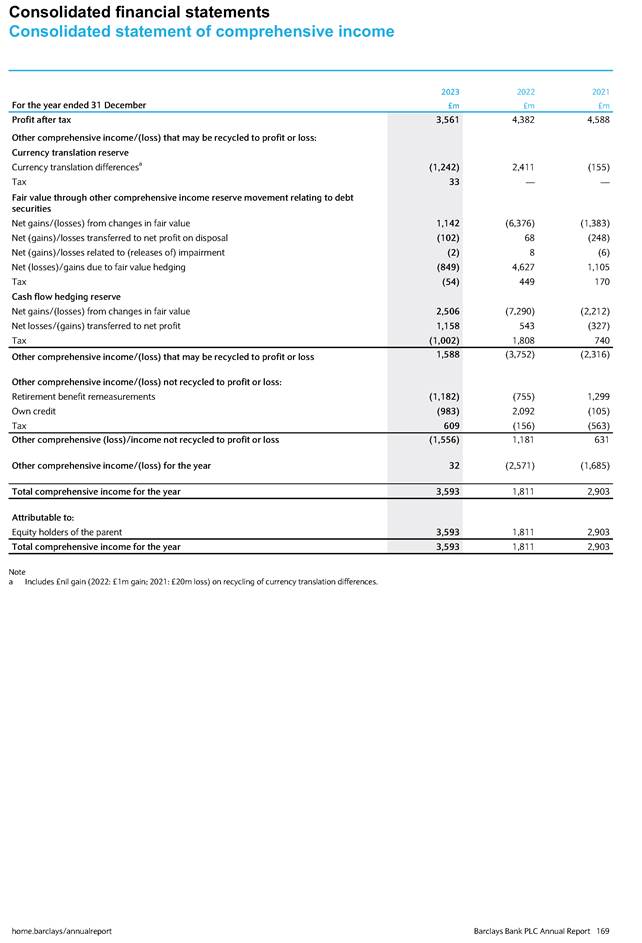
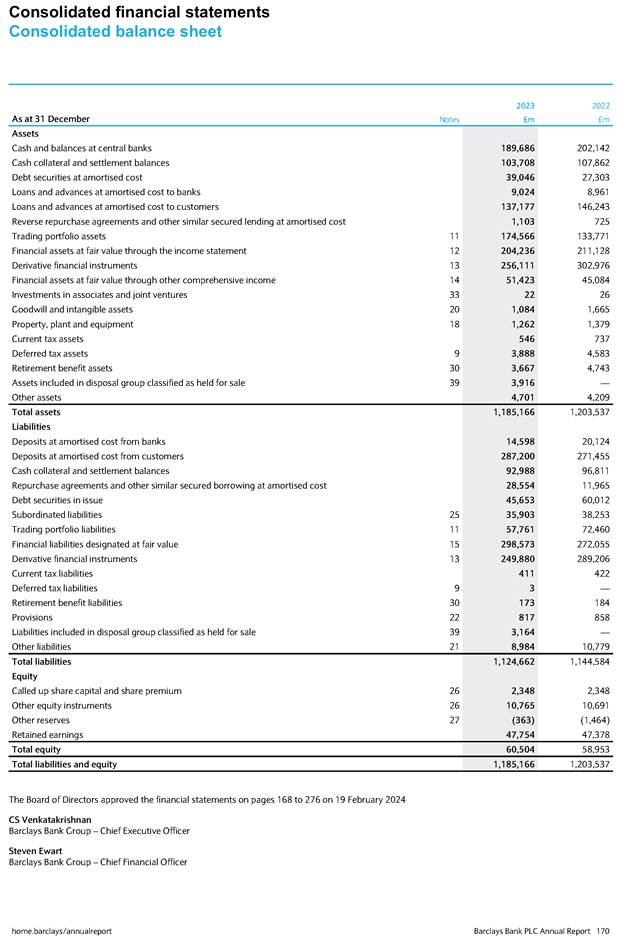
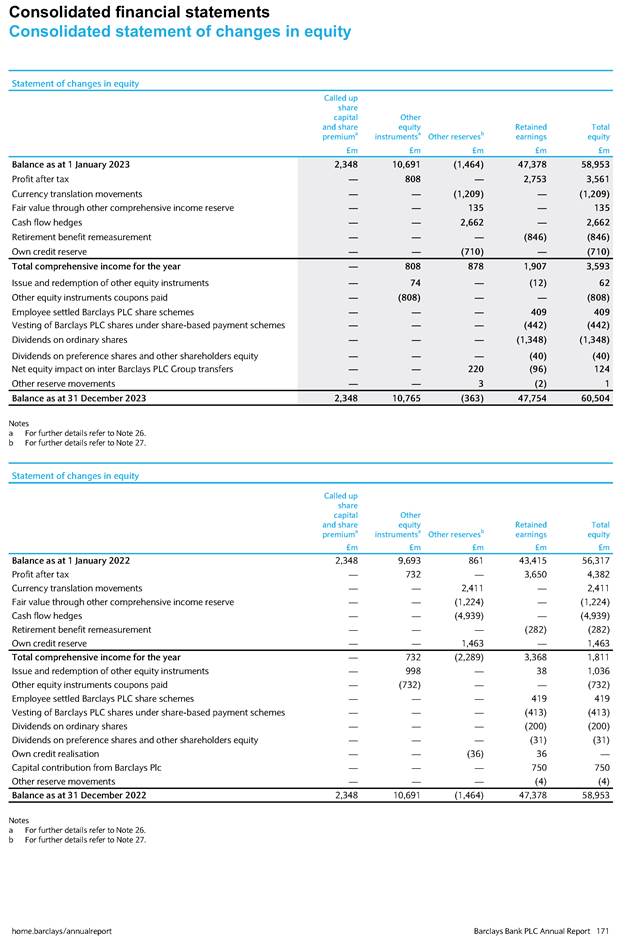
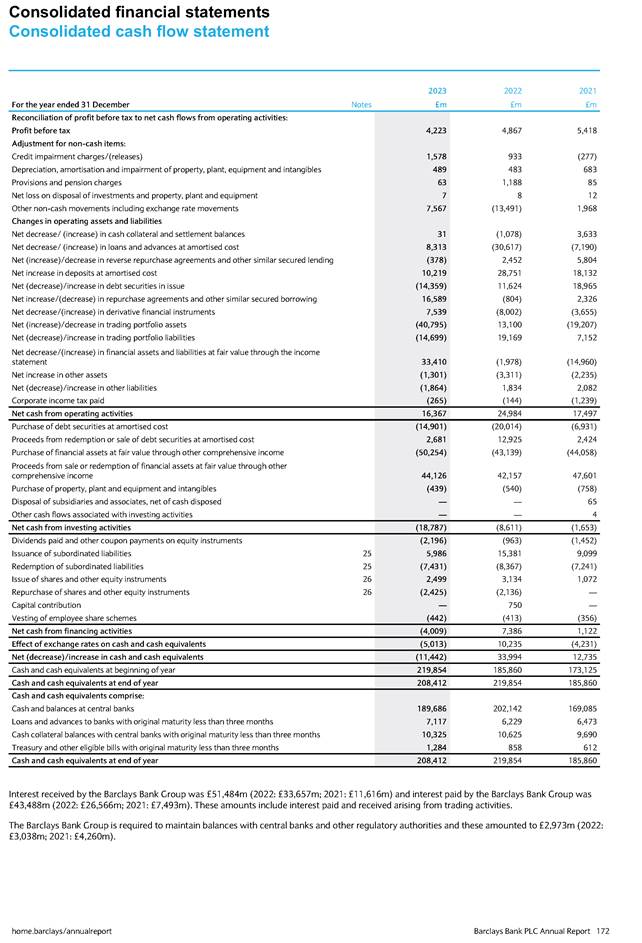
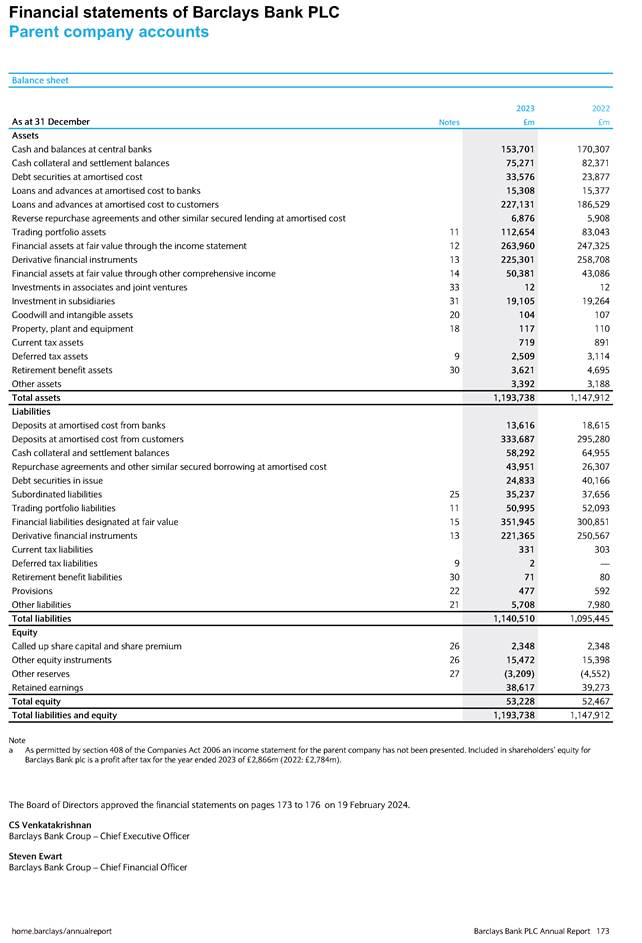
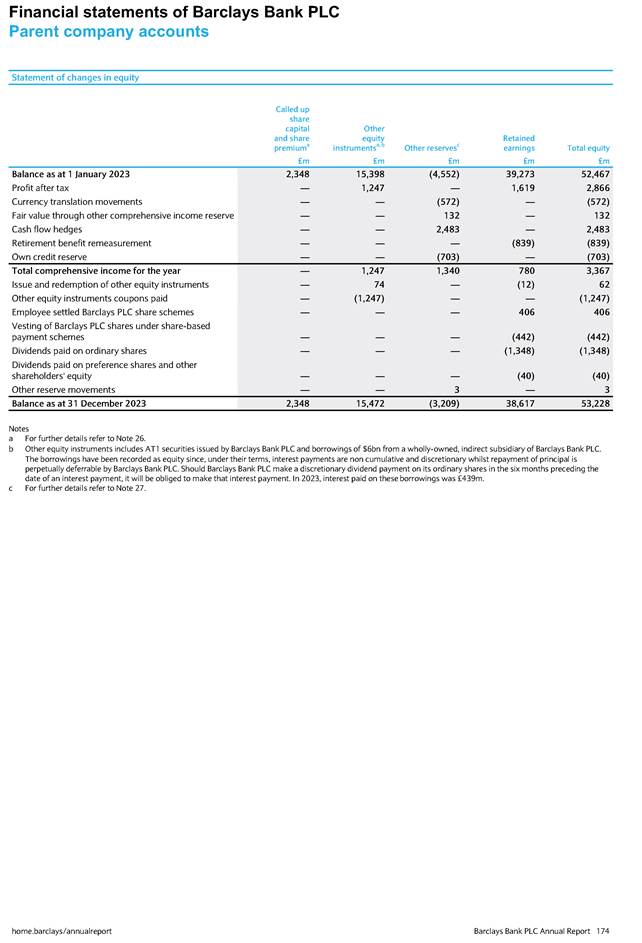
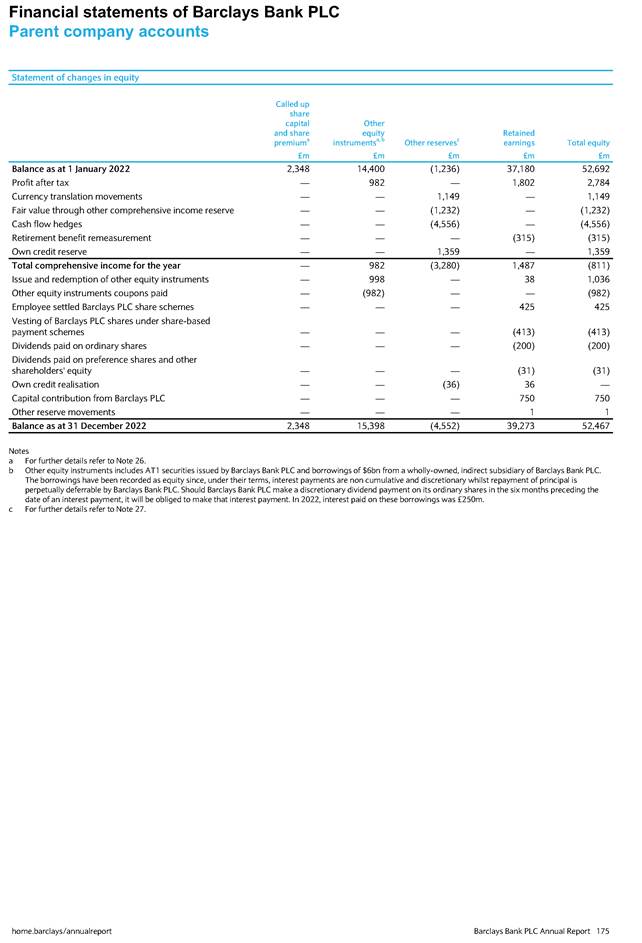
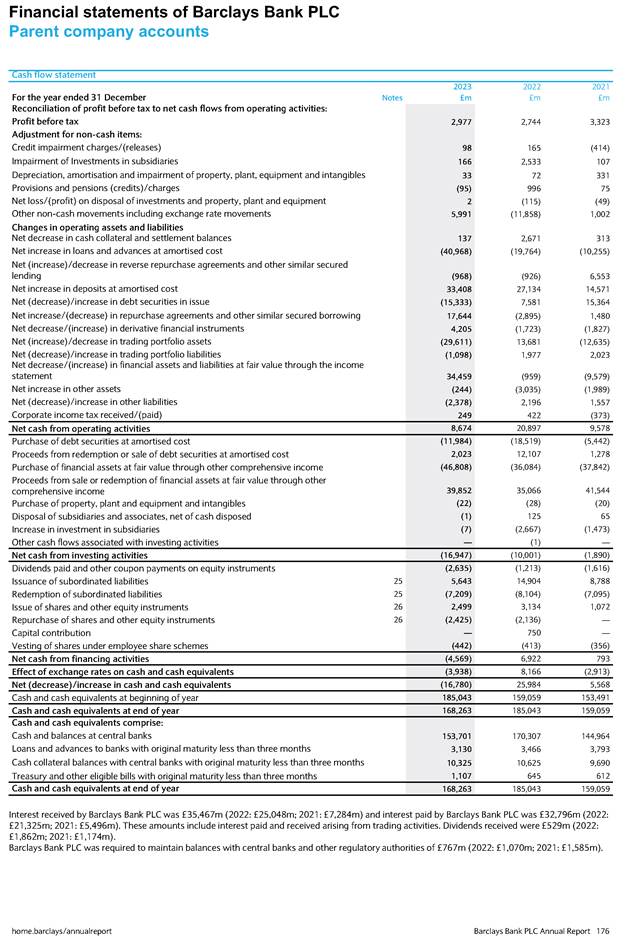
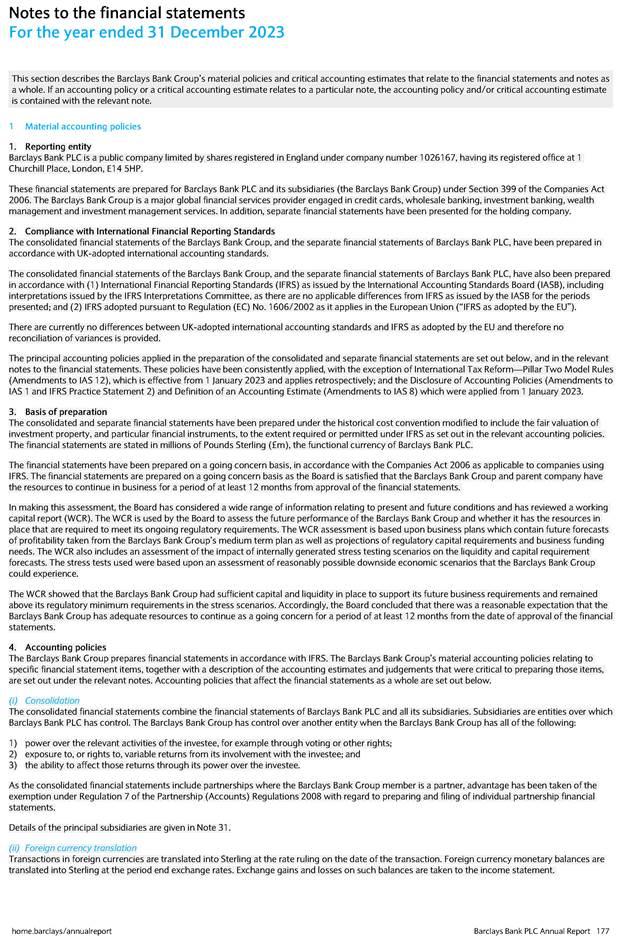
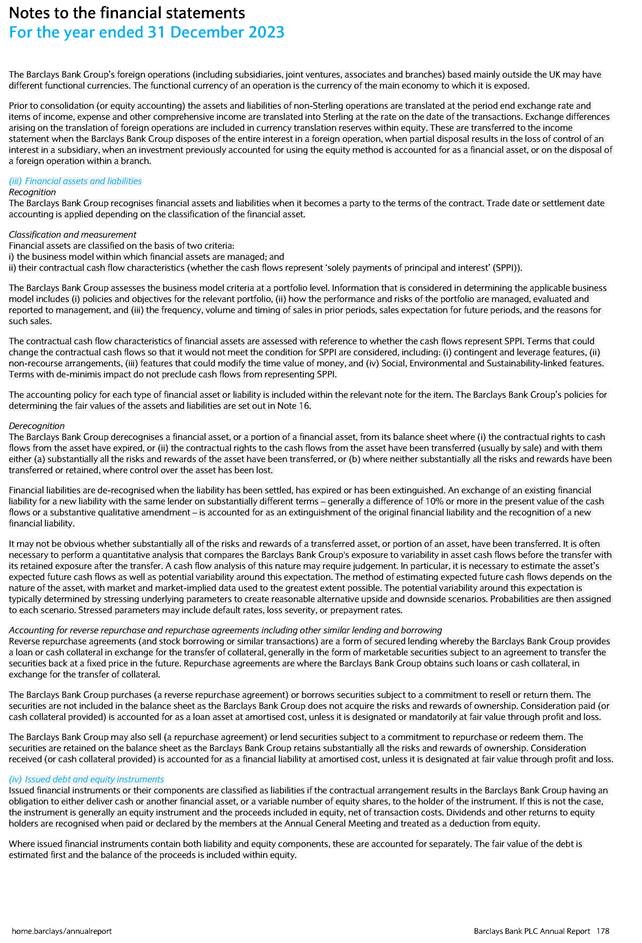
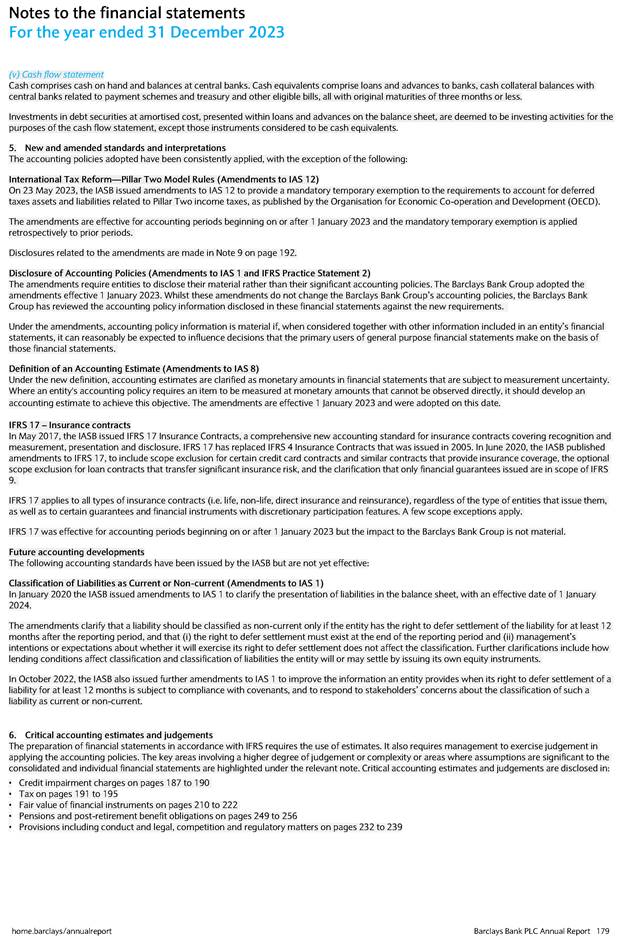

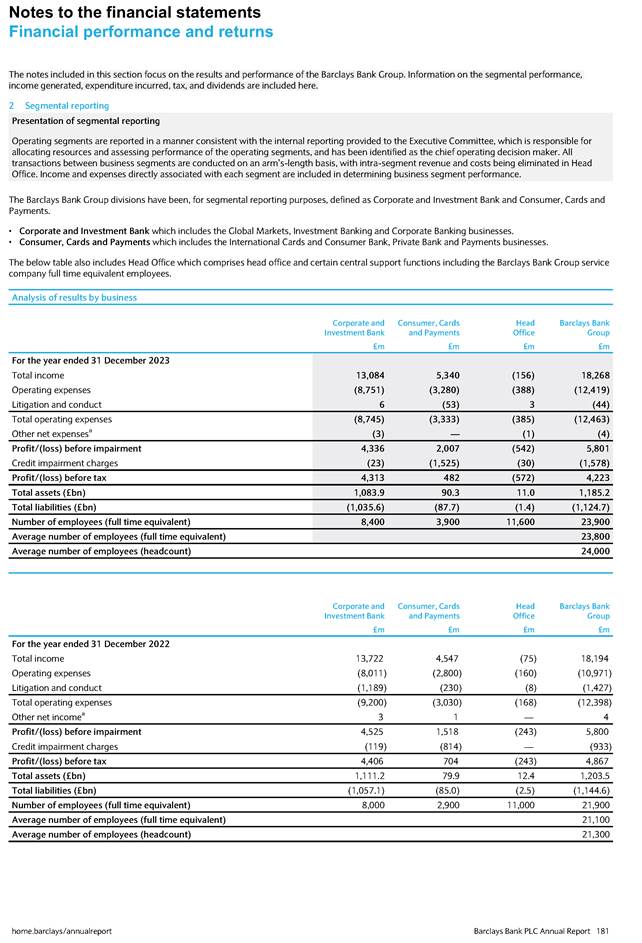
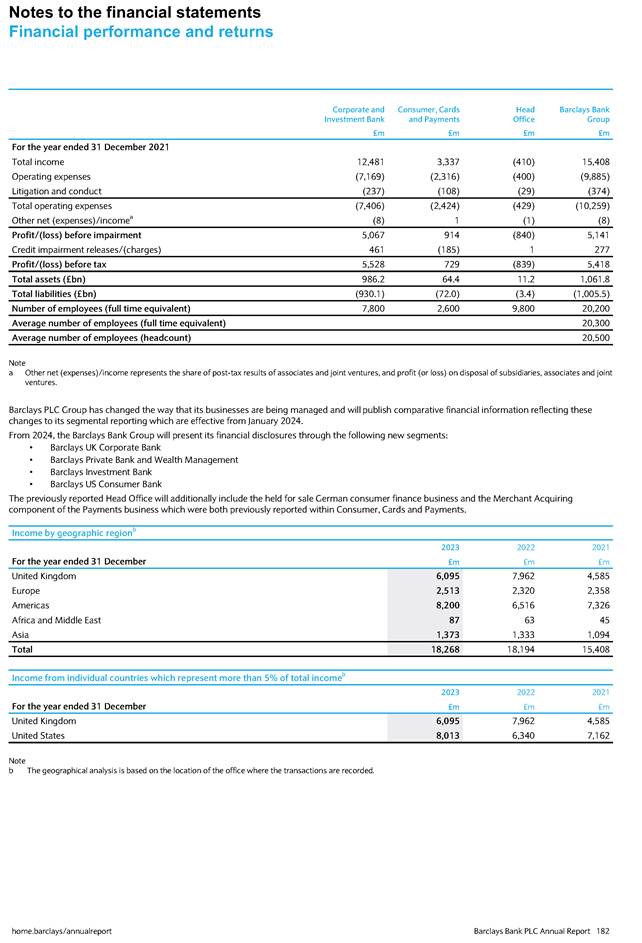
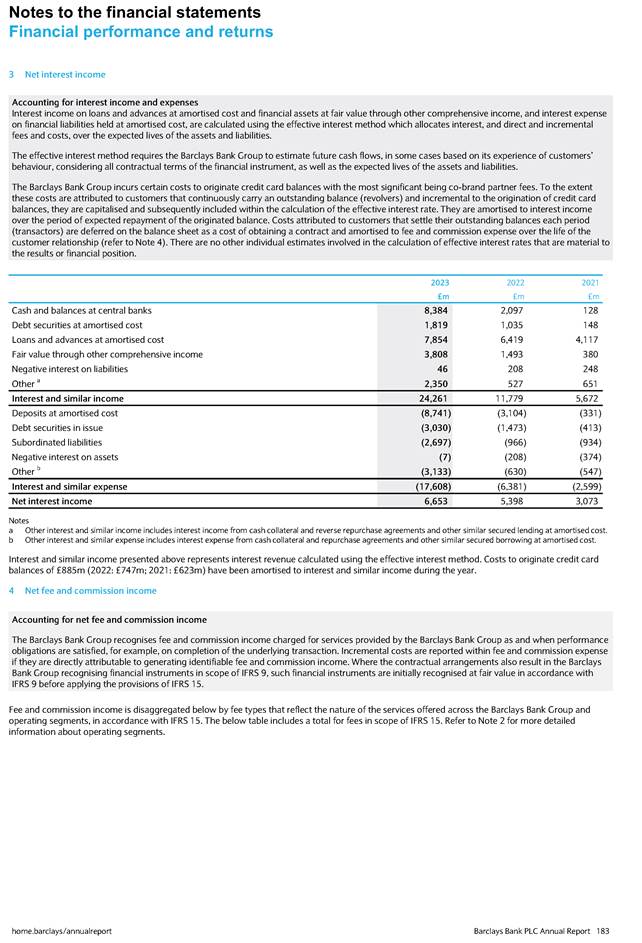
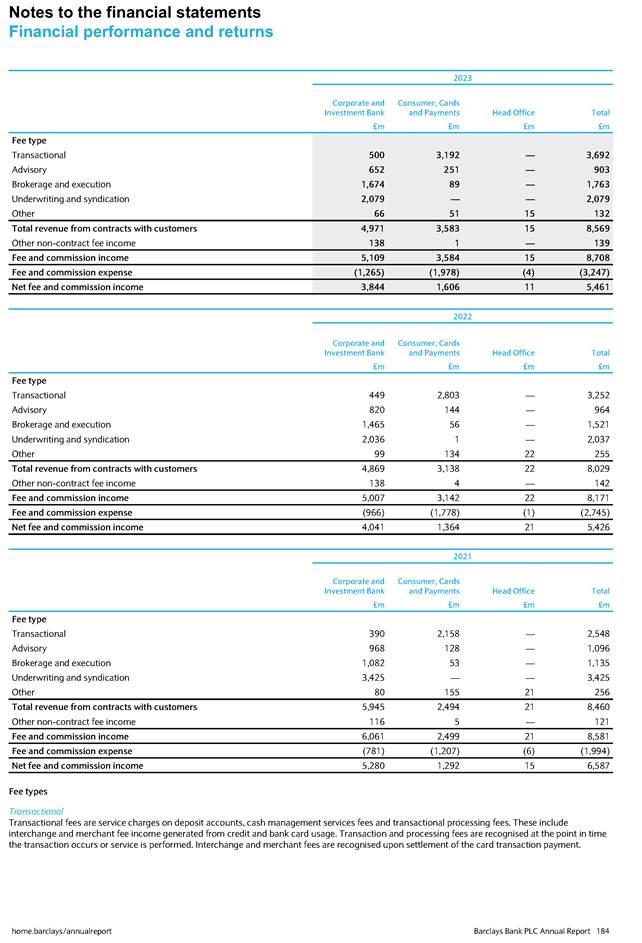
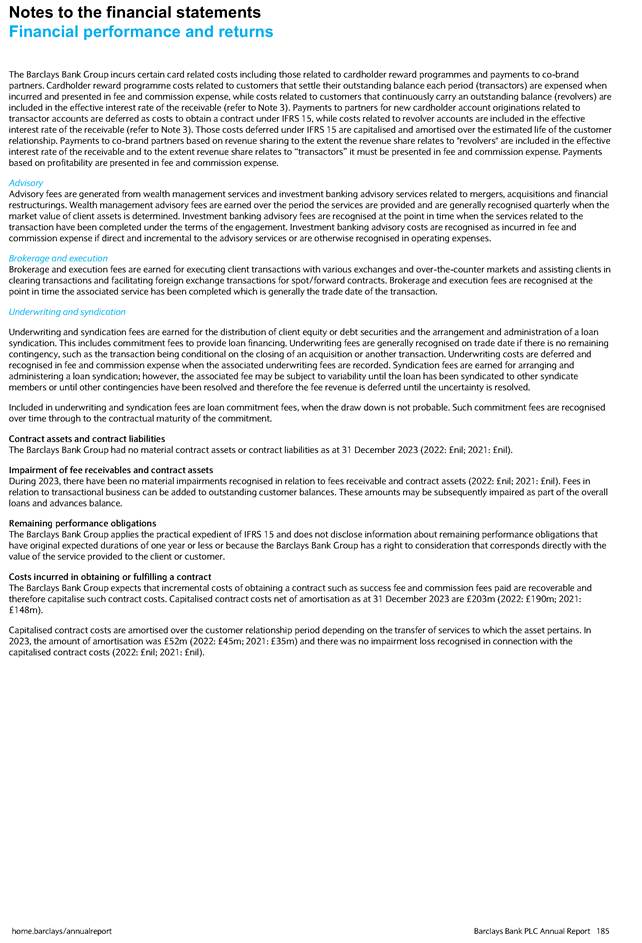
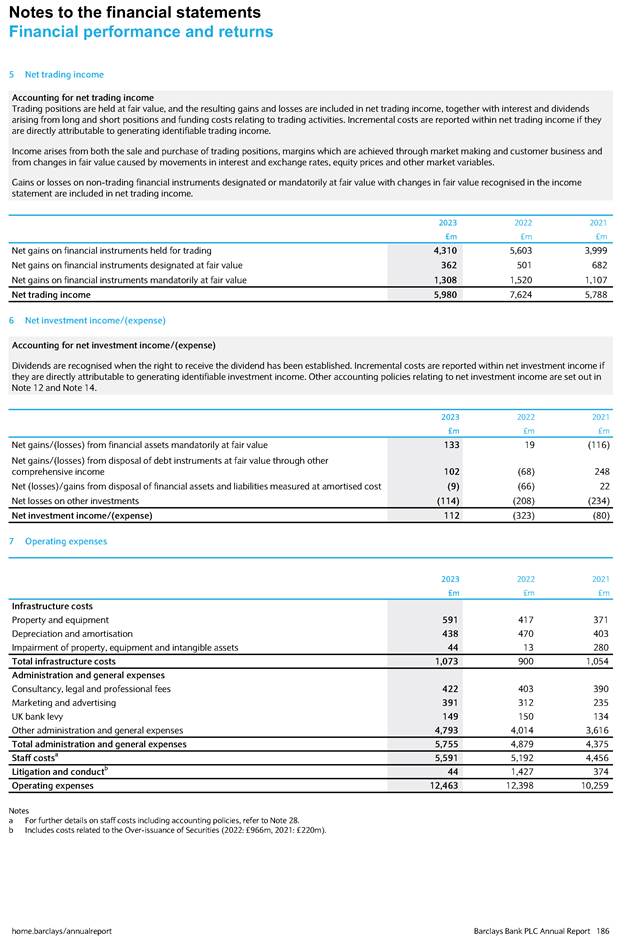
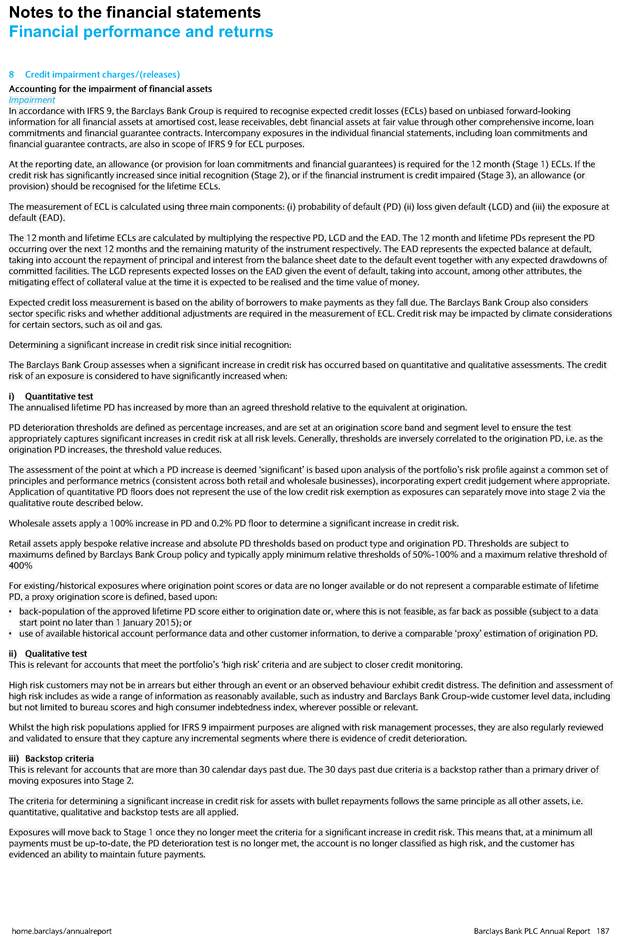
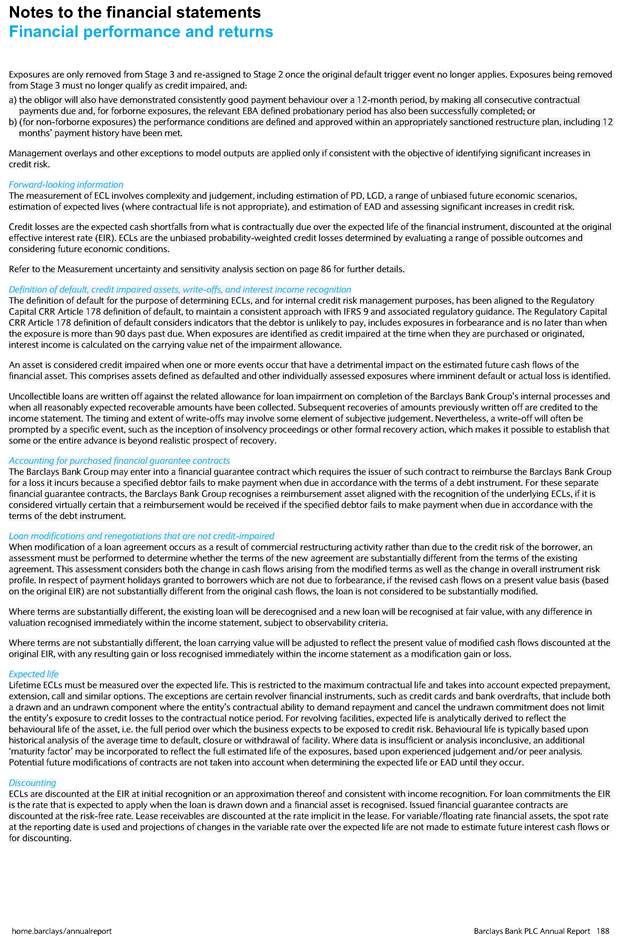
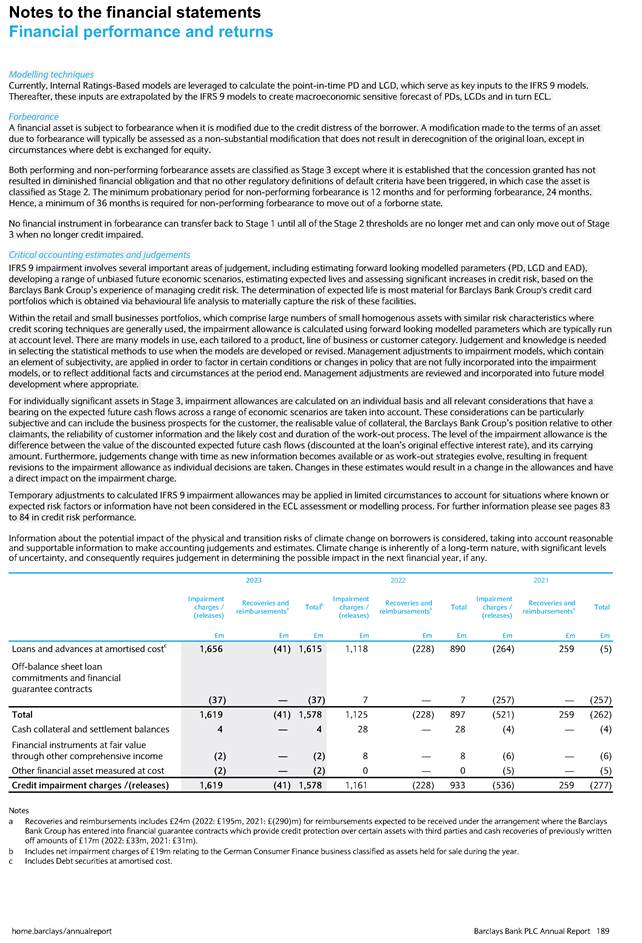


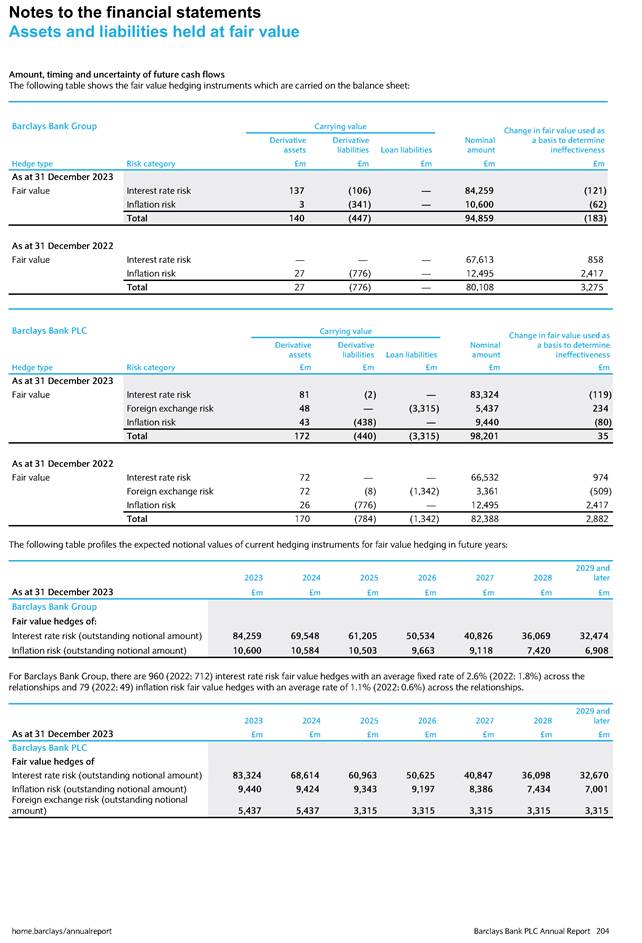
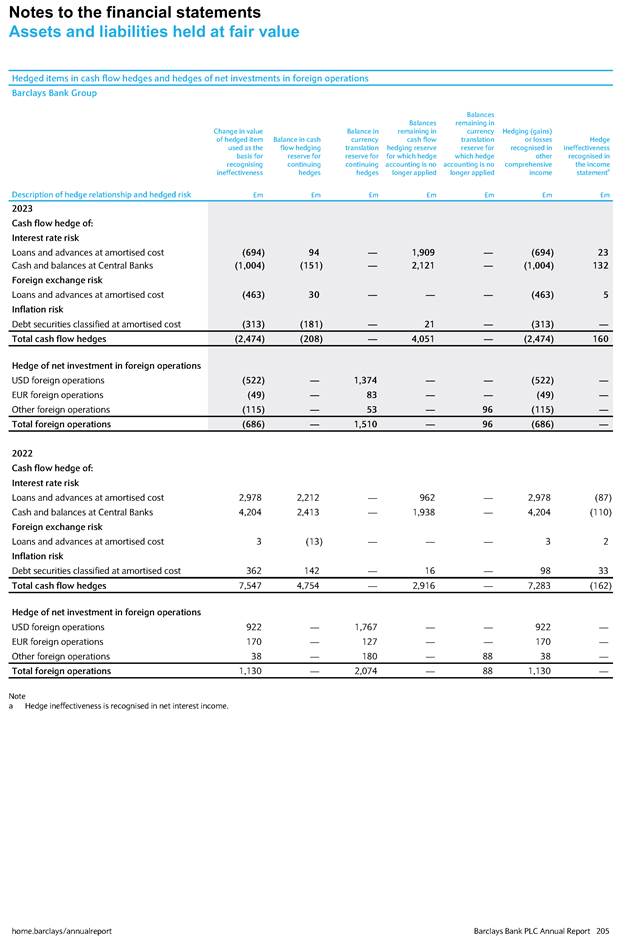
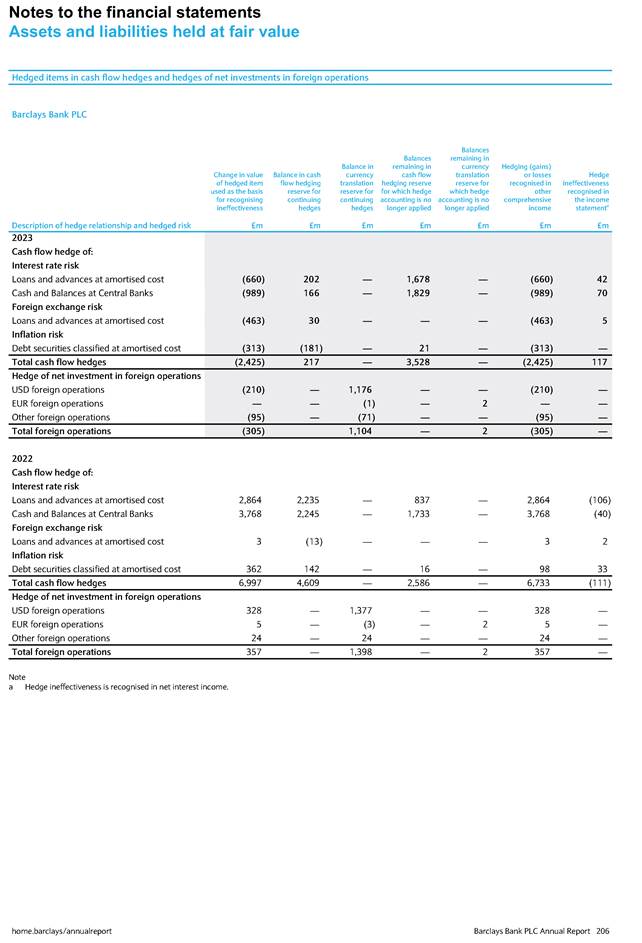
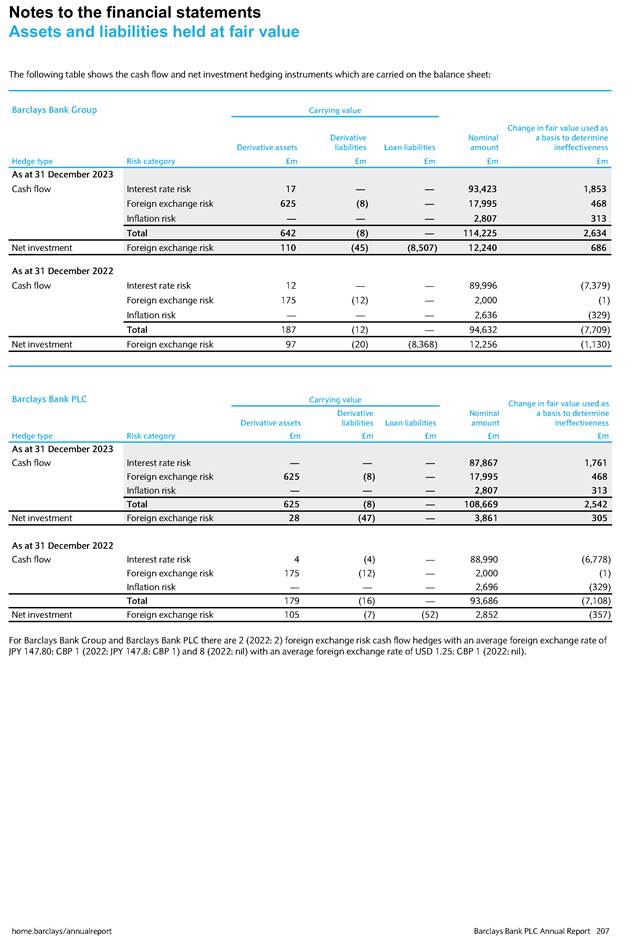
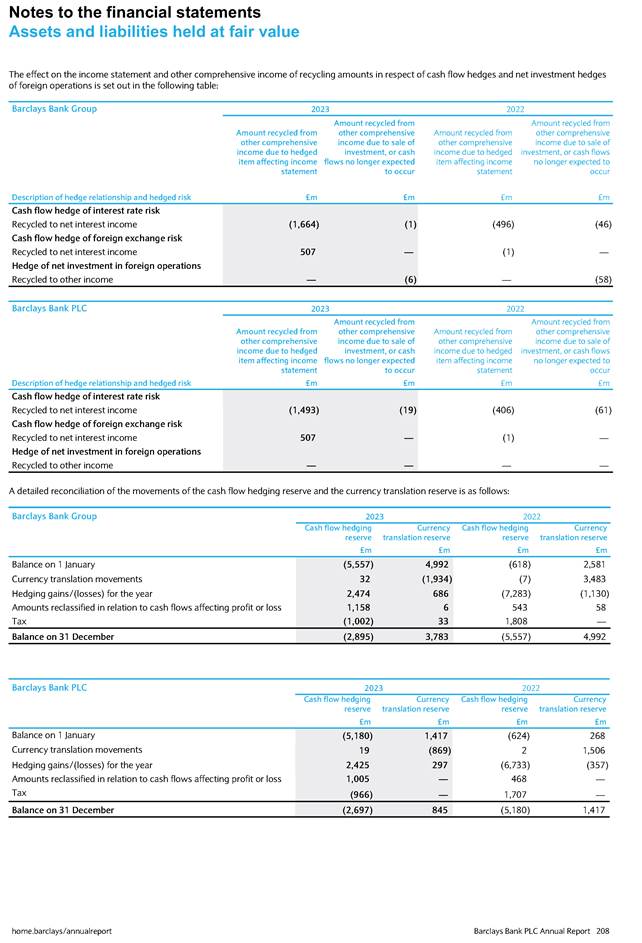
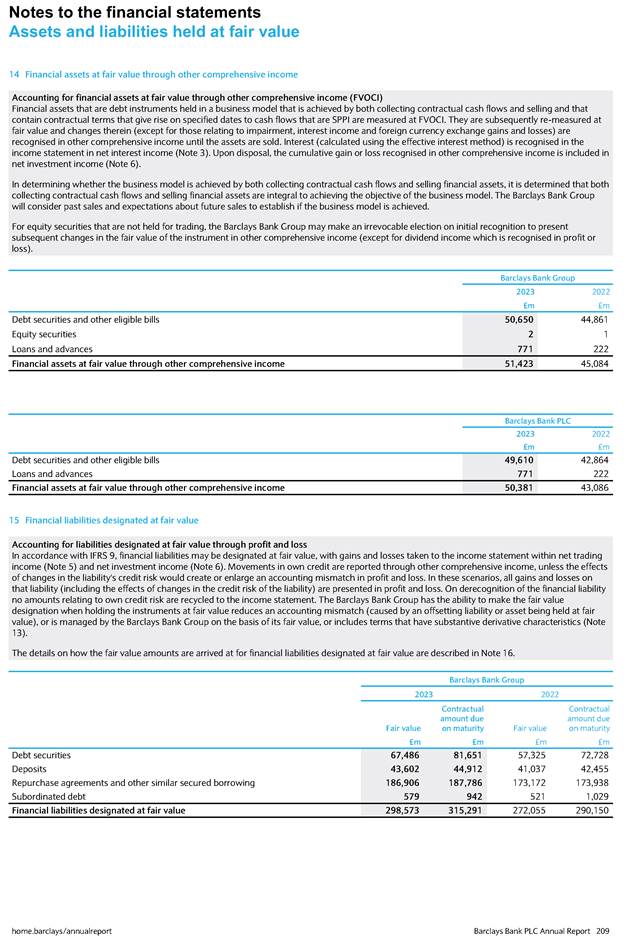
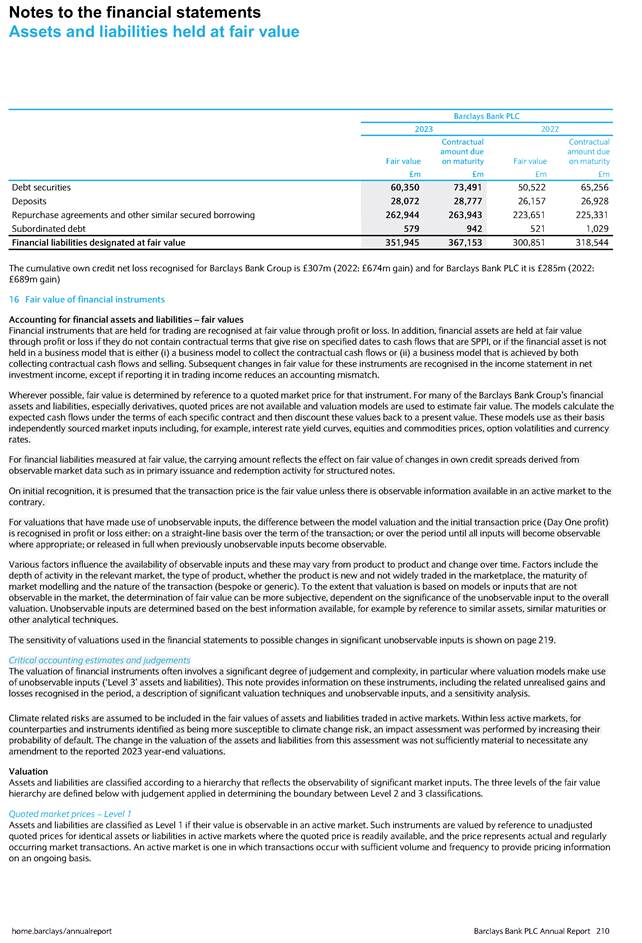
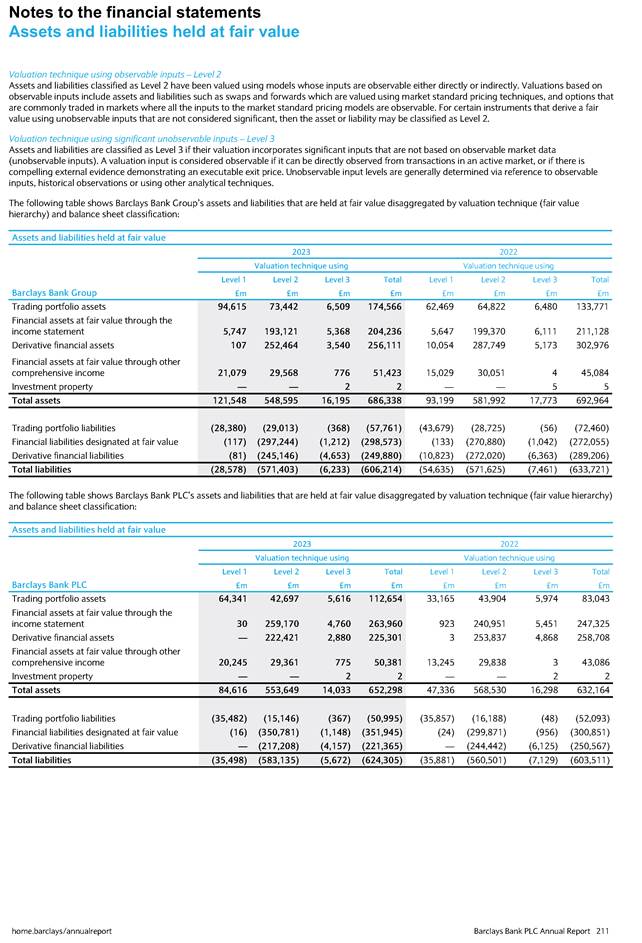

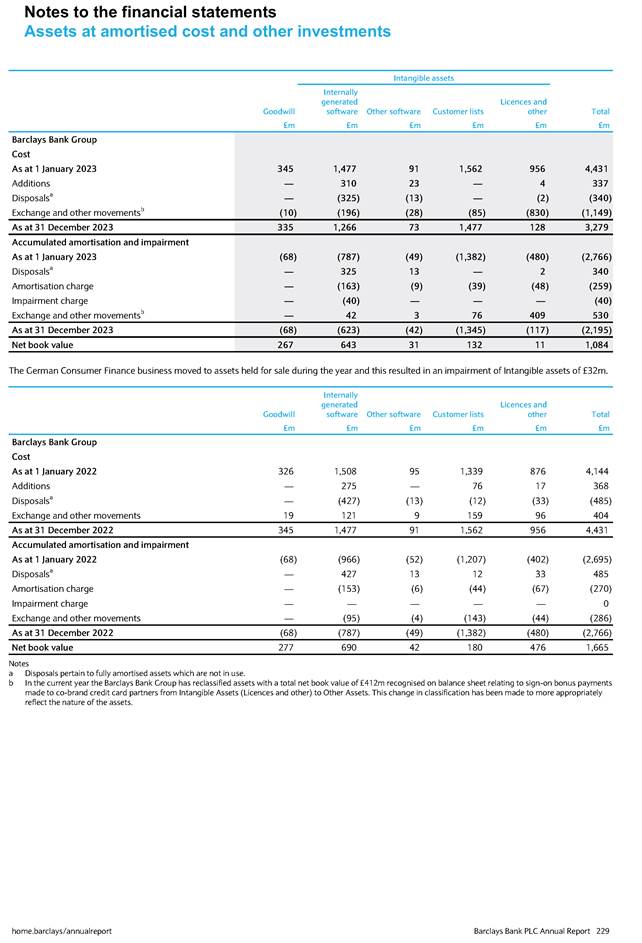
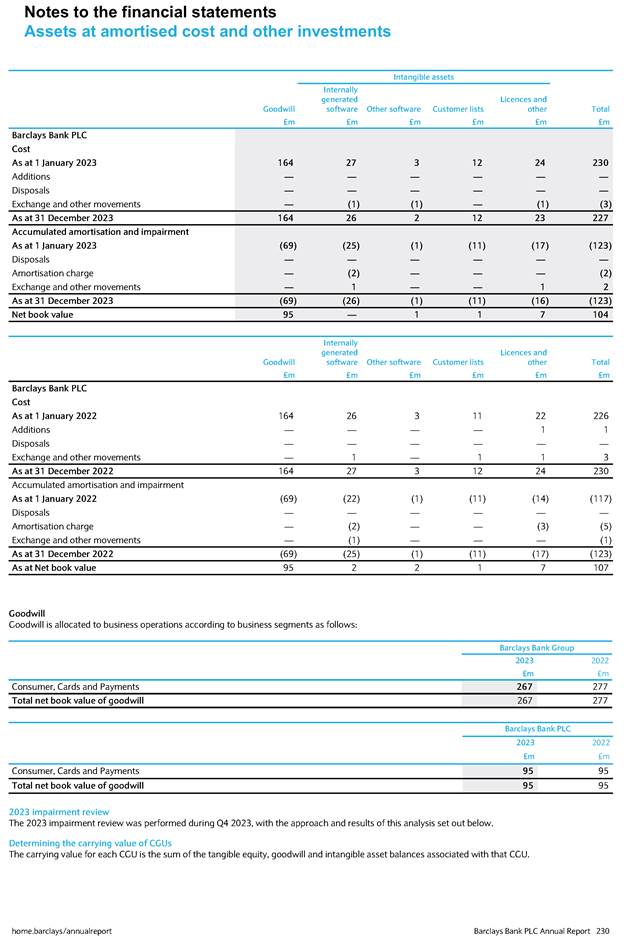

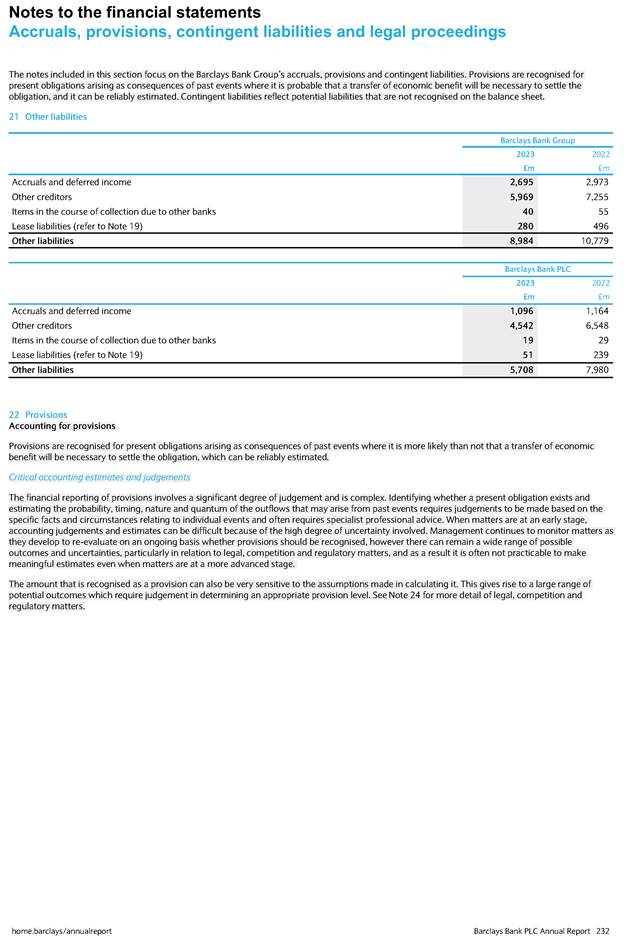
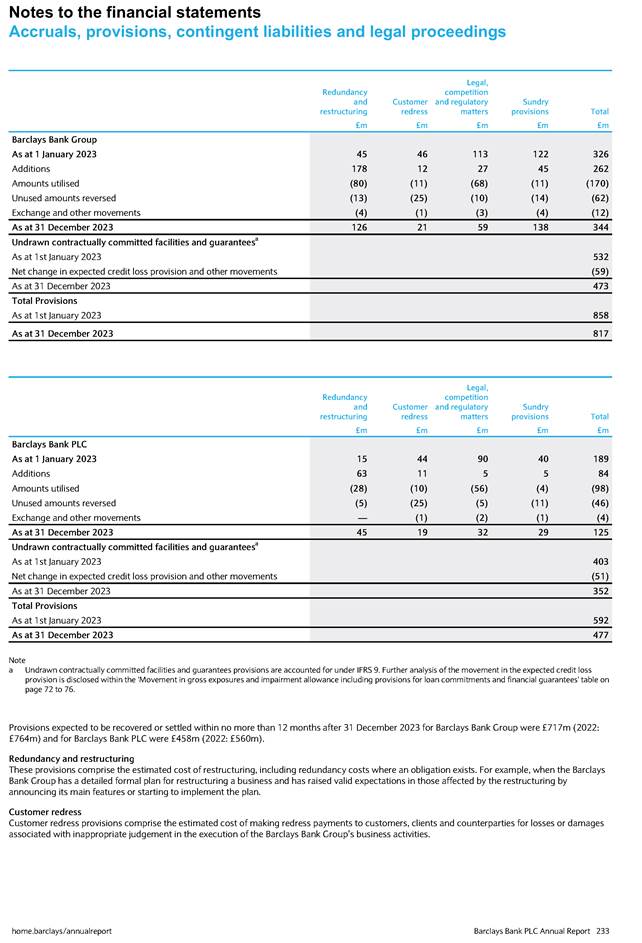
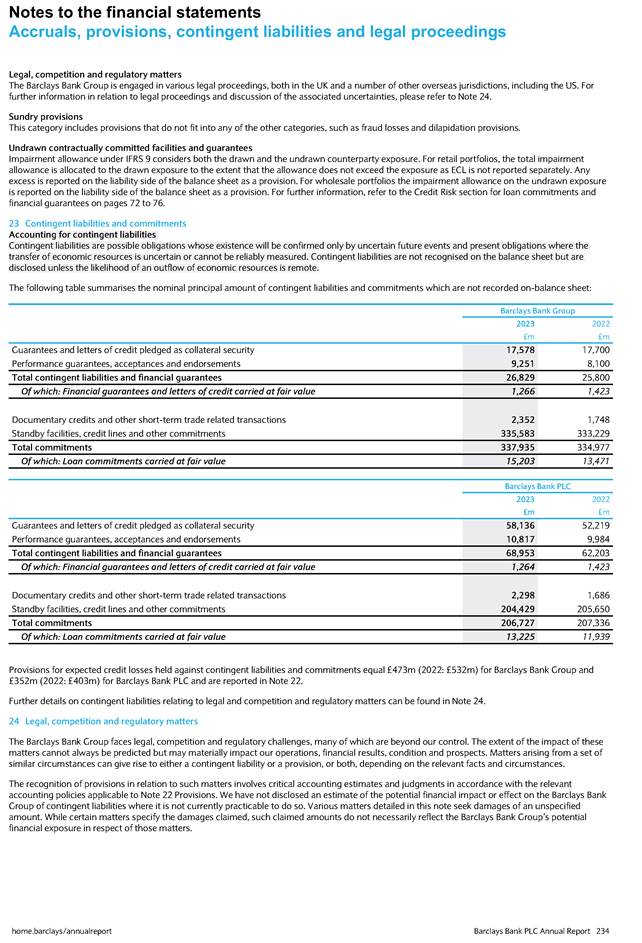
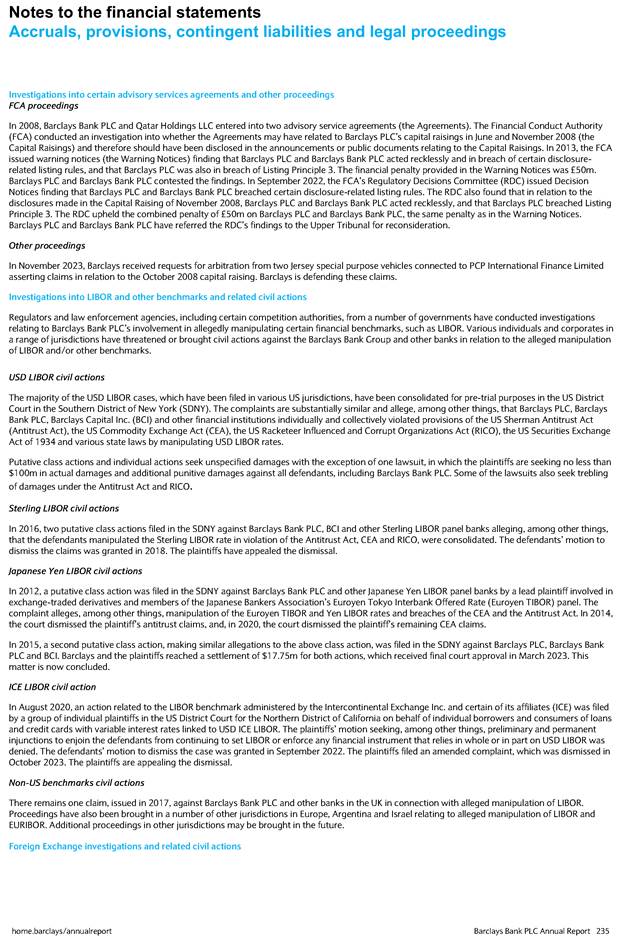
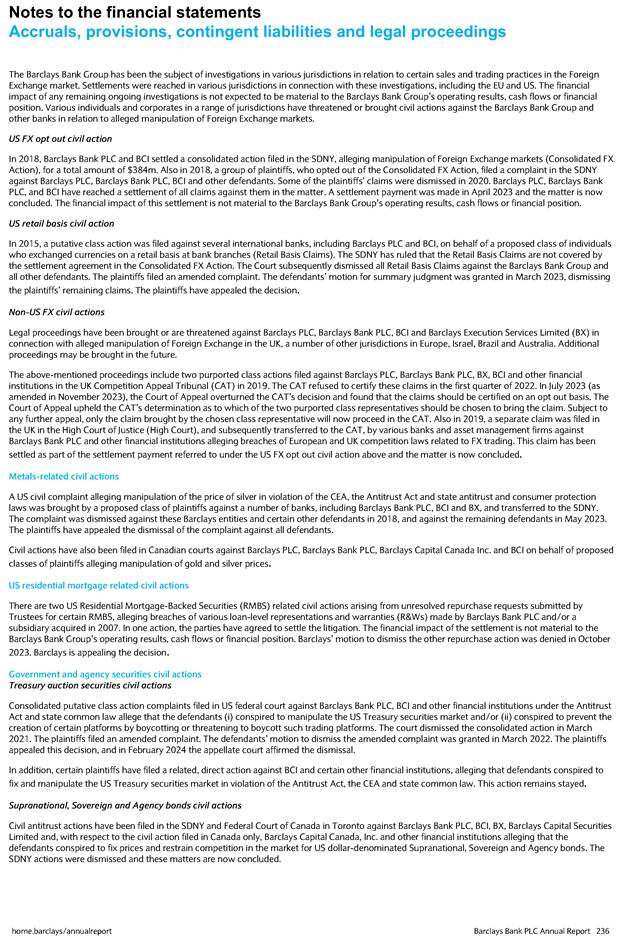
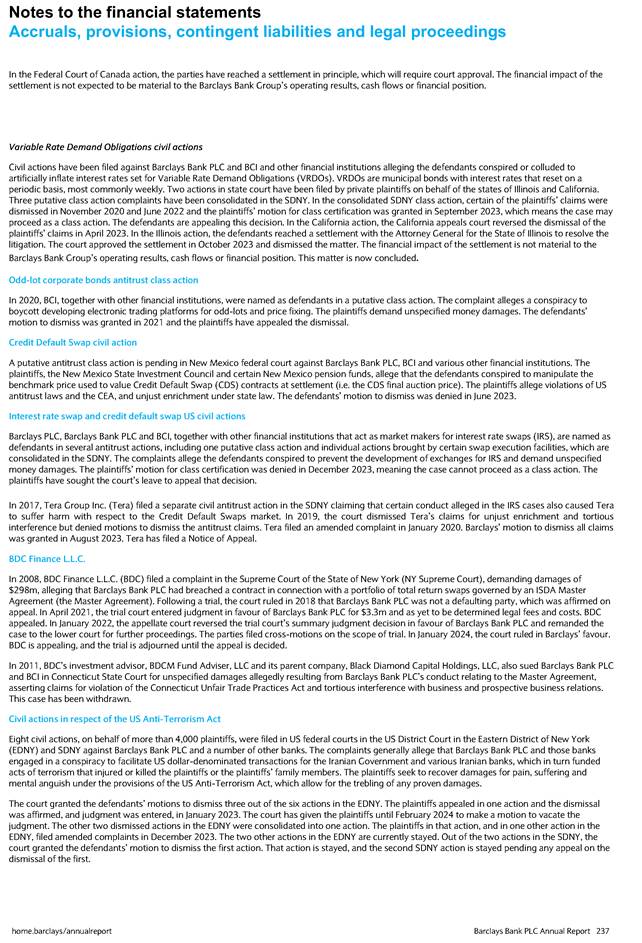

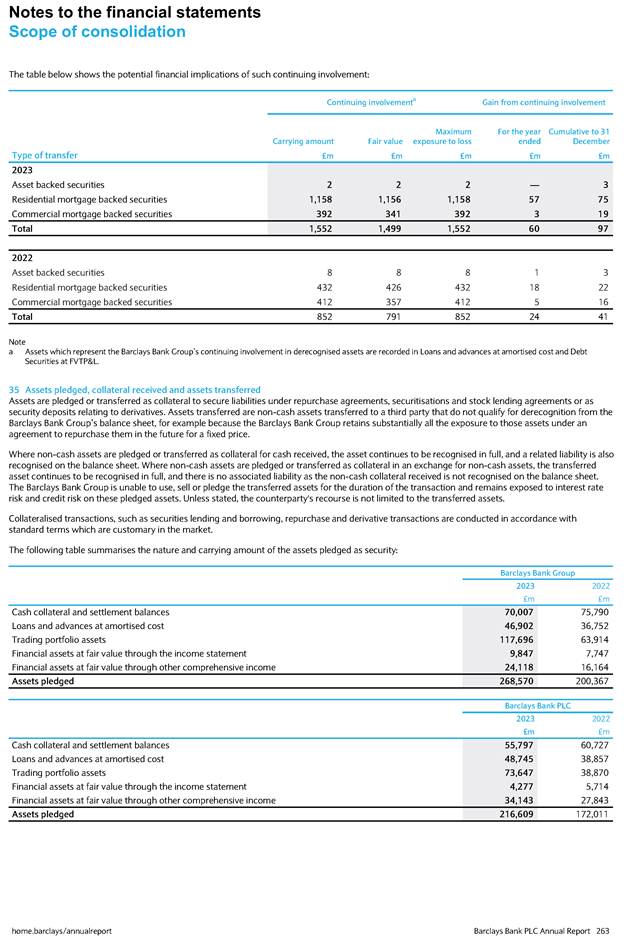
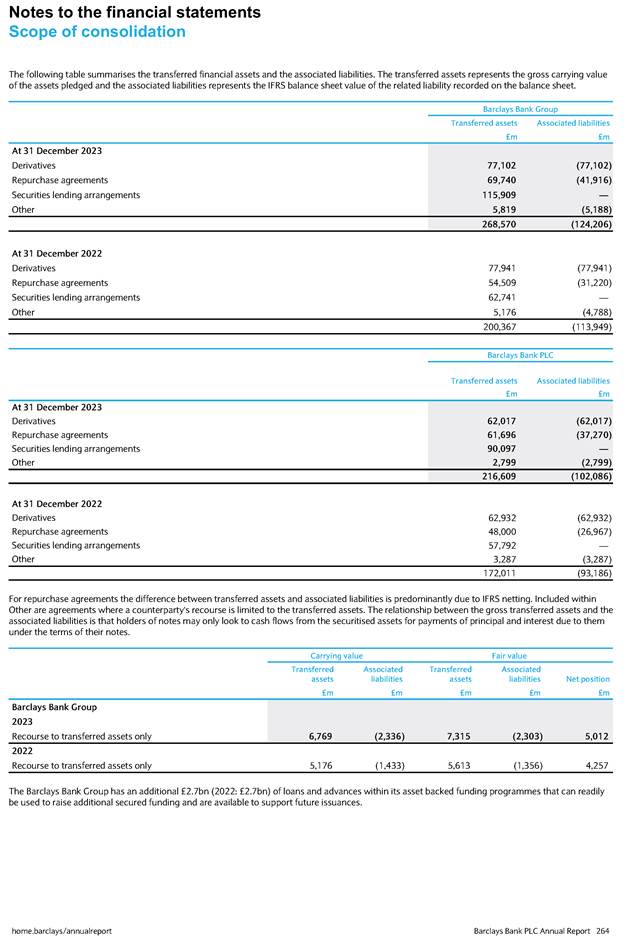

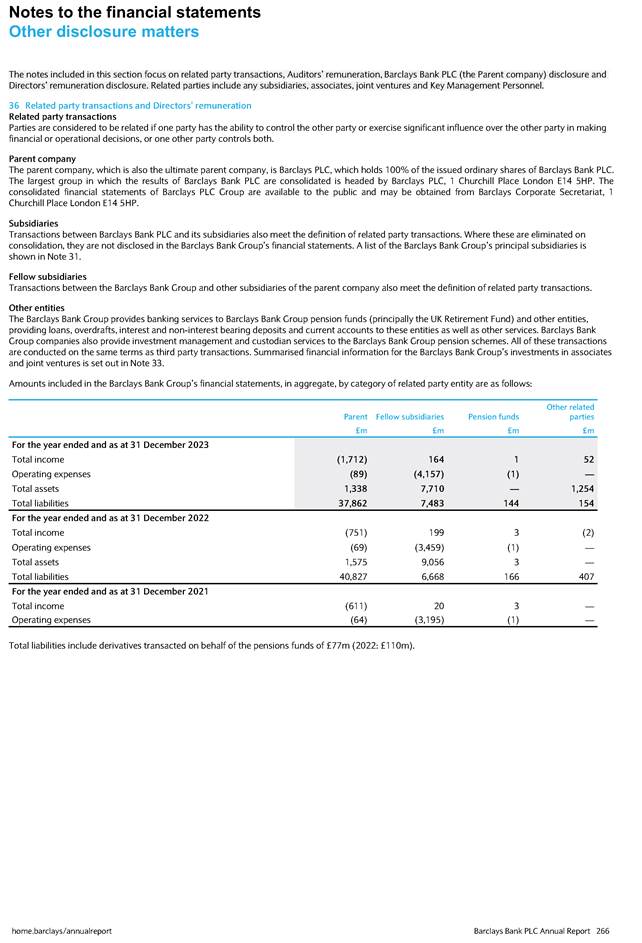
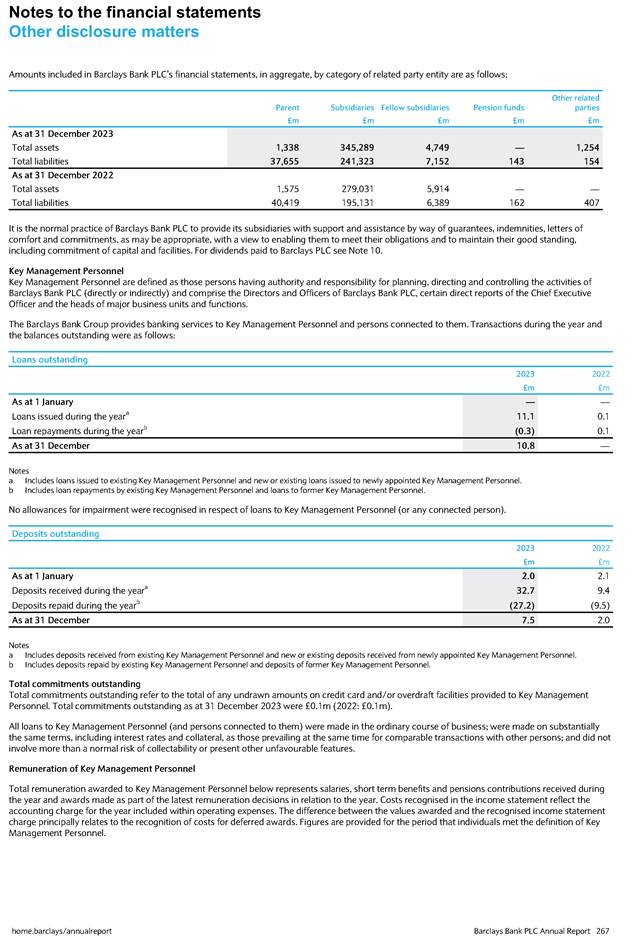


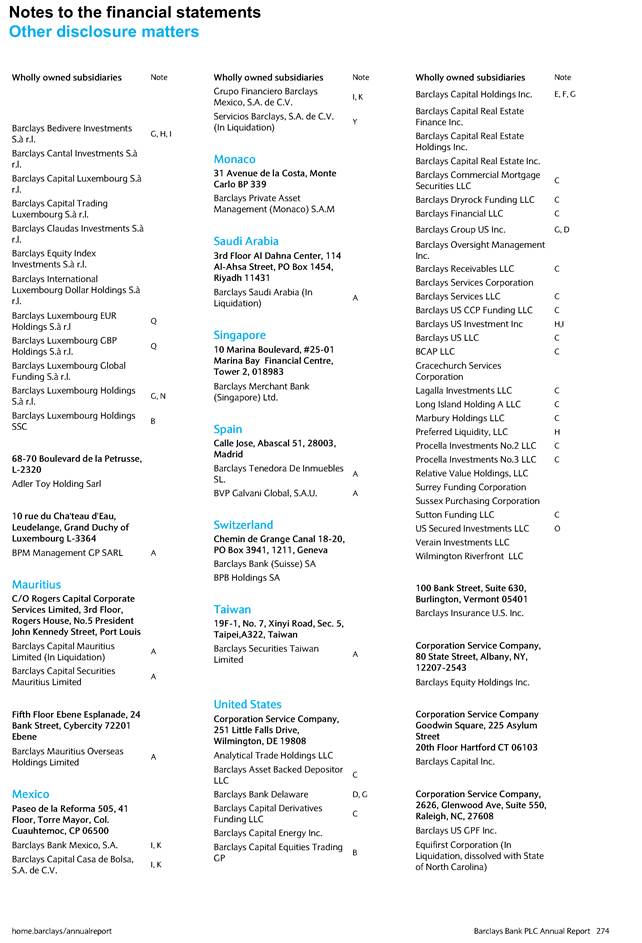
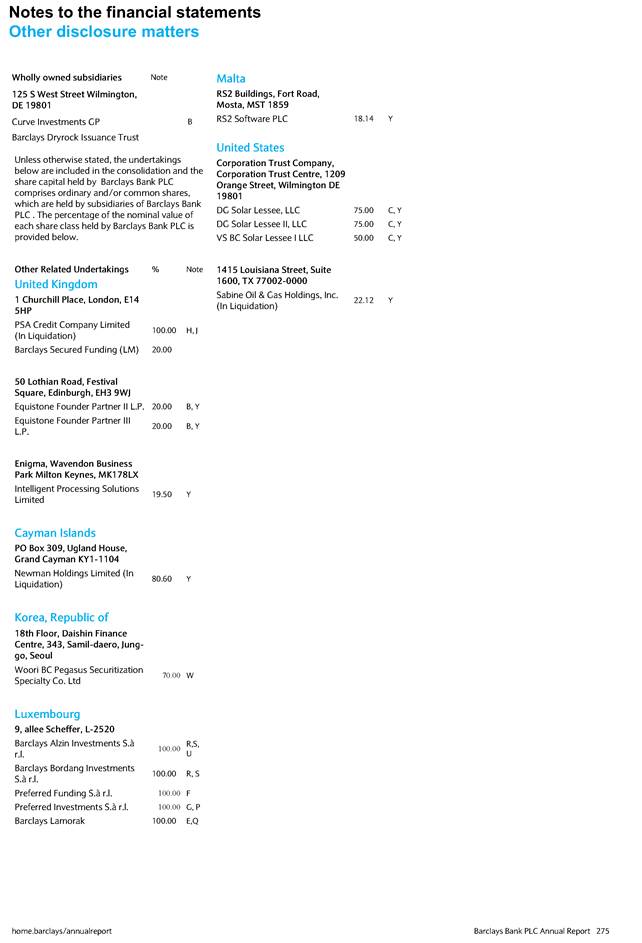
(訳文)
独立監査人の監査報告書
バークレイズ・バンク・ピーエルシーのメンバーに対する独立監査人の監査報告書
1.無限定適正意見
私どもは、以下を認める。
・ バークレイズ・バンク・ピーエルシーの財務書類は、2023年12月31日現在のグループおよび親会社の財政状態ならびに同日に終了した事業年度におけるグループの経営成績について真実かつ公正な概観を与えている。
・ グループの財務書類は、英国が採用した国際会計基準に準拠して適正に作成されている。
・ 親会社の財務書類は、2006年会社法の規定に準拠して適用される、英国が採用した国際会計基準に準拠して適正に作成されている。
・ グループおよび親会社の財務書類は、2006年会社法の要求事項に準拠して作成されている。
監査意見の範囲
私どもは、年次報告書(原文)に含まれ、以下の書類から構成される、2023年12月31日終了事業年度(以下「2023年度」という。)のバークレイズ・バンク・ピーエルシーのグループおよび親会社の財務書類を監査した。
| グループ(バークレイズ・バンク・ピーエルシーとその子会社) | 親会社(バークレイズ・バンク・ピーエルシー) |
|---|---|
| 連結損益計算書 連結包括利益計算書 連結貸借対照表 連結株主資本等変動計算書 連結キャッシュフロー計算書 重要性がある会計方針の要約を含む連結財務書類に対する注記1から40 | 貸借対照表 株主資本等変動計算書 キャッシュフロー計算書 |
欧州連合が採用しているIFRSに関する追加意見
グループの財務書類に対する注記1にも説明されている通り、グループおよび親会社は、英国が採用した国際会計基準を適用する法的義務に従うことに加えて、欧州連合で適用される規則(EC)第1606/2002号に準拠して採用された国際財務報告基準(以下「EUが採用したIFRS」という。)も適用している。私どもは、グループおよび親会社の財務書類が、EUが採用したIFRSに準拠して適正に作成されているものと認める。
監査意見の根拠
私どもは、国際監査基準(英国)(以下「ISA(英国)」という。)および準拠法に従って監査を実施した。私どもの責任は、以下に記載されている。私どもは、意見表明の基礎となる十分かつ適切な監査証拠を入手したと判断している。本報告書に含まれる私どもの監査意見や事項は、取締役会監査委員会(以下「BAC」という。)と協議し、BACに対する報告に含めた内容と一致している。
私どもは、社会的影響度の高い事業体に適用される英国財務報告評議会(以下「FRC」という。)の倫理基準を含む英国の倫理規定の下で、倫理上の責任を果たし、グループに対して独立性を保持している。
2.監査の概要
| 私どものリスク評価に影響を及ぼす要素 | 私どもは、2022年度の監査報告以降に生じたバークレイズ・バンク・ピーエルシー・グループに影響のある状況に基づき、私どものリスク評価を更新した。 経済全般の不確実性により、インフレ率と金利の上昇に関連する買い控え圧力が続いているため、マクロ経済の状況は、依然として、私どものリスク評価に影響を及ぼす要素となっている。 この経済の不確実性や状況の変化は、減収圧力と増収機会の双方をもたらしている。金利上昇の環境により純金利収入が増加しており、預金をめぐる競争が激化している。 市場のボラティリティの低下と顧客の取引活動量の減少により、コーポレート・バンクおよびインベストメント・バンクにおいて困難な環境が生じ、その結果、2023年度の収益が減少した。 私どものリスク評価においては、グループの年度末現在および(該当する場合は)将来予測的な主要な見積りの両方に用いた、将来の経済状況に関する仮定が引き続き重要であると判断された。 また、私どものリスク評価においては、法規制違反(グループに対して実施中の強制措置を含む)、具体的には、財務書類に重要な影響を及ぼす可能性があると合理的に予想されるものを考慮した。私どもは、これらの発生経緯ならびにこのリスクがより広範な影響を及ぼすものとなる可能性の有無について経営陣が行った評価を考慮した。 | |||||||||||||||
| 監査上の主要な検討事項 項目 貸付金(償却原価ベース)に対する減損引当金(オフバランス項目に対する引当金を含む) ↗ 4.1 公正価値で保有する金融商品の評価 ←→ 4.2 英国退職基金(以下「UKRF」という。)に係る確定給付年金債務総額の評価 ←→ 4.3 ユーザー・アクセス管理 ←→ 4.4 2022年度に比べリスクが同水準の項目 ←→ 2022年度に比べリスクが高まった項目 ↗ | 監査上の主要な検討事項 | 項目 | 貸付金(償却原価ベース)に対する減損引当金(オフバランス項目に対する引当金を含む) | ↗ | 4.1 | 公正価値で保有する金融商品の評価 | ←→ | 4.2 | 英国退職基金(以下「UKRF」という。)に係る確定給付年金債務総額の評価 | ←→ | 4.3 | ユーザー・アクセス管理 | ←→ | 4.4 | ||
| 監査上の主要な検討事項 | 項目 | |||||||||||||||
| 貸付金(償却原価ベース)に対する減損引当金(オフバランス項目に対する引当金を含む) | ↗ | 4.1 | ||||||||||||||
| 公正価値で保有する金融商品の評価 | ←→ | 4.2 | ||||||||||||||
| 英国退職基金(以下「UKRF」という。)に係る確定給付年金債務総額の評価 | ←→ | 4.3 | ||||||||||||||
| ユーザー・アクセス管理 | ←→ | 4.4 |
| 専門家の利用 および監査の変革 | 会計または監査の特定の専門領域に関する知識を有する専門家およびチーム・メンバーの利用:私どもは、監査の様々な局面において会計または監査の専門領域に関する知識を有する専門家およびチーム・メンバーを利用した。これには、例えば、以下の者が含まれていた。 - ECLモデルの検証における信用リスクのモデル専門家 - ECL引当金の算定に用いられたマクロ経済関連の変数やシナリオに関する監査手続きに利用した経済専門家 - 金融商品のサンプルを対象に監査人が独自に行った価格再評価に利用した評価の専門家 - 確定給付債務の評価に関する監査手続きに利用した年金数理人 - 税金費用、実効税率および不確実な税務ポジションに関する監査手続きに利用した税務の専門家 - 自動化された内部統制およびIT全般統制のテストを行うIT監査人 監査における予測不可能性の組み込み:監査基準は、私どもが、意図的に予想外の手続き、またバークレイズ・バンク・ピーエルシーの経営陣が合理的には予測し得ない手続きを実施することを求めている。例えば、私どもは、経営陣による内部統制の無効化リスクがより高い仕訳の抽出基準を毎年更新し、抽出基準の予測ができないようにしている。仕訳以外では、抽出した公正価値で測定する金融商品のサンプルについて、期中のある月において、公正価値を独自に再計算することにより、私どもの監査手続きに予測不可能性の要素を組み込んでいる。 監査における変革:私どもは、監査において変革を推進し、先端技術の活用度を高めることに努めている。2023年度においても、私どもは監査全般で引き続き多くのデータアナリティクス・ツールを導入した。また私どもは、デジタルメディア分析ツールを使用して、私どものリスク評価手続きの一環として検討するために市場ニュースや主要な自己資金投資、レバレッジド・ファイナンス・エクスポージャーのデータを収集することにより、金融商品の評価に係る監査手続きの変革も引き続き行った。 | ||||||||||||||||
| 取締役会監査委員会(BAC)とのコミュニケーション | 2023年度において、BACの会議が11回開催された。ケーピーエムジーは、すべてのBACの会議に招かれ、業務執行取締役不在の下でBACと非公式に話し合う機会も与えられた。私どもは、セクション4に記載されている監査上の主要な検討事項(それぞれについて特定の判断が必要となるような事項を含む)のそれぞれに関してBACとコミュニケーションを行った。 加えて、私どもの監査チームには、監査品質の確保に対して特定の責任を有するシニアパートナー(以下、私どもの「監査品質担当パートナー」という。)が含まれている。取締役会監査委員会は、当年度に2回、監査品質担当パートナーと会合し、監査品質に関する当該パートナーの評価報告を受けた。取締役会監査委員会はケーピーエムジーの監査品質責任者とも会合し、ケーピーエムジーが監査品質を高水準に維持するために講じている取り組みについての最新情報を入手した。 年次報告書(原文)の19ページから20ページのBAC議長の報告書(原文)に含まれる事項は、上記の会議における私どもの見解と実質的に一致している。 さらに、ケーピーエムジーは取締役会リスク委員会の会議に出席するよう招かれている。 | ||||||||||||||||
| 独立性 | 私どもは、社会的影響度の高い事業体に適用されるFRCの倫理基準を含む英国の倫理規定の下で、倫理上の責任を果たし、グループに対して独立性を保持している。 下記の事項を除き、私どもは2023年12月31日終了事業年度において、またはそれ以降に、FRCの倫理基準が禁じる非監査業務を提供していない。 私どもは、ケーピーエムジーのあるメンバー・ファームが、2018年から2023年までの期間にわたり、親会社の1支店を含む事業体に対して現地の財務書類作成業務を提供していたことを特定した。このメンバー・ファームは、バークレイズ・バンク・ピーエルシーのグループまたは親会社の監査には関与していなかった。当該業務は既に終了しているが、本質的に事務的な業務であり、経営判断または記帳を行うものではなかった。当該業務は、関連する各事業年度のグループ監査意見にケーピーエムジー エルエルピーが署名した後に引き受けられたもので、バークレイズ・バンク・ピーエルシーの親会社財務書類または連結財務書類に対し、直接的にも間接的にも影響を及ぼすものではなかった。 職業的専門家としての私どもの判断では、上記の違反を評価した結果、私どもは監査人として維持すべき誠実性や客観性を損ねていないことを確認し、これらの業務の提供は、事情に精通し、客観的かつ合理的な判断を行うことができる第三者であれば、影響のあった事業年度のいずれにおいても私どもが誠実性または客観性を損ねていないと結論付けるものと考えている。監査委員会もこの見解に同意した。 私どもは、2017年12月31日終了事業年度において、株主から初めて監査人に任命された。連続関与期間の合計は、2023年12月31日現在、7事業年度である。 グループ・リード・エンゲージメント・パートナーは、選任から5年で交代しなければならない。2023年度の財務書類は、スチュアート・クリスプが2度目に署名した、英国にて作成された財務書類であり、同氏は2026年度監査の後に交代を求められることになる。 セクション7に記載されている構成単位の監査に対する責任を負う主要監査パートナーの平均在任期間は2年で、最短では1年、また最長では5年の関与となっている。 監査報酬合計 40百万ポンド その他の監査関連報酬 8百万ポンド その他の業務 1百万ポンド 初めて選任された日 2017年3月31日 連続関与期間 7年 入札が求められる次の事業年度 2027年12月31日終了事業年度 グループ・リード・エンゲージ メント・パートナーの在任期間 2年 主要監査パートナーの平均在任期間 2年 | 監査報酬合計 | 40百万ポンド | その他の監査関連報酬 | 8百万ポンド | その他の業務 | 1百万ポンド | 初めて選任された日 | 2017年3月31日 | 連続関与期間 | 7年 | 入札が求められる次の事業年度 | 2027年12月31日終了事業年度 | グループ・リード・エンゲージ メント・パートナーの在任期間 | 2年 | 主要監査パートナーの平均在任期間 | 2年 |
| 監査報酬合計 | 40百万ポンド | ||||||||||||||||
| その他の監査関連報酬 | 8百万ポンド | ||||||||||||||||
| その他の業務 | 1百万ポンド | ||||||||||||||||
| 初めて選任された日 | 2017年3月31日 | ||||||||||||||||
| 連続関与期間 | 7年 | ||||||||||||||||
| 入札が求められる次の事業年度 | 2027年12月31日終了事業年度 | ||||||||||||||||
| グループ・リード・エンゲージ メント・パートナーの在任期間 | 2年 | ||||||||||||||||
| 主要監査パートナーの平均在任期間 | 2年 | ||||||||||||||||
| 重要性の基準値 (後段のセクション6) | 私どもの監査対象範囲は、重要性に関する私どもの見解や、私どもが評価した重要な虚偽表示リスクの影響を受ける。 私どもは、バークレイズ・バンク・ピーエルシー・グループの財務書類全体の重要性の基準値を230百万ポンド(2022年度:170百万ポンド)に設定した。 私どもは、税引前利益が引き続き、バークレイズ・バンク・ピーエルシー・グループの主要なベンチマークであると判断した。2023年度においては、グループの通常の継続事業を表すものではない項目について、税引前利益を調整した。このため、私どもは、2023年度における重要性の基準値は、正常化された税引前利益4,681百万ポンドに基づくものとした(正常化された税引前利益の4.9%(2022年度:3.5%)。 親会社の財務書類全体の重要性の基準値は、参照ベンチマークとして親会社の税引前利益を用いて決定し、140百万ポンド(2022年度:130百万ポンド)に設定した(親会社の税引前利益の4.7%(2022年度:4.7%)。 |
| グループ監査の 範囲 (後段のセクション7) | 私どもは、リスク評価と計画の手続きにより、グループの財務書類にとって重要な虚偽表示のリスクが含まれる可能性が高いグループの構成単位はどれか、当該構成単位において実施する手続きの種類、ならびに連結財務書類に対する監査意見を表明するために世界各地の構成単位監査人にどの程度関与を求めるかについて判断を行った。 私どもはまた、グループがシェアード・サービス・センターの構造の中でインドに設けている複数のセントラル・ハブの役割の程度も考慮した。これらのハブによるアウトプットは、構成単位が報告する財務情報に含まれているため、私どもは、インドにおける業務を個別の構成単位とはみなしていない。 私どもは、特定の監査手続きをグループ全体にわたって実施した。その詳細はセクション7に記載している。私どもはまた、残りの構成単位を対象とするグループ全体での分析を実施し、これらの構成単位にさらなる重要な虚偽表示リスクが存在するかどうかを判断した。 私どもは、取締役会監査委員会と合意した私どもの監査対象範囲が、意見表明の基礎とするために適切であると判断している。 私どもの監査対象範囲に含まれている構成単位の割合は以下の通りである。 グループ財務書類に占める割合 *私どもが、フル・スコープ監査を実施した勘定残高のグループの収益合計および資産合計に対する割合。 |
|---|---|
| 気候変動が 監査に及ぼす影響 | 監査の計画において、私どもは、気候変動に伴うリスクがグループの事業や財務書類に及ぼす潜在的影響を考慮した。グループは、パリ協定に従い、2050年までにネット・ゼロ・バンクになるという目標を掲げている。より詳しい情報は、グループの年次報告書(原文)の48ページから52ページに記載されている。 気候変動に伴うリスクおよび機会、グループのコミットメント、ならびに規制の変更は、グループの事業や業務に重要な影響を及ぼす可能性がある。気候変動に伴う物理的リスクおよび移行リスクはいずれも、信用リスクや市場リスク等の見積りを通じて財務書類残高に影響を及ぼす可能性がある。気候変動に関する事項については、年次報告書(原文)で詳述している。 私どもは、監査の一環として、気候変動リスクや、気候変動に関するグループのコミットメントが、財務書類および私どもの監査アプローチに及ぼす影響についてリスク評価を実施した。このリスク評価の一環として、私どもは内部の気候変動の専門家と協議し、私どものリスク評価を批判的に検証した。この過程においては以下の手続きを実施した。 - 経営陣のプロセスの理解:私どもは、気候変動リスクがグループの年次報告書(原文)に潜在的に及ぼす影響、ならびにそれに対するグループの備えについて経営陣がどのように評価しているかを理解するために質問を行った。この中で、私どもは、気候変動リスクがグループの年次報告書(原文)に潜在的に及ぼす影響について、経営陣が行ったリスク評価プロセスを理解するための質問を行い、気候変動リスクを反映するためにグループの会計方針(気候変動に関する特性を有する特定の金融商品の会計方針を含む)がどのように更新されているのかについての質問も含めた。また、私どもは、気候リスクが信用リスクに及ぼす影響についてのグループによる評価を裏付けるために、グループが作成した定量的分析を通読し、これについて経営陣と協議した。 - 法人の信用リスク:私どもは、個々の貸付金の評価を通じて、気候変動リスクが法人である取引相手に及ぼす影響についてグループがどのように考慮しているか評価し、正常債権の取引相手については、商業銀行や投資銀行における特定の取引相手を対象として、気候変動リスクがどのような影響を及ぼすかを、該当する場合には当該取引相手の信用格付けにどのような影響を及ぼすかも含めて評価した。私どもは、この手続きにおいて、気候変動リスクに対するエクスポージャーがより高い業界、すなわちエネルギー、運輸、素材および建物、農業、食品ならびに林産といったセクターで営業している特定の取引相手に焦点を当てた。 - 市場リスク:私どもは、気候変動リスクが、エネルギー、金属および採鉱を含む高リスクなセクターの特定金融商品の評価に用いられる観察不能インプットに及ぼす影響を検討する手続きを私どものリスク評価に織り込んだ。 - 年次報告書(原文)の説明:私どもは、気候変動に関する説明の作成プロセスについて理解するため、説明の作成に用いた主なデータ・ソースやガバナンス・プロセスも含めて、経営陣に質問を行った。私どもは、リスク評価の一環として、年次報告書(原文)前半に記載されている気候変動関連の情報を通読し、財務書類や監査の過程で得た知識と整合しているかを検討した。 上記手続きの結果に基づき、気候変動は2023年度の資産価値の算定にリスクをもたらすものではあるものの、当該資産の性質や関連契約の条件に基づき検討すると、そのリスクは重要なものではないという結論に至った。このため、気候変動による監査上の主要な検討事項への重要な影響はなかった。 |
3. 継続企業の前提
取締役は、親会社またはグループを清算または事業停止する意図がなく、また親会社およびグループの財政状態が現実的に継続できることを示しているという結論に至ったため、継続企業の前提に基づいて財務書類を作成している。また取締役は、財務書類承認日から少なくとも1年間(以下「継続企業としての存続期間」という。)に継続企業として存続する能力に重大な疑義を生じさせるような重要な不確実性は存在しないという結論にも至っている。
| 継続企業の前提 | |
| 私どもは、グループおよび親会社、金融サービス業界、ならびに経済全般の状況に関する知識を用いて、事業モデルに固有のリスクを特定し、当該リスクが、グループおよび親会社の財源または継続企業としての存続期間にわたる事業の継続能力にどのような影響を及ぼすかを分析した。この期間においてグループおよび親会社の財源に最も不利な影響を及ぼす可能性があると私どもが考えたリスクは以下のものであった。 - 市場全体のストレスが発生した場合に資金調達および流動性を確保する能力 - 景気後退局面での規制資本の要求事項への影響 私どもは、これらのリスクが継続企業としての存続期間において財源の利用可用性に影響を及ぼし得るかを検討するため、これらリスクが個別にまたは集合的に発生することによる生じる深刻だが妥当性の高い下方シナリオを、グループの財務予測に織り込まれている利用可能な財源水準と比較した。 また私どもの手続きには、財務書類に対する注記1の継続企業の前提の開示が、継続企業の前提に関する取締役の評価を網羅的かつ正確に説明しているかどうかの評価も含まれた。 それらの手続きの結果、私どもは、グループおよび親会社の継続企業としての存続能力に重大な疑義を生じさせるような不確実性は存在しないとして、取締役が継続企業の前提を用いて財務書類を作成するのは許容されると判断した。ただし、私どもがあらゆる将来の事象または状況を予測することは不可能であり、後発事象により、判断を行った時点では合理的であったものが結果として矛盾することになる可能性もあるため、上記の結論は、グループまたは親会社の事業継続を保証するものではない。 | 私どもの結論 ・ 私どもは、取締役が継続企業の前提を用いてグループおよび親会社の財務書類を作成するのは適切であると判断した。 ・ 私どもは、継続企業としての存続期間において、個別にまたは集計すると、グループまたは親会社の継続企業としての存続能力に重大な疑義を生じさせるような重要な不確実性または状況を特定しておらず、当該事象または状況は存在しないという取締役の評価に同意している。 ・ 私どもは、取締役の財務書類に対する注記1の記載内容、すなわち継続企業としての存続期間においてグループおよび親会社の継続企業としての存続能力に重大な疑義を生じさせるような重要な不確実性は存在しないことから継続企業の前提を用いたとする内容について、追加または注意を喚起すべきいかなる重要な事項も特定しておらず、継続企業の前提に関する注記1の開示の内容は許容されると判断した。 |
4. 監査上の主要な検討事項
監査上の主要な事項の定義
監査上の主要な検討事項とは、財務書類監査において、私どもが職業的専門家としての判断に基づき最も重要であると判断した事項をいい、以下の事項に最も大きな影響を及ぼすものを含む、私どもがリスク評価を通じて特定した最も重要な虚偽表示リスク(不正に起因するものかどうかは問わない)が含まれる。
・ 全体的な監査方針
・ 監査におけるリソースの配分
・ エンゲージメント・チームの業務の指示
私どもは、監査上の主要な検討事項の内容を、当該事項に対応するための主要な監査手続きおよびその結果と併せて、監査における重要性の高い順に以下の欄に記載している。当該事項は、財務書類全体の監査において対応した事項であり、私どもの監査意見はこれらの手続きが基礎となっている。私どもは当該事項に対して個別の意見を表明しない。
4.1.貸付金(償却原価ベース)に対する減損引当金(オフバランス項目に対する引当金を含む)
| 財務書類計上額 | 私どものリスク評価 (2022年度比) | 私どもの手続きの結果 | |||
| 2023年度 | 2022年度 | ||||
| 貸付金(償却原価ベース)に対する減損引当金(オフバランス項目に対する引当金を含む)-グループ(63ページ参照) | 45億ポンド | 44億ポンド | ↗ | 私どもの評価によると、リスクは2022年度と比べて高まったと評価された。金利の上昇およびインフレ率の上昇圧力の継続により生じる不確実性が高まっている。 | 2023年度:許容可能 2022年度:許容可能 |
| 貸付金(償却原価ベース)に対する減損引当金-親会社(70ページ参照) | 11億ポンド | 12億ポンド | |||
| ローン・コミットメントおよび金融保証契約に対する減損引当金-親会社(70ページ参照) | 4億 ポンド | 4億 ポンド | |||
| 監査上の主要な検討事項の説明 | リスクに対する監査上の対応 |
|---|---|
| 主観的な見積り 金融商品の予想信用損失(以下「ECL」という。)の見積りは、重要な判断や見積りを伴う。グループおよび親会社のECLの見積りにおいて、特に経営陣による主観的な判断の余地が大きいため監査重点領域として特定した項目は以下の通りである。 ・ モデルの見積り - デフォルト確率(以下「PD」という。)、デフォルト時損失率(以下「LGD」という。)およびデフォルト時エクスポージャー(以下「EAD」という。)の決定が含まれるECLの見積りには、本質的にはモデルや仮定に関する判断が必要となる。このため、特定のモデルまたは基礎とする仮定が、一定期間における債務不履行または回収可能性を正確に予測していない場合、業界の多数の実績からかけ離れている場合、もしくは金融資産の信用リスクを正確に示していない場合には、不適切なECLとなる可能性がある。したがって、IFRS第9号に基づくモデルおよびモデルの仮定は、グループおよび親会社がECLの見積額を算定する上で、それが複雑性および不確実性があるとされる主要な要因である。 ・ 経済シナリオ - IFRS第9号は、グループおよび親会社に対し、一定範囲の将来における経済状況が反映された偏りのない将来予測的なベースに基づくECLを測定するよう求めている。ECLの算定のインプットとして用いられる将来予測的なシナリオ、関連するシナリオの確率加重、およびシナリオを推進する主要な経済変数を決定するためには、経営陣の重要な判断が必要となる。確立加重を算出するために用いられるモデルも非常に複雑である。 ・ 定性的な調整 - モデルにより算定されるECLは、減損モデルの既知の限界、新たな動向、またはモデルでは捕捉できないリスクに対応するために経営陣が行う調整の対象となる。調整は、ECLの約マイナス0.4%である。これらの調整は本質的に不確実であり、特定のモデル適用後の調整(以下「PMA」という。)および経営陣のオーバーレイの特定および見積りには、経営陣の重要な判断が伴う。 これらの事項がもたらす影響として、私どもは、リスク評価に基づき、顧客に対する貸付金の減損(オフバランス項目に対する引当金を含む)の見積りは高度な不確実性を伴うものであり、合理的な見積りの範囲が財務書類全体の重要性の基準値を超えるか、場合によってはその何倍にもなる可能性があると判断した。グループおよび親会社による感応度の見積りは、年次報告書(原文)の63ページから110ページに記載の信用リスクに関するセクションに開示されている。 開示の質 グループおよび親会社によるIFRS第9号の適用に関する開示は、IFRS第9号に基づくECLの見積りにおいて用いられた主要な判断や重要なインプットの説明として重要である。 | リスクに対応するために実施した手続き リスク評価:私どもは、グループおよび親会社の財務書類に含まれる、オフバランス項目に対する引当金を含む貸付金(償却原価ベース)全体について、詳細なリスク評価手続きを実施した。私どもは、リスク評価の一環として、重要な虚偽表示リスク(インプット、手法または仮定のいずれかにより、ECLの見積りに係る重要な判断から生じる重要な虚偽表示リスクを含む)を伴うポートフォリオを特定した。 内部統制評価:私どもは、エンド・ツー・エンドの業務プロセスのウォークスルー手続きを実施して、ECLの見積りのプロセスに用いられる主要なシステム、アプリケーションおよび内部統制を特定した。私どもは、ECLの見積りのプロセスに関連する主要なシステムの手作業による統制、IT全般統制および業務処理統制を評価した。 私どもの内部統制評価手続きには、主に、以下の事項に係るキーコントロールの整備および実施状況ならびに運用状況の有効性評価が含まれていた。 ・ IFRS第9号の減損モデルに用いられる主要なインプットの網羅性および正確性 ・ ステージ分類要件の適用 ・ モデルの検証、適用および監視 ・ モデル適用後の調整や経営陣のオーバーレイに係る網羅性、承認および算定 ・ 経済変数の選択および適用、および経済シナリオの選択および発生確率に係る内部統制 ・ ホールセール顧客全体の顧客のリスク格付けを決定するクレジット・レビュー(リスクベースのサンプリングを含む) 私どもの信用リスクのモデル専門家:私どもは、以下の手続きにおいて内部の信用リスクのモデル専門家を利用した。 ・ グループおよび親会社の減損評価手法がIFRS第9号に準ずるものかを評価する手続き ・ ECLモデルの特定のコンポーネントに用いられるモデル・コードを視察し、グループおよび親会社のモデル手法との整合性を評価する手続き ・ 2023年度に変更または更新されたモデルのサンプルについて、更新されたモデル手法と適用会計基準を照合し評価することにより、当該変更(更新されたモデル・コードを含む)の適切性を評価する手続き ・ 特定の調整を再計算することにより、定性的調整手法との整合性を評価する手続き ・ モデルのサンプルについて、モデルの予測結果と実際の結果を比較して差異を評価することにより、モデルの予測結果の妥当性を評価し、当該予測を再実施する手続き ・ モデルのサンプルについて、当該モデルの機能性を視察し、モデル・コードを再構築して当該モデルを独自に適用した上で、独自のアウトプットを経営陣のアウトプットと比較することにより、モデル・アウトプットを評価する手続き ・ 特定のポートフォリオについて、より直近のデータを用いてモデルのサンプルの仮定を独自に再計算する手続き。この再計算は、ECLの金額の範囲を見積り、その結果を、経営陣の独自の見積額と比較するために用いられた。 私どもの経済専門家:私どもは、以下の手続きにおいて経済専門家を利用した。 ・ 使用する経済シナリオ、およびシナリオに適用する確率加重を決定するためにグループや親会社が用いた手法やモデルの妥当性を評価する手続き ・ 主要経済変数(主要経済変数のサンプルと外部ソースのものとの比較を含む)を評価する手続き ・ グループおよび親会社の予測を監査人独自のモデルで行った予測と比較することにより、経済予測の全体的な妥当性を評価する手続き ・ 定性的調整の算定に用いた外部ソースに基づく主要な経済仮定の妥当性を確認することにより、グループおよび親会社による定性的調整を批判的に検証する手続き その他の詳細テスト:私どもは、上記の手続きに加えて、主に以下の詳細テストも実施した。 ・ ECLの算定に用いた主要なインプットのサンプル・テスト ・ 経営陣のオーバーレイの規模や複雑さを考慮し、モデル適用後の調整からサンプルを抽出し、主要な仮定を批判的に検証し、算出手法を査閲し、また使用したサンプル・データからソース・データまでトレースすることによる調整の妥当性の評価 ・ 私どもがその他のリスク評価手続きおよび実証的監査手続きから得た知識に基づいて特定した、モデル適用後の調整の網羅性の評価 ・ クレジット・レビュー結果からサンプルを抽出し、主要な判断に対する批判的検証や反証または矛盾する証拠の検討による、顧客のリスク格付けの妥当性の評価 透明性の評価:私どもは、開示の中で、ECLの算定に伴う不確実性が適切に開示され、説明されているかどうかを評価した。加えて私どもは、主要な判断および仮定について十分明確に開示されていたかどうかも評価した。 |
| バークレイズ・バンク・ピーエルシーの取締役会監査委員会とのコミュニケーション 私どもは、以下を含む事項について取締役会監査委員会と協議し、同会に報告した。 ・ ECL引当金の算定に係る内部統制環境の有効性 ・ 認識されている、判断を伴うモデル適用後の調整に係る決定および利用 ・ モデルの監視結果や実施された調整 ・ 経営陣の経済予測や、関連シナリオの確率加重 ・ 結果的な見積りの不確実性に関する説明を含む、ECLに関する説明の開示 監査人による独自の判断が必要な領域 私どもは、以下の領域を、監査人による独自の判断が必要な領域とした。 ・ モデルの見積り、および現在の経済環境の反映のためにモデルに基づくECLの算定結果に計上された定性的調整の適切性 私どもの手続きの結果 私どもは、特定したリスクや実施した手続きに基づき、貸付金(償却原価ベース)に対する減損引当金(オフバランス項目を含む)や関連する開示は許容可能なものであると判断した(2022年度の結果:許容可能なものである)。 |
|---|
年次報告書(原文)により詳しい説明がある事項:取締役会監査委員会がなぜ減損を重点領域としたかに関する詳細については、年次報告書(原文)の19ページから20ページの取締役会監査委員会報告書(原文)を、IFRS第9号に基づく金融資産の減損の会計方針については187ページを、信用リスクに関する開示については63ページから110ページを、また財務開示については187ページから190ページにある注記8「信用に係る減損費用」をそれぞれ参照のこと。
4.2. 公正価値で保有する金融商品の評価
| 財務書類計上額 | 私どものリスク評価 (2022年度比) | 私どもの手続きの結果 | |||
| 2023年度 | 2022年度 | ||||
| グループ: 公正価値で測定するレベル2資産*(注記16) | 5,490億 ポンド | 5,820億 ポンド | ←→ | 私どもの評価結果によると、該当リスクは2022年度と同水準である。 | 2023年度:許容可能 2022年度:許容可能 |
| 公正価値で測定するレベル2負債*(注記16) | 5,710億 ポンド | 5,720億 ポンド | |||
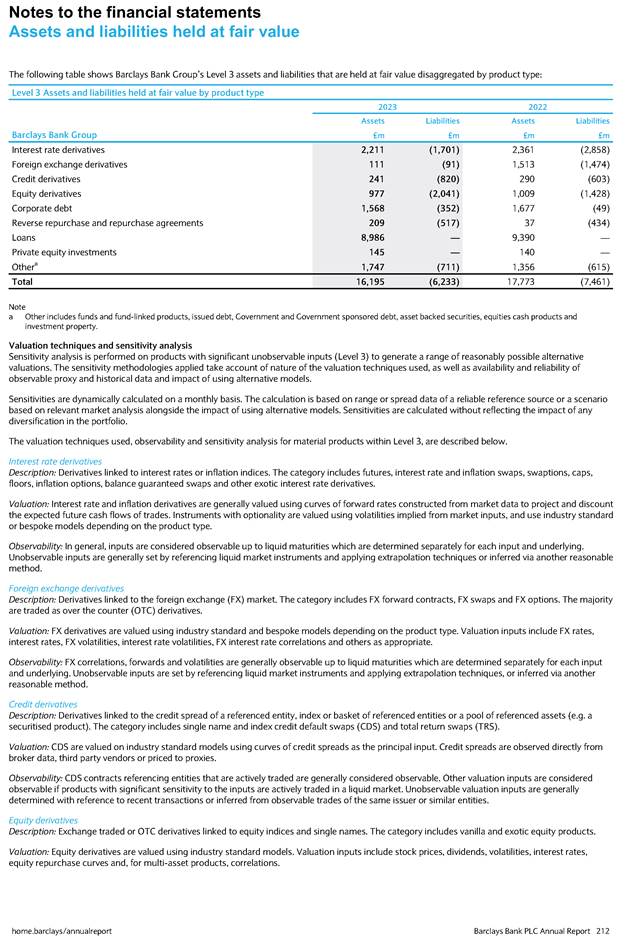
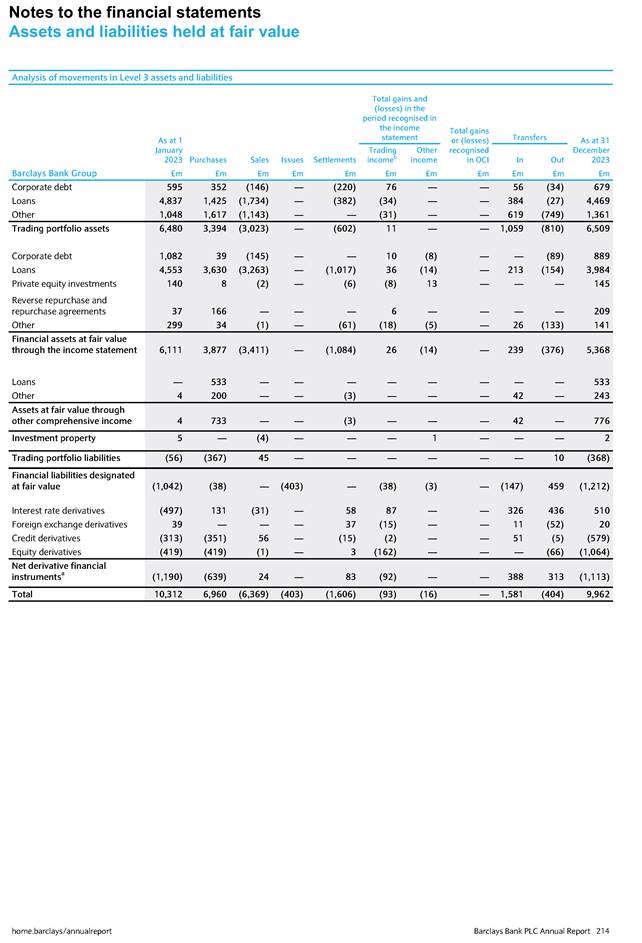
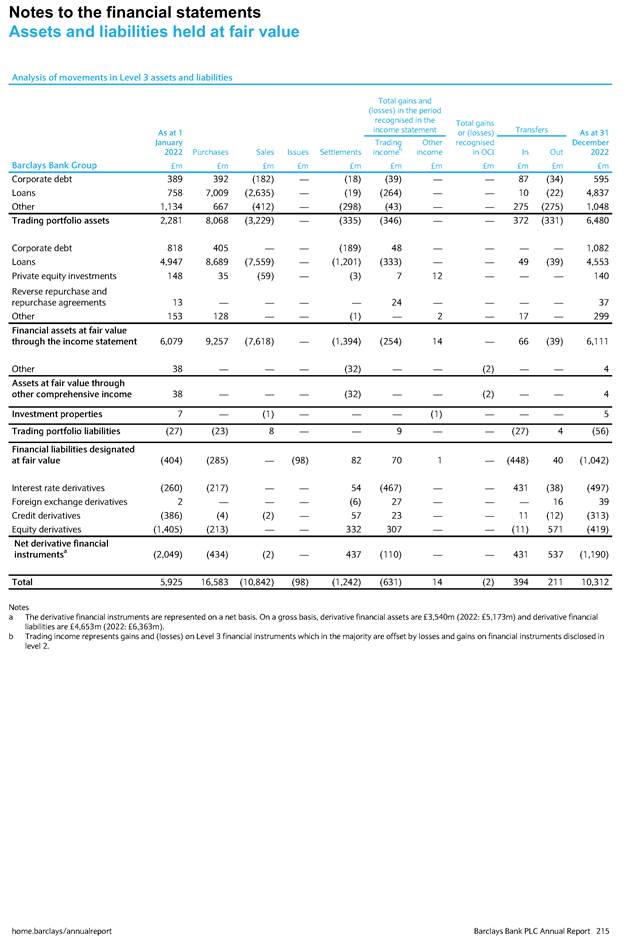
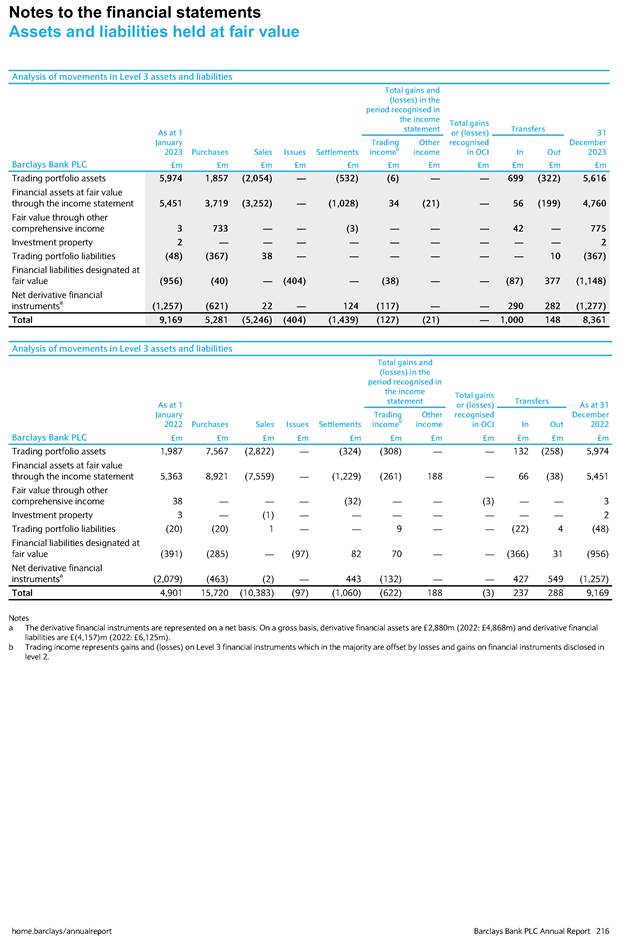
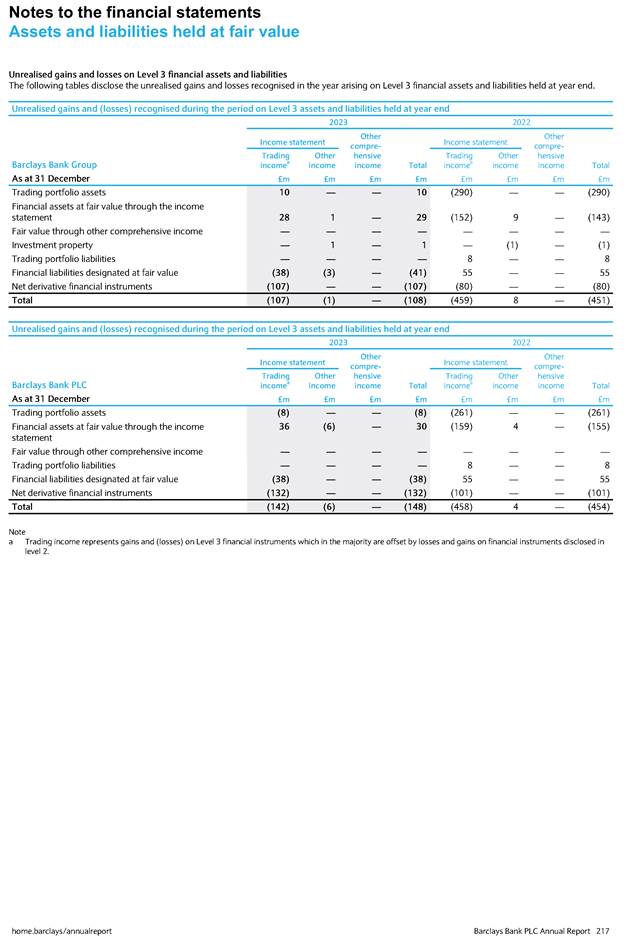
| 公正価値で測定するレベル3資産(注記16) | 162億 ポンド | 178億 ポンド | |||
| 公正価値で測定するレベル3負債(注記16) | 62億 ポンド | 75億 ポンド | |||
| 親会社: 公正価値で測定するレベル2資産*(注記16) | 5,540億 ポンド | 5,690億 ポンド | |||
| 公正価値で測定するレベル2負債*(注記16) | 5,830億 ポンド | 5,610億 ポンド | |||
| 公正価値で測定するレベル3資産(注記16) | 140億 ポンド | 163億 ポンド | |||
| 公正価値で測定するレベル3負債(注記16) | 57億 ポンド | 71億 ポンド | |||
| *レベル3のポートフォリオに加えて、これらの残高に含まれる1つのレベル2のデリバティブ・ポートフォリオと、デリバティブ評価に対する特定の評価調整が、私どもが特定した監査上の主要な検討事項に関連しており、私どもは、その双方について、測定にはより困難を伴うと考えている。 | |||||
| 監査上の主要な検討事項の説明 | リスクに対する監査上の対応 |
|---|---|
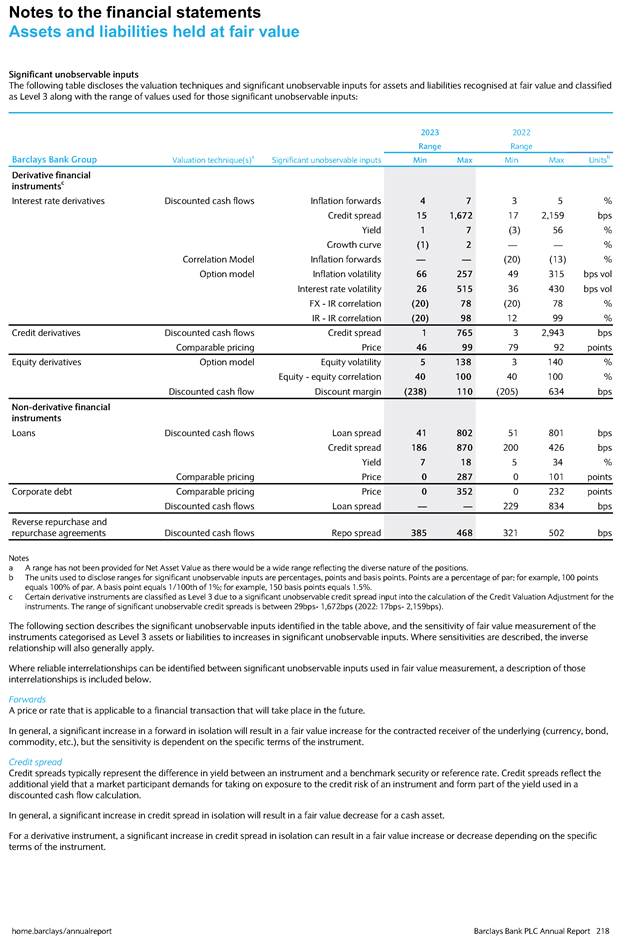
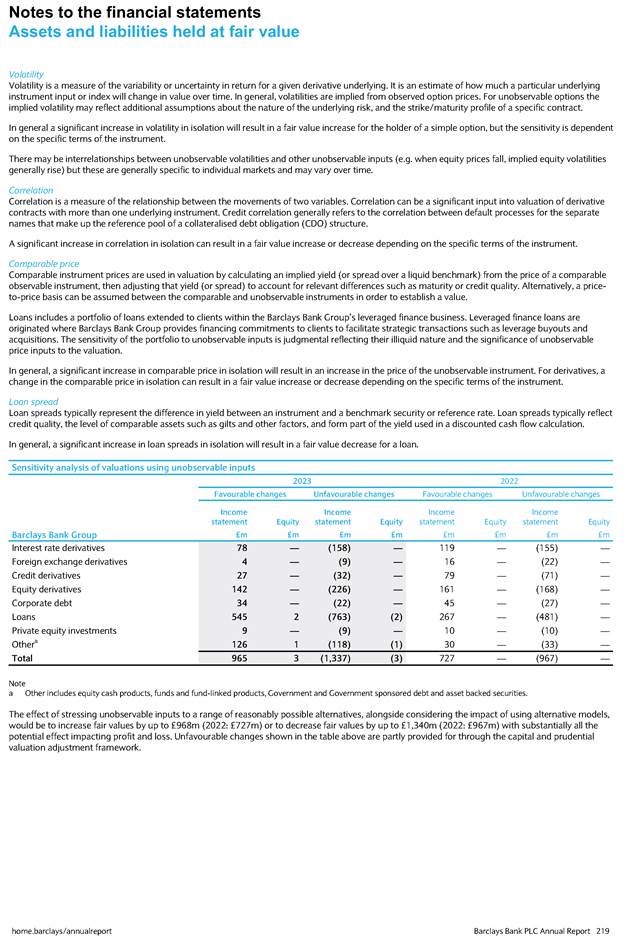
| 主観的な評価 グループおよび親会社の金融商品の公正価値は、評価モデルの選定、価格決定に係るインプット、ならびに公正価値調整(以下「FVA」という。)、信用価値調整、担保価値評価調整および資金調達価値調整(以下、これらの調整を「各種評価調整」と総称する。)といったモデル適用後の価格決定に係る調整に関して、グループによる重要な判断を伴う可能性のある評価技法を用いて算定されている。 価格決定に関する重要なインプットが観察不能な場合、経営陣が公正価値測定に利用可能な信頼できる関連市場データの入手が限定されるため、見積りに伴う不確実性が高まる可能性がある。これらの金融商品はレベル3に分類され、レベル2と3のどちらに分類するかの基準に係る内部統制は経営陣が整備している。このため、レベル3のポートフォリオに関する私どもの重要な監査リスクは、主に、こうした観察不能なインプットによるものである。 また、レベル2のポートフォリオについては、特に、モデル化された評価技法の使用により評価上重大な制約が生じる場合や、適切な価格決定手法の選定に伴う不確実性が高いため、市場における商品の評価に複数の手法を使用する可能性がある場合、評価に複雑性が伴う場合がある。 私どもは、上記の複雑性を伴う領域として以下の2つを特定した。1つ目は、商品に関連するモデル化に伴う複雑性により、レベル2の評価がより困難であると考えるデリバティブ・ポートフォリオで、2つ目は、無担保デリバティブおよび一部担保付デリバティブ評価に対する各種評価調整である。 上記の事項がもたらす影響により、私どもは、リスク評価の一環として、レベル3のポートフォリオと測定がより困難なレベル2のポートフォリオの公正価値測定における主観的な見積りは高度な不確実性を伴うものであり、合理的な見積りの範囲が財務書類全体の重要性の基準値を超えるか、場合によってはその何倍にもなる可能性があると判断した。グループおよび親会社によるレベル3のポートフォリオにおける感応度の見積りは、財務書類(注記16)に開示されている。 開示の質 レベル3のポートフォリオについての開示は、評価技法、重要な判断、仮定および重要なインプットの説明として重要である。 | リスクに対応するために実施した手続き リスク評価手続き:私どもは、監査期間を通じて、グループおよび親会社の財務書類の該当残高のすべて(すなわち、グループおよび親会社が保有する公正価値で測定する金融商品のすべて)を対象に、詳細なリスク評価手続きを実施した。私どもは、リスク評価の一環として、重要な虚偽表示リスク(観察不能なインプットまたは複雑なモデルのいずれかにより、公正価値測定に関する重要な判断から生じる重要な虚偽表示リスクを含む)を伴うポートフォリオおよび関連する評価インプットを特定した。 内部統制評価:私どもは、経営陣の評価委員会に年間を通じて参加して協議を観察したほか、評価がより困難な公正価値で測定する金融商品の評価に関する議題といった評価委員会の議題を批判的に検証した。 私どもは、エンド・ツー・エンドの業務プロセスのウォークスルー手続きを実施して、評価プロセスに用いられている主要なシステム、アプリケーションおよび内部統制を特定した。私どもは、特に上記のポートフォリオに係るキーコントロールの整備状況および運用状況の有効性を評価した。 私どもの内部統制評価手続きには、主に、以下の事項に係るキーコントロールの整備および実施状況ならびに運用状況の有効性評価が含まれていた。 ・ 内部統制担当部門が実施する独立第三者価格との比較検証(以下「IPV」という。)プロセス。IPV統制の対象となるポジションや評価インプットの網羅性を含む。 ・ (ポートフォリオをビッドまたはオファー価格で評価するための)出口価格調整を含むFVA、モデルに伴う制約に対応するためのモデル欠点補完措置、ならびに各種評価調整 ・ 評価モデルの検証、網羅性、導入および使用(これには、モデルに伴う制約や仮定に係る内部統制も含まれる) 私どもの評価専門家:私どもは、以下の手続きにおいて監査人として利用する評価専門家の検証結果を利用した。 ・ 公正価値で測定する金融商品のサンプルを対象とした公正価値の独自の再計算と、経営陣の公正価値測定の結果が監査人の許容値を超えている場合のより批判的な検証 ・ 業界慣行との比較を含む、公正価値計算、リスク・エクスポージャー、ならびにFVAおよび各種評価調整の計算に用いられる重要なモデルや手法の適切性に対する批判的な検証 矛盾する証拠の評価:私どもは、経営陣の内部統制を通じて特定された担保評価額の不一致のあったサンプルについて、経営陣の公正価値測定結果と取引相手である市場参加者による公正価値との間に重大な差異が観察できる場合に、当該不一致が調査、解消された証拠を検証することにより、経営陣による評価を批判的に検証した。また私どもは、担保評価額の不一致に係るデータを利用し、市場取引相手による公正価値との間に重要な差異が存在する公正価値で測定する金融商品を特定し、当該商品を対象に公正価値の再計算を独自に実施した。 変動の通査:私どもは、レベル3のポジションから生じたトレーディング収益勘定を通査し、重要な損益がトレーディング損益として会計基準に準ずるものかどうかを評価した。 過去との比較:私どもは、監査期間中に生じた公正価値で測定する新たな金融商品、ポジション解消および条件変更のサンプルについて、重要な損益を通査することで遡及的なレビューを実施し、これらのデータが、既存の公正価値測定手法の中に織り込まれていない公正価値の構成要素の存在を示唆していないかどうかを評価した。また私どもは、監査期間中における観察不能なインプットの変動を通査し、発生した損益を批判的に検証した。 透明性の評価:私どもは、グループおよび親会社の財務書類におけるレベル3のポートフォリオに関する開示が、関連する会計基準に照らして十分なものかどうかを評価した。 |
バークレイズ・ピーエルシーの取締役会監査委員会とのコミュニケーション 私どもは、以下を含む事項について取締役会監査委員会と協議し、同会に報告した。 ・ レベル3の金融資産および負債と測定がより困難なレベル2の金融資産および負債の公正価値測定を対象とする私どもの監査アプローチ(これには、私どもが実施したリスク評価、内部統制評価手続きおよび実証手続きの詳細も含まれる) ・ グループの公正価値測定手法、モデル、価格決定に係るインプットおよび公正価値調整の適切性に関する私どもの結論 監査人による独自の判断が必要な領域 私どもは、以下の領域を、監査人による独自の判断が必要な領域とした。 ・ レベル3の金融商品および測定がより困難なレベル2の金融商品の公正価値測定(特に、市場データインプットや評価モデルのサンプル)の妥当性 私どもの手続きの結果 私どもは、特定したリスクや実施した手続きの結果に基づき、認識したレベル3の金融資産および負債と、測定がより困難なレベル2の金融資産および負債の公正価値や、関連する開示は許容可能なものであると判断した(2022年度の結果:許容可能なものである)。
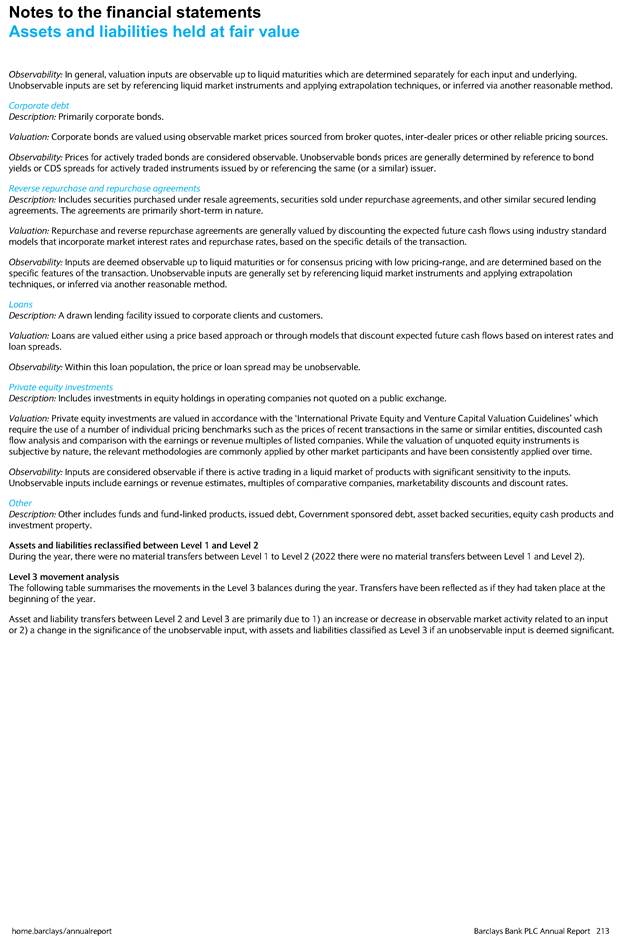
年次報告書(原文)により詳しい説明がある事項:取締役会監査委員会がなぜ公正価値測定を重点領域としたかに関する詳細については、年次報告書(原文)の19ページから20ページの取締役会監査委員会報告書(原文)を、金融資産および負債の会計方針については210ページを、また財務開示については210ページから222ページにある注記16「金融商品の公正価値」をそれぞれ参照のこと。
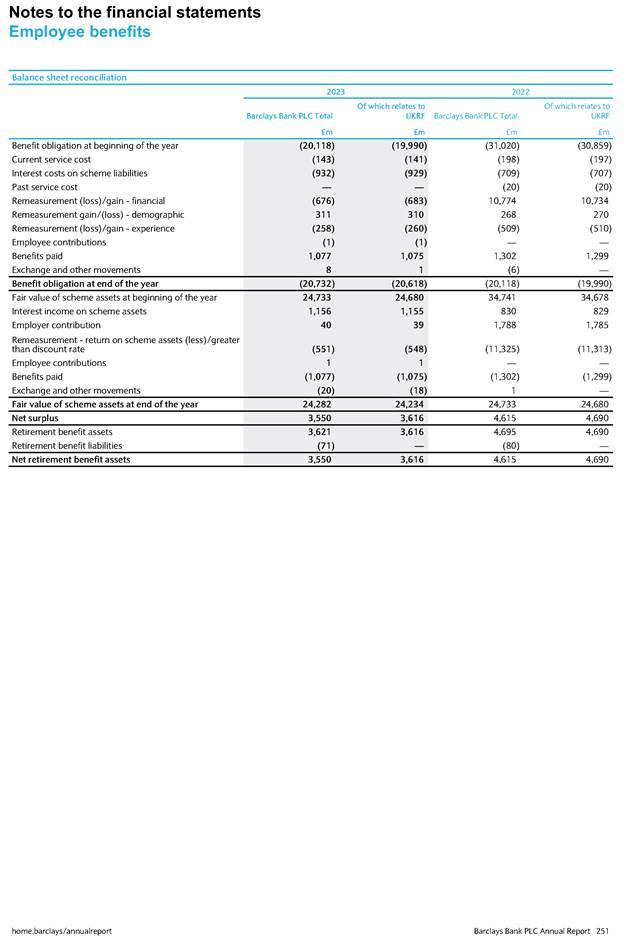
4.3. 英国退職基金(UKRF)に係る確定給付年金債務総額の評価
| 財務書類計上額 | 私どものリスク評価 (2022年度比) | 私どもの手続きの結果 | |||
| 2023年度 | 2022年度 | ||||
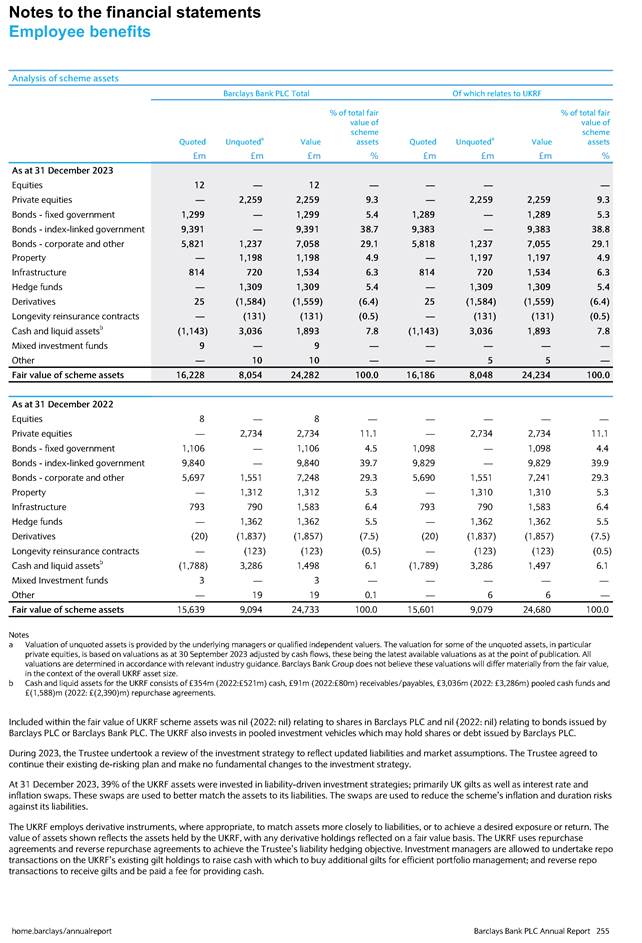
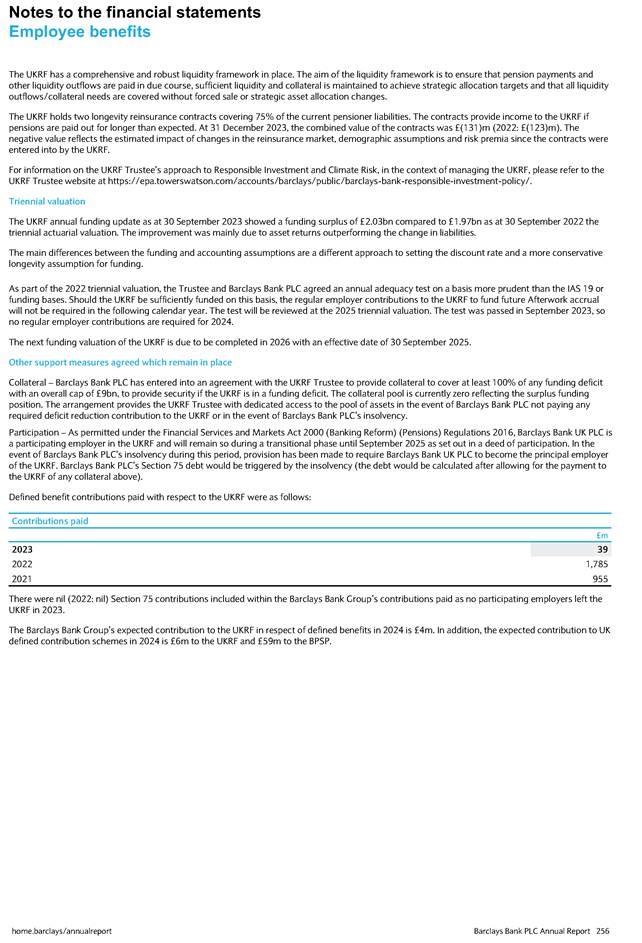
| UKRFに関する確定給付債務 - グループおよび親会社(注記30) | 206億ポンド | 200億ポンド | ←→ | 私どもの評価結果によると、該当リスクは2022年度と同水準である。 | 2023年度:許容可能 2022年度:許容可能 |
| 監査上の主要な検討事項の説明 | リスクに対する監査上の対応 |
|---|---|
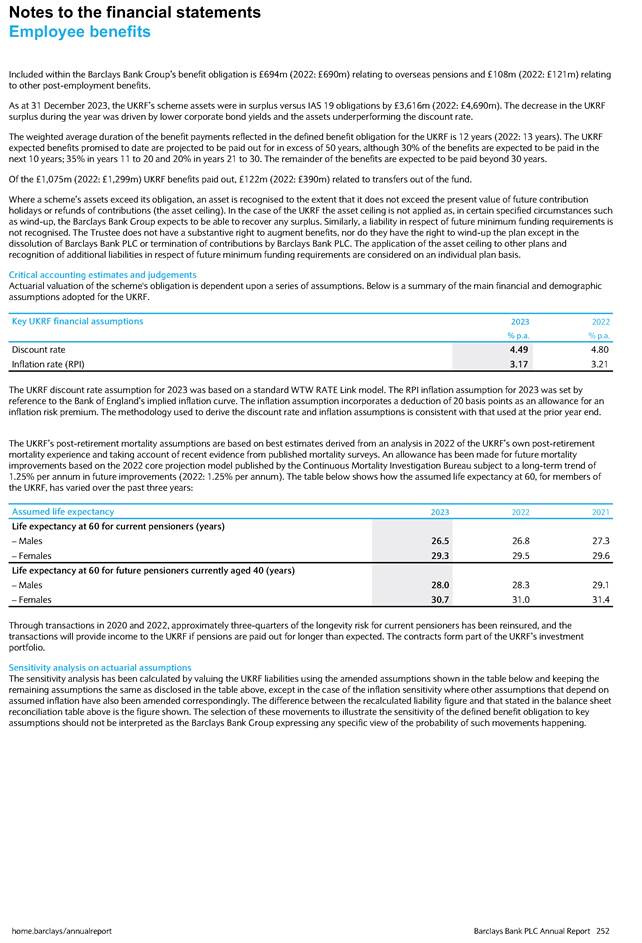
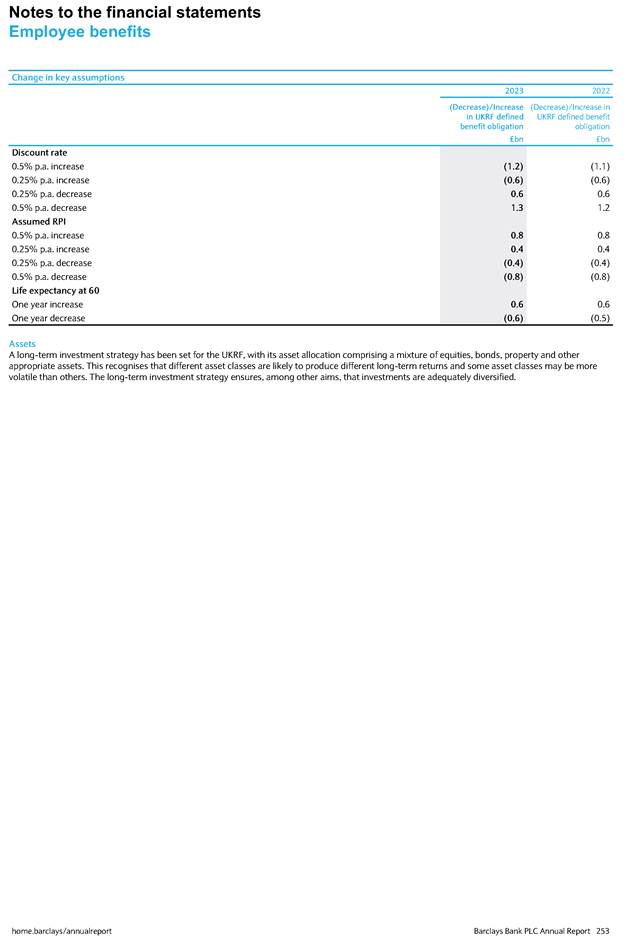
| 主観的な評価 UKRFに係る確定給付債務の評価は、割引率、小売物価指数(以下「RPI」という。)および死亡率に関する仮定を含む、年金数理計算上の仮定の影響を受ける。これらの仮定は、僅少な変動であっても、確定給付債務の測定に重大な影響を及ぼす可能性がある。 私どもは、リスク評価の一環として、確定給付債務は、その見積りに高度な不確実性を伴うものであり、合理的な見積りの範囲が財務書類全体の重要性の基準値を超えるか、場合によってはその何倍にもなる可能性があると判断した。 開示の質 グループおよび親会社によるIAS第19号の適用に関する開示(仮定や見積りに伴う不確実性の原因に関する開示を含む)は、IAS第19号に基づく確定給付債務の計算における重要な判断の説明として重要である。 | リスクに対応するために実施した手続き 内部統制評価:私どもは、エンド・ツー・エンドの業務プロセスのウォークスルー手続きを実施して、確定給付債務測定プロセスに用いられる主要なシステム、アプリケーションおよび内部統制を特定した。私どもは、上記のプロセスに係るキーコントロールの整備状況および運用状況の有効性を評価し、これには以下が含まれる。 ・ 割引率、RPIおよび死亡率に関する仮定といった、IAS第19号に基づく仮定に対する経営陣のレビューに係る内部統制 ・ IAS第19号に基づく開示と基礎となるデータの調整に係る内部統制 経営陣が関与させた専門家の評価:私どもは、経営陣が確定給付債務の評価に関与させた年金数理人の客観性や能力を評価した。 私どもの年金数理人:私どもは、以下の手続きにおいて年金数理人を利用した。 ・ 数理計算上の主要な仮定の決定において、経営陣自身および経営陣が関与させた年金数理人が下した判断、ならび手法の適切性の評価 ・ バークレイズ・バンク・ピーエルシーが用いた仮定と、市場で観察可能な指数や市場経験に基づき、私どもが独自に算出した範囲の期待値との比較 透明性の評価:私どもは、グループおよび親会社の財務書類における開示が、関連会計基準に照らして十分なものかどうかを評価した。 |
| バークレイズ・バンク・ピーエルシーの取締役会監査委員会とのコミュニケーション 私どもは、以下を含む事項について、取締役会監査委員会と協議し、同会に報告した。 ・ 私どもが、年金資産の評価を監査上の主要な検討事項に含めていない根拠を含め、確定給付債務の評価を監査上の主要な検討事項としている理由 ・ 私どもは、専門家を利用して経営陣による年金数理計算の重要な要素の批判的検証を含め、監査上の主要な検討事項への監査上の対応についても協議した。 監査人による独自の判断が必要な領域 私どもは、以下の領域を、監査人による独自の判断が必要な領域とした。 ・ グループおよび親会社が用いた年金数理計算上の仮定(割引率、小売物価指数および死亡率に関する仮定を含む)の評価にあたり監査人が行う、主観的かつ複雑な判断 私どもの手続きの結果 私どもは、特定したリスクや実施した手続きの結果に基づき、UKRFに係る確定給付年金債務総額の評価や関連する開示は許容可能なものであると判断した(2022年度の結果:許容可能なものである)。 |
|---|
年次報告書(原文)により詳しい説明がある事項:確定給付制度の会計方針については年次報告書(原文)の249ページを、また財務上の開示については249ページから256ページにある注記30「年金および退職後給付」をそれぞれ参照のこと。
4.4. ユーザー・アクセス管理
| 財務書類計上額 | 私どものリスク評価 (2022年度比) | 私どもの手続きの結果 | |
| ユーザー・アクセス管理は、財務書類全般に影響を及ぼす可能性がある。 | 2023年度および2022年度: | ||
| ←→ | 私どもの評価結果によると、該当リスクは2022年度と同水準である。 | 私どもの手続きにより、立案した詳細テストの範囲を大幅に拡大しなければならなくなるような、財務報告システムへの不正アクセスは特定されなかった。 | |
| 監査上の主要な検討事項の説明 | リスクに対する監査上の対応 |
|---|---|
| 内部統制の有効性 複数の国で広範な商品やサービスを提供するという事業の性質上、大規模かつ複雑なITインフラが必要となり、財務報告プロセスや関連する内部統制にも影響を及ぼす。 ユーザー・アクセス管理に係る内部統制は、システムへのアクセスならびにシステムおよびデータの変更の双方が承認され適切であることを保証するためのIT環境に不可欠な要素である。私どもの監査アプローチは、ITアクセス管理に係る内部統制の有効性に依拠するものである。私どもは、監査手続きの実施により、財務報告システムへのITアクセスに係る内部統制の不備を検出した。 より具体的には、過年度に特定された内部統制の不備は、システム・コンポーネント上で特権ユーザーが実行している処理の監視に関して、引き続き存在している。経営陣は、上記の不備を是正するための継続的なプログラムを設けている。 上記の不備は、当年度中も存在していたため、私どもは、財務報告に係る自動化された内部統制が無断で変更されるリスクに対応するための追加的手続き(経営陣が導入した補完的内部統制の評価等)を実施した。 | リスクに対応するために実施した手続き 内部統制評価:私どもは、財務書類における重要な残高に関する自動化された内部統制の整備状況、実施状況および運用状況の有効性を評価した。私どもは、以下を含むユーザー・アクセス管理に係る予防的および発見的IT全般統制の整備状況および運用状況の有効性も評価した。 ・ 新入社員に対するアクセス権の付与 ・ ユーザー・アクセス権の適時削除 ・ ユーザーによる処理のログや監視 ・ 特権ユーザー・アクセスの管理や監視 ・ 開発者による取引情報や残高情報へのアクセス ・ 職務の分離 ・ ユーザー・アクセス権の再設定 ・ システムおよびデータに変更を加えるようなアクセスの制限 私どもは、不正処理に関する私どもの評価を裏付けるため、追加の発見的および補完的内部統制が要求される精度で運用されているかどうかを評価するための手続きを実施し、経営陣による発見的統制を評価した。 |
| バークレイズ・バンク・ピーエルシーの取締役会監査委員会とのコミュニケーション 私どもは、以下を含む事項について取締役会監査委員会と協議し、同会に報告した。 ・ 監査上の主要な検討事項に対する私どもの対応 監査人による独自の判断が必要な領域 私どもは、以下の領域を、監査人による独自の判断が必要な領域とした。 ・ ユーザー・アクセス管理に係る内部統制が有効に整備、実施および運用されているかどうかの評価に関する監査上の主要な検討事項。他に特定された監査上の主要な検討事項と比較して、監査人の判断は限定的である。 私どもの手続きの結果 特定したリスクや実施した手続きの結果に基づき、立案した詳細テストの範囲を大幅に拡大しなければならなくなるような、財務報告システムへの不正アクセスは特定されなかった。 |
|---|
私どもは、親会社による子会社への投資の回収可能性に関する手続きを引き続き実施していく。しかしながら、前年度に存在していた減損を示唆する要因が当年度にはないことを勘案し、これを2023年度監査における最も重要なリスクの一つとして評価していないため、当年度の監査報告書において個別に特定していない。
5. 私どもの異常検出能力と当該事項への対応
| 不正 - 不正による重要な虚偽表示リスクの特定と当該リスクへの対応 | |
| 不正リスク評価 | 不正による重要な虚偽表示リスク(以下「不正リスク」という。)を特定するため、私どもは、不正による虚偽表示が生じやすくなる動機もしくはプレッシャー、または不正による虚偽表示を行いうる機会を示唆する事象もしくは状況の有無を評価した。 私どもは、このリスク評価において、以下の事項を検討した。 ・ 当年度を通じて、グループリスク管理部門長、グループ法令遵守管理部門長およびグループ法務部門長と会合し、バークレイズ・バンク・ピーエルシー内部での職業倫理および法令遵守状況を検査した結果 ・ 営業マネージャー、内部監査担当者および取締役会監査委員会に対して質問し、以下の事項に関するグループ全体の方針や手続きの大枠が記載される方針書の内容を検査した結果 ・ 不正リスクの検出および対応や、グループによる実際の不正、不正の疑いまたは不正の申立てに関する認識の有無 ・ 不正に関するリスクを軽減するための内部統制(リモート/ハイブリッド勤務の状況下における内部統制運用に伴う内部統制の変更の適切性やその影響を含む) ・ グループの報酬方針や、報酬および賞与の水準を決定する主要な要素 ・ 財務書類における不正はどのように、どこで起こり得るかや、不正の兆候を示す事象についてエンゲージメント・チーム内で協議した結果。当エンゲージメント・チームには、不正リスクの発生可能性に関する十分な協議が適切に実施できるほど銀行監査の幅広い経験を有する監査パートナーやスタッフが含まれている。また、上記の協議には監査人独自のフォレンジック専門家も関与させ、グループおよび親会社の状況に関する協議の結果に基づき、不正リスクの特定にあたり支援を受けた。これには、グループと同種のセクターや業界で生じている不正のスキームに関する検討も含まれた。フォレンジック専門家は、不正リスク評価に関する初回の協議に参加した。また私どもは、当該専門家から追加の助言を得る必要がある場合には、その都度相談した。 |
| 不正リスクに 関するコミュニケーション | 私どもは、特定した不正リスクについて監査チーム内で共有しつつ、監査期間を通じて不正の兆候を示唆する状況を引き続き注視した。これには、グループ・レベルで特定された不正リスクをグループ監査チームから構成単位の監査チームへ伝達することが含まれる。 |
| 不正リスクと 私どもの不正 リスク対応手続き | 私どもは、4つの不正リスクを特定し、構成単位の監査チームに伝達した。特定した不正リスクの性質は、前年度とほぼ同様である。私どもが特定した不正リスクは、以下の通りである。 1) IFRS第9号に基づくECLの見積り:経営陣の主観的な判断を伴う、ECL引当金の定性的な調整 2) 評価:レベル3の金融商品の公正価値測定に用いられる、観察不能な価格インプットに関するリスク 3) コンファーム未了の店頭相対デリバティブの実在性および正確性 4) ISA(英国)に準拠したすべての監査において必須とされている、経営陣による内部統制の無効化リスク 監査基準の要求事項と、統制環境に関する私どもの全般的な知識に基づき、私どもは、上記の各リスク、グループおよび構成単位の経営陣が不適切な会計仕訳入力を行わねばならない立場に置かれるリスク、会計上の見積りや判断の際に偏向が生じるリスクに対応するための手続きを実施した。当年度の監査において、グループ全体の収益認識に関連する重大な不正リスクは特定されなかった。 私どもの監査手続きには、関連内部統制の整備状況、実施状況および運用状況の有効性評価の手続き、重要な会計上の見積りにおける経営陣の偏向の有無を評価する手続き、不正リスクに対応するための実証手続きが含まれた。 また上記の手続きには、リスク・クライテリアを設定しテスト対象の仕訳の抽出を行い、抽出された仕訳に対し証憑突合によるテストを実施することが含まれる。 監査における予測不可能性の組み込み:監査基準は、私どもが、意図的に予想外の手続き、またバークレイズ・バンク・ピーエルシーの経営陣が合理的には予測し得ない手続きを実施することを求めている。例えば、私どもは、経営陣による内部統制の無効化リスクが高い仕訳の抽出基準を毎年更新し、抽出基準の予測ができないようにしている。仕訳以外では、抽出した公正価値で測定する金融商品のサンプルについて、期中のある月において、公正価値を独自に再計算することにより、私どもの監査手続きに予測不可能性の要素を組み込んでいる。 |
| 監査上の主要な 検討事項との関連性 | ECLや金融商品の公正価値に関して特定された不正リスクに対応するために私どもが実施した手続きの詳細は、当報告書の、監査上の主要な検討事項に関するセクション4.1および4.2に記載されている。当該セクションに記載の見積りに関する手続きは、不正リスクにも対応した手続きである。 |
| 法令 - 法令違反による重要な虚偽表示リスクの特定と当該リスクへの対応 | |
| リスク評価 | 私どもは、財務書類に重要な影響を及ぼすと合理的に予想し得る法令の領域を特定した。このリスク評価において、以下の事項を検討した。 ・ 商取引全般や各セクターに関する私どもの経験 ・ 取締役やその他経営陣に対する質問の結果(監査基準の要求事項) ・ グループと規制当局や司法機関の間での主要なやり取りについて通査した結果 ・ 法令遵守に関する方針や手続きについて通査した結果 ・ グループの外部顧問弁護士と関連事項について協議した結果 ・ 英国健全性監督機構、英国金融行為監督機構、米国連邦準備制度理事会、米国連邦預金保険公社および合同監督チームを含む、グループの主要な規制監督当局と関連事項について協議した結果 ・ 法令違反リスクや、当該リスクを軽減するために整備している内部統制についてグループ自身が実施した評価の結果。この評価は、取締役会が検討および承認したものである。 また、私どものリスク評価においては、当年度中に生じた、グループによる法令違反やグループに対する強制措置(特に、財務書類に重要な影響を及ぼすものになると合理的に予想し得る違反や措置)も検討した。 グループは高度に規制された環境で事業を運営しているため、私どもの重要な虚偽表示リスク評価においては、規制要件の充足を保証するためのグループ全体での手続きを含む統制環境も検討した。私どもの評価には、整備される主要な枠組み、方針および基準の通査、当該枠組み、方針および基準の策定において法令遵守管理部門が果たしている役割の理解および評価、法令遵守状況の監視、ならびに内部告発や苦情に係る内部統制の評価手続きも含まれた。 |
| リスクに関するコミュニケーション | 私どもは、特定した法令違反リスクについて監査チーム内で共有し、監査期間を通じて法令違反の兆候を示唆する状況を注視した。これには、グループ・レベルで特定された関連法令違反リスクをグループ監査チームから構成単位の監査チームへ伝達することが含まれる。 |
| 財務書類に直接的 な影響を及ぼす 法令の内容と 監査との関連性 | 上記の法令が財務書類に及ぼし得る影響は非常に広範にわたる。 初めに、グループは、財務書類に直接的な影響を及ぼす法令に従う必要があり、これには以下の法令が含まれる。 ・ 財務報告に関する法令(関連する会社に関する法令を含む) ・ 配当可能利益に関する法令 ・ 租税に関する法令(直接および間接) 私どもは、該当する財務書類項目を対象とする手続きの一環として、上記法令の遵守状況を評価した。 |
| 財務書類に間接的 な影響を及ぼす 最も重要な法令 | 次に、グループは、法令違反により財務書類上の金額または開示事項に重要な影響が及ぶ可能性がある、上記以外の多数の法令にも従う必要がある。具体的には、当該影響には、グループに対する罰金賦科、賠償金もしくは訴訟提起、または所定の法律違反により該当国では事業運営ができなくなる可能性がある場合の営業許可の取り消しが含まれる。 私どもは、以下の法令を、上記の影響をグループに及ぼす可能性が最も高い法令として特定した。 ・ 規制上の自己資本や流動性に係る要件に関する特定の法令 ・ 証券発行法を含む、銀行業務に関するその他の法令 ・ 顧客に関する行動規範 ・ マネー・ロンダリング ・ 制裁対象一覧や金融犯罪 ・ 市場阻害行為規制 ・ グループの事業活動の金融上および規制上の性質を規制する特定の会社関連法 監査基準により、法令違反の特定に必要な監査手続きが、取締役やその他経営陣に対する質問や(該当する場合)規制当局や司法機関との主要なやり取りの通査に限定される。営業規制に反する行為が私どもに開示されない場合や、関連するコミュニケーションの内容から必要な証拠を得られない場合は、監査を実施しても法令違反を検出できない。 |
| 監査上の対応 | 注記24に開示されている、法律、競争および規制に関する事項について、私どもは、バークレイズ・バンク・ピーエルシーの内部顧問弁護士に対する質問や、会議の議事録および規制当局とのやり取りの内容の通査を含む監査手続きを実施した。上記事項のうち、より重要であると私どもが判断した事項については、バークレイズ・バンク・ピーエルシーの外部顧問弁護士に対して質問し、当該弁護士から弁護士確認状に対する回答を得た。 注記24に開示されているコンダクト・リスクに関する規制対象事項については、規制当局とのやり取りの内容の通査、グループの主な規制当局に対する独自の質問、認識されているコンダクト・リスク引当金について特定された重要な虚偽表示リスクに対応するための手続きを含む監査手続きを実施した。 |
| 不正または法令違反を検出するための監査の能力に影響を及ぼす事象 | 監査の固有の限界により、私どもの監査には、適用監査基準に従って監査を適切に計画および実施したとしても、財務書類における重要な虚偽表示を検出できない可能性があるという避けられないリスクがある。具体的には、法令違反が財務書類に反映される事象や取引から乖離すればするほど、監査基準での固有の限界により手続きが当該違反を特定できる可能性はより低くなる。 また、他の監査同様、監査の対象は通謀、偽造、意図的な省略、不実記載または内部統制の無効化を伴う可能性があるため、監査において不正を検出できないリスクはより高い状況にある。私どもの監査手続きは、重要な虚偽表示を検出できるように策定されているが、私どもは法令違反または不正を防止する責任を有してはおらず、あらゆる法令違反の検出を私どもに対し期待することはできない。 |
6. 重要性の基準値の決定
私どもの監査の範囲は、私どもが適用する重要性の基準値の影響を受ける。私どもは、定量的な閾値を設定し、また、定性的な検討の結果に基づき、監査の範囲ならびに監査手続きの内容、実施時期および範囲の決定、また、虚偽表示が個別にまた集計した場合に財務書類全体に及ぼす影響の評価に使用した。
| グループの財務書類全体の重要性の基準値 2023年度:230百万ポンド 2022年度:170百万ポンド | 定義 監査計画の策定や実施のための定量的な閾値。 |
| 重要性の基準値の決定の根拠と判断 私どもは、バークレイズ・バンク・ピーエルシー・グループの財務書類全体の重要性の基準値を230百万ポンド(2022年度:170百万ポンド)に決定した。 私どもは、税引前利益が引き続き、バークレイズ・バンク・ピーエルシー・グループの主要なベンチマークであると判断した。私どもは、基本財務書類における指標のうち税引前利益が、財務書類利用者の着目点を最もよく反映するものであることから、税引前利益をベンチマークとして選択した。2023年度において、バークレイズ・バンク・ピーエルシーは、年次報告書(原文)の4ページで開示されている通り、第4四半期に講じた措置により458百万ポンドという多額の追加費用を計上した。これらは将来の利益を獲得するための一時的な費用であると考えられる。私どもはこれらの費用の性質を勘案し、これらの項目がグループの通常の継続事業を表すものではないことから、これらの項目を戻し入れ、税引前利益を正常化した。そのため、2023年度のグループの財務書類全体の重要性の基準値は、グループの正常化された税引前利益4,681百万ポンド(2022年度:4,867百万ポンド)に基づいている。 私どもは、正常化された税引前利益に一定割合を適用して、グループの財務書類全体の重要性の基準値を230百万ポンド(2022年度:170百万ポンド)と算定した。利益に関連する測定指標を用いて財務書類全体の重要性の基準値を決定する場合にケーピーエムジーが用いるアプローチは、当該指標に3%から5%の割合を適用するというものである。私どもは、財務書類全体の重要性の基準値を決定するにあたり、ベンチマークに4.9%(2022年度:3.5%)の割合を適用した。 親会社の財務書類全体の重要性の基準値は、ベンチマークとして参照した親会社の税引前利益に基づき、140百万ポンド(2022年度:130百万ポンド)に設定された(税引前利益の4.7%(2022年度:税引前利益の4.7%)に相当する)。 |
| 手続実施上の 重要性の基準値 2023年度:149百万ポンド 2022年度:111百万ポンド | 定義 個々の勘定残高や開示事項を対象とする私どもの手続きは、個々の勘定残高レベルでは重要でない虚偽表示が、集計すると財務書類全体で重要な金額となるリスクを許容可能な水準に抑えるために、より低い閾値である手続実施上の重要性の基準値を用いて実施された。 |
| 手続実施上の重要性の基準値の決定の根拠と判断 私どもは、手続実施上の重要性の基準値について、バークレイズ・バンク・ピーエルシー・グループの財務書類全体の重要性の基準値の65%(2022年度:65%)が適切であると判断した。 親会社の手続実施上の重要性の基準値は91百万ポンド(2022年度:85百万ポンド)(親会社の財務書類全体の重要性の基準値の65%(2022年度:65%)に相当する)に設定した。 私どもは、手続実施上の重要性の基準値の決定にあたり、過年度において明らかとなった内部統制の不備の水準に基づき、上記の割合を適用した。 |
| 未修正の虚偽表示基準値 2023年度:11百万ポンド 2022年度: 8百万ポンド | 定義 この金額を下回る場合、「定量的観点から、明らかに僅少であるとみなされる虚偽表示」と判断される。私どもは、この閾値を下回る差異であるものの、私どもの監査手続きの内容、実施時期および範囲の変更理由になり得る差異を特定する場合もあり、例えば、少額の差異ではあるが不正を示唆する場合がある。 この閾値を上回る差異が特定された場合には、その差異はすべてバークレイズ・バンク・ピーエルシーの取締役会監査委員会に伝達される。 |
| 未修正の虚偽表示基準値の決定の根拠と判断 未修正の虚偽表示基準値は、バークレイズ・バンク・ピーエルシー・グループの財務書類全体の重要性の基準値の5%(2022年度:5%)に設定された。 私どもはまた、定性的な観点から報告の必要があると判断したその他に特定された虚偽表示についても、取締役会監査委員会に報告した。 |
グループの財務書類全体の重要性の基準値である230百万ポンド(2022年度:170百万ポンド)と、主要な財務書類勘定残高は以下の通りである。
| 収益合計 | 資産合計 | 純資産 | ||||
| 2023年度 | 2022年度 | 2023年度 | 2022年度 | 2023年度 | 2022年度 | |
| 18,268 百万ポンド | 18,194 百万ポンド | 1,185,166 百万ポンド | 1,203,537 百万ポンド | 60,504 百万ポンド | 58,953 百万ポンド | |
| グループの財務書類全体の重要性の基準値が上記の額に占める割合 | 1.26% | 0.93% | 0.02% | 0.01% | 0.38% | 0.29% |
7. 監査の範囲
| グループ監査の 範囲 | 定義 グループ監査チームが、グループ全体で実施する手続きをどのように決定したか。 | ||||||||
| 私どもは、グループの構成単位のうち3つ(2022年度:3つ)を、グループ監査チームによるフル・スコープ監査の対象とした。私どもは、以下のアプローチを採用して3つの構成単位のフル・スコープ監査を実施した。 ・ バークレイズ・バンク・デラウェアとバークレイズ・キャピタル・インクの2つの構成単位については、構成単位監査人に対し、フル・スコープ監査を実施してその結果を報告するよう直接指示した。 ・ フル・スコープ監査対象の3つ目の構成単位であるバークレイズ・バンク・ソーラスについては、グループ監査チームが直接フル・スコープ監査を実施した。 私どもは、グループの構成単位のうち2つ(2022年度:4つ)を、特定勘定残高のみの監査の対象とした。私どもは、バークレイズ・バンク・アイルランド・ピーエルシーとバークレイズ・キャピタル・セキュリティーズ・リミテッドについては、構成単位監査人に対し、特定勘定残高のみを監査してその結果を報告するよう直接指示した。 さらに、グループには他にも多くの構成単位があり、私どもはこれらの構成単位から抽出した特定の勘定残高に対して、リスクに重点を置いた特定の監査手続きを実施した。私どもが手続きを実施した構成要素は、バークレイズ・バンク・ピーエルシー・グループの収益合計の7.75%(2022年度:4.67%)およびグループの資産合計の3.07%(2022年度:2.96%)を占めた。 範囲 構成単位数 適用された重要性の 基準値の範囲 フル・スコープ監査 3 58百万ポンド - 140百万ポンド 特定勘定残高監査 2 40百万ポンド - 48百万ポンド バークレイズ・バンク・ピーエルシーは、グループ全体に係るプロセスの一部をインドのシェアード・サービス・センターに集約しており、そのプロセスのアウトプットは、サービス提供先である報告構成単位の財務情報に含まれているため、サービス提供元は個別の報告構成単位とはみなされない。このサービス・センターを、主に取引の処理、突合およびレビューに係る内部統制の評価手続きを含む、特定の監査手続きの対象とした。また、シェアード・サービス・センターに対して実施した手続きではカバーされない監査リスクに対応するため、特定の報告構成単位に対して追加の手続きが実施された。 グループ監査チームはまた、関連する構成単位監査人の代わりに、以下の領域に含まれる特定の監査手続きも実施した。 ・ ITシステムや自動化された業務処理に係る内部統制の評価手続き ・ 営業費用とグループ間付け替え グループ監査チームは、これらの手続きの結果を、該当する構成単位監査人に伝達した。 私どもはまた、残りの構成単位についてグループ全体での分析を実施し、これらの構成単位にさらなる重要な虚偽表示リスクが存在するかどうかを評価した。 私どもは、監査のすべての領域においてグループが運用していた財務報告に係る内部統制について、私どもの内部統制評価により依拠できるという裏付けが得られた内部統制については依拠することができたため、実証手続きの範囲を減らすことができた。 | 範囲 | 構成単位数 | 適用された重要性の 基準値の範囲 | フル・スコープ監査 | 3 | 58百万ポンド - 140百万ポンド | 特定勘定残高監査 | 2 | 40百万ポンド - 48百万ポンド |
| 範囲 | 構成単位数 | 適用された重要性の 基準値の範囲 | |||||||
| フル・スコープ監査 | 3 | 58百万ポンド - 140百万ポンド | |||||||
| 特定勘定残高監査 | 2 | 40百万ポンド - 48百万ポンド | |||||||
| グループ監査 チームが監督する 業務 | 定義 グループ監査チームが構成単位監査人を関与させる範囲。 | ||||||||
| 当年度の監査においては、グループ監査チームと構成単位監査人との間のコミュニケーションや構成単位監査人による業務の監督を、ハイブリッドで行う体制とした。この体制には、以下の要素が含まれている。 - グループ監査チームが主導して、主要な監査リスクについて協議し、構成単位監査チームや他の関与拠点から必要なインプットを得るための、グローバル監査計画策定会議をロンドンにて実施した。 - グループ監査対象構成単位については、グループ監査チームが直接往査して監査リスクや戦略を評価するか、当該評価をリモートで実施した。監査期間にわたり、私どもは、各構成単位の監査アプローチと監査上の検出事項を理解し批判的に検証するために構成単位の主要な監査調書を通査し、グループ監査チームに報告された検出事項についてより詳しく協議した後に、グループ監査チームが必要であると判断した追加の手続きを構成単位監査人が実施した。 - グループ監査チームが構成単位監査人に対して発行する指示書には、上述の監査上の主要な検討事項やグループ監査チームに報告すべき情報を含む、カバーすべき重要な領域が示された。例えば、グループ監査チームは高リスクな仕訳入力に係る最低限の要件を設定し、監査に一貫して適用された。 - 構成単位の重要性の基準値はすべて、グループ監査チームがレビューおよび承認した。 - 監査の計画策定段階、期中段階および最終段階において、各構成単位監査チームも交えたリスク評価や批判的検証を、グループ・リード・エンゲージメント・パートナーと監査品質担当パートナーが主導して実施した。 - 構成単位監査のアプローチや検出事項の批判的検証ついては、グループ・エンゲージメント・パートナーおよびディレクターと構成単位監査チームによる月次のテレビ会議を行い、また、対面会議、テレビ電話および電子メールで定期的に連絡を取ることで実施した。 - グループ・リード・エンゲージメント・パートナー(兼上級法定監査人)のスチュアート・クリスプが、バークレイズ・ピーエルシーおよびバークレイズ・バンク・ピーエルシーの取締役会監査委員会および取締役会リスク委員会の各回と、バークレイズ・バンクUK、バークレイズ・バンク・ヨーロッパならびにバークレイズ・キャピタル・インクおよびバークレイズ・バンク・デラウェアをカバーする各IHCの取締役会監査委員会に1回以上出席した。 |
8. 年次報告書(原文)におけるその他の情報
取締役は、年次報告書(原文)内に記載されているその他の情報および財務書類に対して責任を有している。私どもの監査意見の対象範囲にはその他の情報は含まれていないため、私どもは下記の内容を除いて、当該その他の情報に対していかなる保証の結論も表明しない。
| その他の情報 | |
| 私どもの責任 私どもの責任は、その他の情報を通読し、通読の過程において、私どもの財務書類監査に基づき、その他の情報に重要な虚偽表示がないか、また、その他の情報と財務書類または私どもが監査の過程で得た知識との間に重要な相違があるかどうかを検討することである。 | 私どもの報告 実施した手続きに基づき、その他の情報に虚偽表示または相違は特定されなかった。 |
| 戦略報告書および取締役報告書 | |
| 私どもの責任と報告 上記その他の情報について実施した手続きに基づき、私どもは以下の事項について報告する。 ・ 戦略報告書および取締役報告書に虚偽表示は特定されなかった。 ・ 私どもの意見では、当年度の戦略報告書および取締役報告書に含まれる情報は財務書類の内容と一致している。 私どもの意見では、これらの報告書は2006年会社法に従って作成されている。 | |
| 私どもが例外的に報告すべきその他の事項 | |
| 私どもの責任 2006年会社法に基づき、私どもの意見において以下に該当する場合には、その旨を報告することが求められる。 ・ 親会社が適正な会計記録を保持していない場合、または私どもが往査していない支店から、私どもが監査の一環として求めた情報として十分な情報が得られていない場合 ・ 親会社の財務書類が、会計記録や得られた情報と一致していない場合 ・ 取締役報酬に関する特定の法定開示が存在しない場合 ・ 私どもが、監査において必要なすべての情報および説明を得られていない場合 | 私どもの報告 左記事項について私どもが報告すべき事項はなかった。 |
9. 欧州単一電子フォーマット(以下「ESEF」という。)
バークレイズ・バンク・ピーエルシーは、連結損益計算書、連結包括利益計算書、連結株主資本等変動計算書、連結貸借対照表および連結キャッシュフロー計算書とこれらに関連する注記からなる連結財務書類を、ESEFで作成している。このフォーマットに関する要件は、単一電子報告フォーマット形式の仕様についての細則に関する欧州委員会委任規則(EU)第2019/815号(以下「ESEF規則」という。)に定められている。
取締役は、ESEF規則に従って財務書類を作成する責任を有する。私どもは、連結財務書類がすべての重要な点においてESEF規則に従い作成されているかどうかについて報告するよう、バークレイズ・バンク・ピーエルシーから依頼を受けた。
私どもは、2023年12月31日現在のグループの連結財務書類が、適用されるESEF規則の要件に従って作成されているかどうかを評価するために、当該連結財務書類を精査した。これは、有効なxHTMLフォーマットの財務書類や、ESEF規則に定められている主要タクソノミや共通規則を用いた連結財務書類のXBRLマークアップに関連するものであった。
私どもの意見では、2023年12月31日現在のバークレイズ・バンク・ピーエルシーの連結財務書類であるbbplc-2023-12-31は、すべての重要な点においてESEF規則の要件に従い作成されている。
- 取締役および監査人の責任
取締役の責任
年次報告書(原文)の27ページで詳述されている通り、取締役は、財務書類が真実かつ公正な概観を与えているという確証を得ることを含めて、財務書類を作成する責任、不正または誤謬による重要な虚偽表示のない財務書類を作成するために必要であると判断した内部統制を整備する責任、グループおよび親会社の継続企業としての存続能力を評価し、必要であれば、継続企業の前提に関する事項について開示する責任、ならびにグループまたは親会社が、清算または事業停止を予定しているか、そうする以外には現実的な代替案がない場合を除き、継続企業の前提に基づき財務書類を作成する責任を有している。
監査人の責任
私どもの目的は、全体としての財務書類に、不正または誤謬による重要な虚偽表示がないかどうかについて合理的な保証を得て、監査意見を表明することにある。合理的な保証は、高い水準の保証であるが、ISA(英国)に準拠して行った監査が、実在するすべての重要な虚偽表示を常に発見することを保証するものではない。虚偽表示は、不正または誤謬から発生する可能性があり、個別にまたは集計すると、財務書類の利用者が財務書類に基づく経済的な意思決定に影響を与えると合理的に見込まれる場合に、重要性があると判断される。
私どもの責任に関する完全な説明は、FRCのウェブサイトであるwww.frc.org.uk/auditorsresponsibi
litiesに掲載されている。
- 監査の目的と私どもが果たす責任の相手
当報告書は、2006年会社法の第16部第3章と、親会社との契約の条件に従い、一機関である会社のメンバーのためだけに作成されたものである。私どもの監査は、監査報告書において会社のメンバーに伝えるべき事項や、会社と合意した条件に従いメンバーに対し伝えるべき追加事項について意見を表明するために実施したものであり、それ以外の目的で実施したものではない。私どもは、監査、当報告書または表明意見について、準拠法が認めている範囲内で、会社や一機関である会社のメンバー以外の者に対するいかなる責任も負わない。
スチュアート・クリスプ
(上級法定監査人)
ケーピーエムジー エルエルピー 法定監査人
勅許会計士
15 カナダスクエア
ロンドン
E14 5GL
2024年2月19日
注:この監査報告書の訳文は、英語で作成された原文監査報告書を翻訳したものです。情報、見解または意見のあらゆる解釈において、英語版の原文監査報告書がこの訳文に優先します。
Independent Auditor’s report
Independent Auditor’s report to the members of Barclays Bank PLC
1. OUR OPINION IS UNMODIFIED
In our opinion:
・ the financial statements of Barclays Bank PLC give a true and fair view of the Group’s and of the Parent Company’s affairs as at 31 December 2023, and of the Group’s profit for the year then ended;
・ the Group financial statements have been properly prepared in accordance with UK-adopted international accounting standards;
・ the Parent Company financial statements have been properly prepared in accordance with UK-adopted international accounting standards as applied in accordance with the provisions of the Companies Act 2006;
・ the Group and Parent Company financial statements have been prepared in accordance with the requirements of the Companies Act 2006.
WHAT OUR OPINION COVERS
We have audited the Group and Parent Company financial statements of Barclays Bank PLC for the year ended 31 December 2023 (FY23) included in the Annual Report and Accounts, which comprise:
| Group (Barclays Bank PLC and its subsidiaries) | Parent Company (Barclays Bank PLC) |
|---|---|
| Consolidated income statement Consolidated statement of comprehensive income Consolidated balance sheet Consolidated statement of changes in equity Consolidated cash flow statement Notes 1 to 40 of the Consolidated Financial Statements, including the summary of material accounting policies | Balance sheet Statement of changes in equity Cash flow statement |
ADDITIONAL OPINION IN RELATION TO IFRS AS ADOPTED BY THE EUROPEAN UNION
As explained in Note 1 to the group financial statements, the Group and the Parent company, in addition to complying with its legal obligation to apply UK-adopted international accounting standards, has also applied International Financial Reporting Standards adopted pursuant to Regulation (EC) No 1606/2002 as it applies in the European Union (“IFRSs as adopted by the EU”). In our opinion the group and the parent company financial statements have been properly prepared in accordance with IFRSs as adopted by the EU.
BASIS FOR OPINION
We conducted our audit in accordance with International Standards on Auditing (UK) (“ISAs (UK)”) and applicable law. Our responsibilities are described below. We believe that the audit evidence we have obtained is a sufficient and appropriate basis for our opinion. Our audit opinion and matters included in this report are consistent with those discussed and included in our reporting to the Board Audit Committee (“BAC”).
We have fulfilled our ethical responsibilities under, and we remain independent of the Group in accordance with, UK ethical requirements including the FRC Ethical Standard as applied to public interest entities.
**
**
2. OVERVIEW OF OUR AUDIT
| Following our FY22 audit and considering developments affecting the Barclays Bank PLC Group since then, we have updated our risk assessment. The macro-economic environment continues to drive our risk assessment as the general economic uncertainty has led to sustained affordability pressures associated with rising inflation and interest rates. This economic uncertainty and change has brought both pressures and opportunities. The higher interest rate environment has provided an uplift to net interest income, and has driven increased competition for deposits. Lower market volatility and reduced client activity have created a challenging environment within the Corporate and Investment Bank, resulting in lower income for FY23. As part of our risk assessment, we have maintained our focus on future economic assumptions used by the Group in its key estimates both at the year end and, where relevant, on a forward-looking basis. Our risk assessment also considered instances of non- compliance with laws and regulations (including open enforcement actions against the Group) and specifically those that could reasonably be expected to have a material effect on the financial statements. We considered management’s assessment of how these occurred and their assessment of whether the risk could be more pervasive. | Key Audit Matters Item Impairment allowance on loans and advances at amortised cost, including off- balance sheet elements of the allowance ↗ 4.1 Valuation of financial instruments held at fair value ⇔ 4.2 Valuation of the gross defined benefit pension obligation in respect of the UK Retirement Fund ('UKRF') ⇔ 4.3 User access management ⇔ 4.4 Similar risk to FY22 ⇔ Increased risk since FY22 ↗ | Key Audit Matters | Item | Impairment allowance on loans and advances at amortised cost, including off- balance sheet elements of the allowance | ↗ | 4.1 | Valuation of financial instruments held at fair value | ⇔ | 4.2 | Valuation of the gross defined benefit pension obligation in respect of the UK Retirement Fund ('UKRF') | ⇔ | 4.3 | User access management | ⇔ | 4.4 | |||||
| Key Audit Matters | Item | |||||||||||||||||||
| Impairment allowance on loans and advances at amortised cost, including off- balance sheet elements of the allowance | ↗ | 4.1 | ||||||||||||||||||
| Valuation of financial instruments held at fair value | ⇔ | 4.2 | ||||||||||||||||||
| Valuation of the gross defined benefit pension obligation in respect of the UK Retirement Fund ('UKRF') | ⇔ | 4.3 | ||||||||||||||||||
| User access management | ⇔ | 4.4 | ||||||||||||||||||
| FACTORS DRIVING OUR VIEW OF RISKS | ||||||||||||||||||||
| OUR USE OF SPECIALISTS AND INNOVATION | Using the work of specialists and specific team members with expertise in a specialised area of accounting or auditing: We used our specialists and specific team members with expertise in a specialised area of accounting or auditing to assist us in various aspects of our audit. This included, for example: - Credit risk modellers for our testing of the ECL models - Economics specialists for our work related to the macro economic variables and scenarios used in the determination of the ECL provisions - Valuation specialists for our independent repricing of samples of financial instruments - Actuarial pensions specialists for our work on the valuation of the defined benefit obligation - Tax specialists for our work over the tax charge, the effective tax rate and uncertain tax positions - IT auditors for our testing of automated and general IT controls Incorporating unpredictability into our audit: A requirement of the auditing standards is that we undertake procedures which are deliberately unexpected and could not have reasonably been predicted by Barclays Bank PLC's management. As an example, we update our criteria for selecting journals with a higher risk of management override each year so that the selection criteria do not become predictable. Outside of journals, for a selection of fair value financial instruments, we performed intra-month independent re-pricing to incorporate an element of unpredictability in our audit procedures. Innovation in the audit: Our audit is committed to driving innovation and the increased use of technology. In 2023 we have continued to deploy a large number of data and analytics tools across our audit. We have also continued to innovate our audit of valuation of financial instruments, by using the Digital Media Analytics tool to gather market news and key principal investments and leveraged finance exposures for consideration as part of our risk assessment procedures. | |||||||||||||||||||
| BOARD AUDIT COMMITTEE (“BAC”) INTERACTION | During the year, the BAC met 11 times. KPMG are invited to attend all BAC meetings and are provided an opportunity to meet with the BAC in private sessions without the Executive Directors being present. For each Key Audit Matter, we have set out communications with the BAC in section 4, including matters that required particular judgement for each. In addition, our audit team includes a senior partner who has specific responsibility for ensuring audit quality (our “Audit Quality Partner”). The Board Audit Committee met with the Audit Quality Partner, twice in the year to receive a report on his assessment of audit quality. The Board Audit Committee also met with KPMG’s Head of Audit Quality who provided an update on the initiatives KPMG is taking to sustain high levels of audit quality. The matters included in the BAC Chair’s report on pages 19 to 20 are materially consistent with our observations of those meetings. In addition, KPMG are invited to attend the Board Risk Committee meetings. | |||||||||||||||||||
| OUR INDEPENDENCE | We have fulfilled our ethical responsibilities under, and we remain independent of the Group in accordance with, UK ethical requirements including the FRC Ethical Standard as applied to public interest entities. Apart from the matters noted below, we have not performed any non-audit services during the year ended 31 December 2023 or subsequently which are prohibited by the FRC Ethical Standard. We have identified that a KPMG member firm has provided preparation of local financial statement services over the period 2018 to 2023, including to a branch of the Company. That member firm had no involvement in the group or parent company audits of Barclays Bank PLC. The services, which have been terminated, were administrative in nature and did not involve any management decision-making or bookkeeping. The work was undertaken after the group audit opinion was signed by KPMG LLP for each of the related financial years and had no direct or indirect effect on Barclays Bank PLC’s parent company or consolidated financial statements. In our professional judgment, we confirm that based on our assessment of the breach, our integrity and objectivity as auditor has not been compromised and we believe that an objective, reasonable and informed third party would conclude that the provision of these services would not impair our integrity or objectivity for any of the impacted financial years. The audit committee concurred with this view. We were first appointed as auditor by the shareholders for the year ended 31 December 2017. The period of total uninterrupted engagement is for the seven financial years ended 31 December 2023. The Group lead engagement partner is required to rotate after five years. This is the second set of UK Financial Statements that Stuart Crisp has signed and he will be required to rotate after the FY26 audit. The average tenure of key audit partners who are responsible for component audits, as set out in section 7 below is two years, with the shortest being their first year of involvement and longest being five years. | Total audit fee £40m Other audit related fees £8m Other services £1m Date first appointed 31 March 2017 Uninterrupted audit tenure 7 years Next financial period which require a tender 31 December 2027 Tenure of Group lead engagement partner 2 years Average tenure of key audit partners 2 years | Total audit fee | £40m | Other audit related fees | £8m | Other services | £1m | Date first appointed | 31 March 2017 | Uninterrupted audit tenure | 7 years | Next financial period which require a tender | 31 December 2027 | Tenure of Group lead engagement partner | 2 years | Average tenure of key audit partners | 2 years | ||
| Total audit fee | £40m | |||||||||||||||||||
| Other audit related fees | £8m | |||||||||||||||||||
| Other services | £1m | |||||||||||||||||||
| Date first appointed | 31 March 2017 | |||||||||||||||||||
| Uninterrupted audit tenure | 7 years | |||||||||||||||||||
| Next financial period which require a tender | 31 December 2027 | |||||||||||||||||||
| Tenure of Group lead engagement partner | 2 years | |||||||||||||||||||
| Average tenure of key audit partners | 2 years | |||||||||||||||||||
| MATERIALITY (ITEM 6 BELOW) | The scope of our work is influenced by our view of materiality and our assessed risk of material misstatement. We have determined overall materiality for the Barclays Bank PLC Group to be £230m (FY22: £170m). We determined that profit before tax (PBT) remains the key benchmark for the Barclays Bank PLC Group. For FY23, we adjusted PBT for items which do not represent the normal, continuing operations of the Group. As such, for FY23 we based our materiality on normalised profit before tax of £4,681m, of which it represents 4.9% (FY22: 3.5%). Materiality for the Parent Company financial statements was set at £140m (2022: £130m), determined with reference to a benchmark of Parent Company profit before tax of which it represents 4.7% (2022: 4.7%). | Profit before tax £4,681m (2022 PBT: £4,867m) |
| GROUP SCOPE (ITEM 7 BELOW) | We have performed risk assessment and planning procedures to determine which of the Group’s components are likely to include risks of material misstatement to the Group financial statements, the type of procedures to be performed at these components and the extent of involvement required from component auditors around the world for the purpose of our opinion on the consolidated financial statements. We have also considered the extent to which the Group has established central hubs in shared service centre structures in India. The outputs from these hubs are included in the financial information of the reporting components and so the India operations are not considered to be a separate component. We have performed certain audit procedures centrally across the Group, set out in more detail in Section 7. In addition, we have performed Group level analysis on the remaining components to determine whether further risks of material misstatement exist in those components. We consider the scope of our audit, as agreed with the Board Audit Committee, to be an appropriate basis for our audit opinion. The components within the scope of our work accounted for the following percentages: | Coverage of Group financial statements *Percentage of Group total income and assets over which we performed full scope audit of account balances. |
| THE IMPACT OF CLIMATE CHANGE ON OUR AUDIT | In planning our audit, we have considered the potential impact of risks arising from climate change on the Group’s business and its financial statements. The Group has set out its ambition under the Paris Accord to be a net zero bank by 2050. Further information is provided in the Group’s Annual report on pages 48-52. Climate change risks, opportunities and the Group’s own commitments and changing regulations could have a significant impact on the Group’s business and operations. There is the possibility that climate change risks, both physical and transitional, could affect financial statement balances, through estimates such as credit risk and market risk. There is enhanced narrative in the Annual Report on climate matters. As part of our audit we performed a risk assessment of the impact of climate change risk and the commitments made by the Group in respect of climate change on the financial statements and our audit approach. As a part of this we held discussions with our own climate change professionals to challenge our risk assessment. In doing this we performed the following: - Understanding management’s processes: we made enquiries to understand management’s assessment of the potential impact of climate change risk on the Group’s Annual Report and Accounts and the Group’s preparedness for this. As a part of this we made enquiries to understand management’s risk assessment process as it relates to possible effects of climate change on the Annual Report and Accounts including the way in which the accounting policies of the Group (including those relating to products with specific climate features) are updated to reflect climate change risks. We also read and discussed with management the quantitative analysis prepared by the Group to support its assessment of the impact of climate risk on credit risk. - Corporate credit risk: we assessed how the Group considers the impact of climate risk on corporate counterparties through our individual loan assessments where, for performing counterparties, we assessed how climate change risk impacts certain counterparties within the commercial bank, including the impact on their credit rating as applicable. The focus of our procedures was on certain counterparties who operate in industries with greater exposure to climate risk - the energy, transportation, materials and buildings, agriculture, food and forest product sectors. - Market risk: as part of our risk assessment, we incorporated a consideration of the climate change impact on unobservable inputs used in the valuation of certain financial instruments in elevated risk sectors including energy, metals and mining. - Annual report narrative: we made enquiries of management to understand the process by which climate related narrative is developed including the primary sources of data used and the governance process in place over the narrative. As a part of our risk assessment, we read the climate related information in the front half of the Annual Report and considered consistency with the financial statements and our audit knowledge. On the basis of the procedures performed above, we concluded that, while climate change posed a risk to the determination of asset values in the current year, the risk was not significant when we considered the nature of the assets and the relevant contractual terms. As a result, there was no material impact from climate change on our key audit matters. | |
**
**
3. GOING CONCERN
The Directors have prepared the financial statements on the going concern basis as they do not intend to liquidate the Parent Company or the Group or to cease their operations, and they have concluded that the Parent Company’s and the Group’s financial position means that this is realistic. They have also concluded that there are no material uncertainties that could have cast significant doubt over their ability to continue as a going concern for at least a year from the date of approval of the financial statements (“the going concern period”).
| GOING CONCERN | |
|---|---|
| We used our knowledge of the Group and Parent Company, the financial services industry, and the general economic environment to identify the inherent risks to the business model and analysed how those risks might affect the Group’s and Parent Company’s financial resources or ability to continue operations over the going concern period. The risks that we considered most likely to adversely affect the Group’s and Parent Company’s available financial resources over this period were: - the availability of funding and liquidity in the event of a market wide stress scenario; and - the impact on regulatory capital requirements in the event of an economic slowdown. We considered whether these risks could plausibly affect the availability of financial resources in the going concern period by comparing severe, but plausible downside scenarios that could arise from these risks individually and collectively against the level of available financial resources indicated by the Group’s financial forecasts. Our procedures also included an assessment of whether the going concern disclosure in note 1 to the financial statements gives a complete and accurate description of the Directors’ assessment of going concern. Accordingly, based on those procedures, we found the directors' use of the going concern basis of preparation without any material uncertainty for the Group and Parent Company to be acceptable. However, as we cannot predict all future events or conditions and as subsequent events may result in outcomes that are inconsistent with judgements that were reasonable at the time they were made, the above conclusions are not a guarantee that the Group or the Parent Company will continue in operation. | Our conclusions ・ We consider that the directors’ use of the going concern basis of accounting in the preparation of the Group’s and Parent Company’s financial statements is appropriate; ・ We have not identified, and concur with the directors’ assessment that there is not, a material uncertainty related to events or conditions that, individually or collectively, may cast significant doubt on the Group’s or Parent Company's ability to continue as a going concern for the going concern period; and ・ We have nothing material to add or draw attention to in relation to the directors’ statement in Note 1 to the financial statements on the use of the going concern basis of accounting with no material uncertainties that may cast significant doubt over the Group and Parent Company’s use of that basis for the going concern period, and we found the going concern disclosure in note 1 to be acceptable. |
4. KEY AUDIT MATTERS
| What we mean | |
| Key Audit Matters are those matters that, in our professional judgment, were of most significance in the audit of the financial statements and include the most significant assessed risks of material misstatement (whether or not due to fraud) identified by us, including those which had the greatest effect on: ・ the overall audit strategy; ・ the allocation of resources in the audit; and ・ directing the efforts of the engagement team. | |
| We include below the Key Audit Matters in decreasing order of audit significance together with our key audit procedures to address those matters and our results from those procedures. These matters were addressed, and our results are based on procedures undertaken for the purpose of our audit of the financial statements as a whole. We do not provide a separate opinion on these matters. | |
| 4.1. IMPAIRMENT ALLOWANCES ON LOANS AND ADVANCES AT AMORTISED COST, INCLUDING OFF-BALANCE SHEET ELEMENTS OF THE ALLOWANCE | |||||
| Financial Statement Elements | Our assessment of risk vs FY22 | Our results | |||
| FY23 | FY22 | ||||
| Impairment allowances on loans and advances at amortised cost, including off-balance sheet elements of the allowance - Group (see page 63) Impairment allowances on loans and advances at amortised cost - Parent (see page 70) Impairment allowances on loan commitments and financial guarantee contracts - Parent (see page 70) | £4.5bn £1.1bn £0.4bn | £4.4bn £1.2bn £0.4bn | ↗ | Our assessment is that the risk has increased since FY22. There is increased uncertainty arising from higher interest rates and continued inflationary pressures. | FY23: Acceptable FY22: Acceptable |
| Description of the Key Audit Matter | Our response to the risk |
|---|---|
| Subjective estimate The estimation of expected credit losses (“ECL”) on financial instruments involves significant judgement and estimates. The key areas where we identified greater levels of management judgement and therefore increased levels of audit focus in the Group and Parent Company’s estimation of ECLs are: ・ Model estimations - Inherently judgemental modelling and assumptions are used to estimate ECL which involves determining Probability of Default (“PD”), Loss Given Default (“LGD”), and Exposure at Default (“EAD”). ECL may be inappropriate if certain models or underlying assumptions do not accurately predict defaults or recoveries over time, become out of line with wider industry experience, or fail to reflect the credit risk of financial assets. As a result, certain IFRS 9 models and model assumptions are the key drivers of complexity and uncertainty in the Group and Parent’s calculation of the ECL estimate. ・ Economic scenarios - IFRS 9 requires the Group and Parent to measure ECL on an unbiased forward-looking basis reflecting a range of future economic conditions. Significant management judgement is applied in determining the forward-looking economic scenarios used as an input to calculate ECL, the associated scenario probability weightings and the key economic variables that drive the scenarios. There is also a high level of complexity of models used to derive the probability weightings. ・ Qualitative adjustments - Adjustments to the model-driven ECL results are raised by management to address known impairment model limitations, emerging trends, or risks not captured by models. They represent approximately (0.4)% of the ECL. These adjustments are inherently uncertain and significant management judgement is involved in identifying and estimating certain post model adjustments (“PMA’s”) and management overlays. | Our procedures to address the risk included: Risk assessment: We performed granular and detailed risk assessment procedures over the entirety of the loan and advances at amortised cost including off-balance sheet elements of the allowance within the Group and Parent Company’s financial statements. As part of these risk assessment procedures, we identified the portfolios associated with a risk of material misstatement including those arising from significant judgements over estimation of ECL either due to inputs, methods or assumptions. Controls testing: We performed end to end process walkthroughs to identify the key systems, applications and controls used in the ECL processes. We tested the relevant manual, general IT and application controls over key systems used in the ECL process. Key aspects of our controls testing involved evaluating the design and implementation and testing the operating effectiveness of the key controls over the: ・ completeness and accuracy of the key inputs into the IFRS 9 impairment models; ・ application of the staging criteria; ・ model validation, implementation and monitoring; ・ completeness, authorisation and calculation of post model adjustments and management overlays; ・ selection and implementation of economic variables and the controls over the economic scenario selection and probabilities; and ・ credit reviews that determine customer risk ratings for a population of wholesale customers, including a risk-based selection. Our credit risk modelling expertise: We involved our own credit risk modellers who assisted in the following: ・ evaluating the Group and Parent’s impairment methodologies for compliance with IFRS 9; ・ inspecting model code for the calculation of certain components of the ECL model to assess its consistency with the Group and Parent’s model methodology; ・ evaluating whether model changes (including updated model code), for a selection of models which were changed or updated during the year, were appropriate by assessing the updated model methodology against the applicable accounting standard; ・ reperforming the calculation of certain adjustments to assess consistency with the qualitative adjustment methodologies; ・ assessing and reperforming, for a selection of models, the reasonableness of the model predictions by comparing them against actual results and evaluating the resulting differences; ・ evaluating the model output for a selection of models by inspecting the corresponding model functionality and independently implementing the model by rebuilding the model code and comparing our independent output with management’s output; and ・ independently recalculating a selection of model assumptions using more recent data for certain portfolios. This is used to develop a range for ECL which is compared to management’s point estimate. |
| The effect of these matters is that, as part of our risk assessment, we determined that the impairment of loans and advances to customers including off-balance sheet elements of the allowance has a high degree of estimation uncertainty, with a potential range of reasonable outcomes greater than our materiality for the financial statements as a whole, and possibly many times that amount. The credit risk sections of the financial statements (page 63-110) disclose the sensitivities estimated by the Group and Parent. Disclosure quality The disclosures regarding the Group and Parent’s application of IFRS 9 are key to explaining the key judgements and material inputs to the IFRS 9 ECL results. | Our economics expertise: We involved our own economic specialists who assisted us in: ・ assessing the reasonableness of the Group and Parent’s methodology and models for determining the economic scenarios used and the probability weightings applied to them; ・ assessing key economic variables which included comparing samples of economic variables to external sources; ・ assessing the overall reasonableness of the economic forecasts by comparing the Group and Parent’s forecasts to our own modelled forecasts; and ・ assessing the reasonableness of the Group and Parent’s qualitative adjustments by challenging key economic assumptions applied in their calculation based on external sources. Other test of details: Key aspects of our testing in addition to those set out above involved: ・ sample testing over key inputs into the ECL calculations; ・ selecting a sample of post model adjustments, considering the size and complexity of management overlays, to assess the reasonableness of the adjustments by challenging key assumptions, inspecting the calculation methodology and tracing a sample of the data used back to source data; ・ assessing the completeness of post model adjustments identified based on our knowledge gained from other risk-assessment and substantive audit procedures; and ・ selecting a sample of credit reviews to assess the reasonableness of customer risk ratings by challenging key judgements and considering disconfirming or contradictory evidence. Assessing transparency: We assessed whether the disclosures appropriately disclose and address the uncertainty which exists when determining the ECL. In addition, we assessed whether the disclosure of the key judgements and assumptions was sufficiently clear. |
| Communications with the Barclays Bank PLC Board Audit Committee Our discussions with and reporting to the Board Audit Committee included: ・ The effectiveness of the control environment operating over the calculation of the ECL provisions; ・ The determination and utilisation of judgemental post model adjustments recognised; ・ Model monitoring results and adjustments made; ・ Management’s economic forecast and associated scenario probability weights; and ・ The disclosures made to explain ECL, including explaining the resulting estimation uncertainty. Areas of particular auditor judgement We identified the following as the areas of particular auditor judgement: ・ The appropriateness of the model estimations and qualitative adjustments recorded to the model driven ECL calculations to reflect the current economic environment. Our results Based on the risk identified and our procedures performed we considered the impairment allowances on loans and advances at amortised cost, including off- balance sheet elements and the related disclosures to be acceptable (2022 result: acceptable). |
|---|
Further information in the Annual Report and Accounts: See the Board Audit Committee Report on pages 19 to 20 for details on how the Board Audit Committee considered impairment as an area of focus, page 187 for the accounting policy on accounting for the impairment of financial assets under IFRS 9, pages 63-110 for the credit risk disclosures, and pages 187 to 190 for the financial disclosure note 8; Credit Impairment charges.
| 4.2 VALUATION OF FINANCIAL INSTRUMENTS HELD AT FAIR VALUE | |||||
| Financial Statement Elements | Our assessment of risk vs FY22 | Our results | |||
| FY23 | FY22 | ||||
| Group: Level 2 assets at fair value* (note 16) | £549bn | £582bn | ⇔ | Our assessment is that the risk is similar to FY22. | FY23: Acceptable FY22: Acceptable |
| Level 2 liabilities at fair value* (note 16) | £571bn | £572bn | |||
| Level 3 assets at fair value (note 16) | £16.2bn | £17.8bn | |||
| Level 3 liabilities at fair value (note 16) | £6.2bn | £7.5bn | |||
| Parent: Level 2 assets at fair value* £554bn £569bn (note 16) Level 2 liabilities at fair value* (note 16) £583bn £561bn Level 3 assets at fair value (note 16) £14.0bn £16.3bn Level 3 liabilities at fair value (note 16) £5.7bn £7.1bn *In addition to Level 3 portfolios, the key audit matter identified relates to one Level 2 derivatives portfolio within these balances, and certain xVA adjustments made to derivative valuations, both of which we considered to be harder-to-value. | |||||
| Description of the Key Audit Matter | Our response to the risk |
|---|---|
| Subjective valuation The fair value of the Group’s and Parent’s financial instruments is determined through the application of valuation techniques which can involve the exercise of significant judgement by the Group in relation to the choice of the valuation models, pricing inputs and post- model pricing adjustments, including fair value adjustments (FVAs) and credit, collateral and funding adjustments (together referred to as XVAs). Where significant pricing inputs are unobservable, management has limited reliable, relevant market data available in determining the fair value and hence estimation uncertainty can be high. These financial instruments are classified as Level 3, with management having controls in place over the boundary between Level 2 and 3 positions. Our significant audit risk for the Level 3 portfolios is therefore primarily due to these unobservable inputs. In addition, for the Level 2 portfolios, there may also be valuation complexity, specifically where valuation modelling techniques result in significant limitations or where there is greater uncertainty around the choice of an appropriate pricing methodology, and consequently more than one valuation methodology could be used for that product across the market. We identified two areas of such complexity. The first a derivatives portfolio that we considered to be harder to value Level 2 due to an element of modelling complexity associated with the product, and the second the XVA adjustments made to uncollateralised and partially collateralised derivative valuations. | Our procedures to address the risk included: Risk assessment: We performed granular and detailed risk assessment procedures throughout the audit period over the entirety of the balances within the Group and Parent’s financial statements (i.e. all of the fair value financial instruments held by the Group and Parent). As part of these risk assessment procedures, we identified which portfolios and the associated valuation inputs have a risk of material misstatement including those arising from significant judgements over valuation either due to unobservable inputs or complex models. Controls testing: We attended management’s Valuation Committee throughout the year and observed discussion and challenge over valuation themes including items related to the valuation of certain harder-to-value financial instruments recorded at fair value. We performed end to end process walkthroughs to identify the key systems, applications and controls used in the valuations processes. We tested the design and operating effectiveness of key controls relating specifically to these portfolios. Key aspects of our controls testing involved evaluating the design and implementation and testing the operating effectiveness of the key controls over: ・ independent price verification (IPV), performed by a control function, of key market pricing inputs, including completeness of positions and valuation inputs subject to the IPV control; ・ FVAs, including exit adjustments (to mark the portfolio to bid or offer prices), model shortcoming reserves to address model limitations and XVAs; and ・ the validation, completeness, implementation and usage of valuation models. This included controls over assessment of model limitations and assumptions. Our valuations expertise: We involved our own valuations specialists in the following: ・ independently re-pricing a selection of fair value financial instruments and challenging management on the valuations where they were outside our tolerance; and ・ challenging the appropriateness of significant models and methodologies used in calculating fair values, risk exposures and in calculating FVAs and XVAs, including comparison to industry practice. Seeking contradictory evidence: For a selection of collateral disputes identified through management’s control where significant fair value differences were observable with the market participant on the other side of the trade, we challenged management’s valuation by inspecting evidence of the investigation and resolution of the disputes. We also utilised collateral dispute data to identify fair value financial instruments with significant fair value differences against market counterparties and selected these to independently reprice. |
| The effect of these matters is that, as part of our risk assessment, we determined that the subjective estimates in fair value measurement of Level 3 portfolios and harder-to-value Level 2 portfolios, have a high degree of estimation uncertainty, with a potential range of reasonable outcomes greater than our materiality for the financial statements as a whole, and possibly many times that amount. The financial statements (note 16) disclose the sensitivity estimated by the Group and Parent. Disclosure quality For the Level 3portfolios, the disclosures are key to explaining the valuation techniques, key judgements, assumptions and material inputs. | Inspection of movements: We inspected trading revenue arising on level 3 positions to assess whether material gains or losses were in line with the accounting standards. Historical comparison: We performed a retrospective review by inspecting significant gains and losses on a selection of new fair value financial instruments, position exits and restructurings throughout the audit period and evaluated whether these data points indicated elements of fair value not incorporated in the current valuation methodologies. We also inspected movements in unobservable inputs throughout the period to challenge whether any gain or loss generated was appropriate. Assessing transparency: For the Level 3 portfolios, we assessed the adequacy of the Group and Parent’s financial statements disclosures in the context of the relevant accounting standards. |
| Communications with the Barclays PLC Board Audit Committee Our discussions with and reporting to the Board Audit Committee included: ・ Our approach to the audit of the fair value of Level 3 and harder-to-value Level 2 financial instrument assets and liabilities. This included details of our risk assessment, controls and substantive procedures. ・ Our conclusions on the appropriateness of the Group’s fair value methodology, models, pricing inputs, and fair value adjustments. Areas of particular auditor judgement We identified the following as the areas of particular auditor judgement: ・ The appropriateness of the valuation of Level 3 and harder-to-value level 2 financial instruments, and particularly the selection of market data inputs and valuation models. Our results Based on the risk identified and our procedures performed we consider the fair value of Level 3 and harder-to-value Level 2 financial instrument assets and liabilities recognised and the related disclosures to be acceptable (2022 result: acceptable). |
|---|
Further information in the Annual Report and Accounts: See the Board Audit Committee Report on pages 19 to 20 for details on how the Board Audit Committee considered Valuations as an area of focus, page 210 for the accounting policy on financial assets and liabilities, and pages 210 to 222 for the financial disclosure note 16; Fair value of financial instruments.
| 4.3. VALUATION OF THE GROSS DEFINED BENEFIT PENSION OBLIGATION IN RESPECT OF THE UK RETIREMENT FUND (‘UKRF’) | |||||
| Financial Statement Elements | Our assessment of risk vs FY22 | Our results | |||
| FY23 | FY22 | ||||
| Defined benefit obligation related to UKRF - Group and Parent (note 30) | £20.6bn | £20.0bn | ⇔ | Our assessment is that the risk is similar to FY22. | FY23: Acceptable FY22: Acceptable |
| Description of the Key Audit Matter | Our response to the risk |
|---|---|
| Subjective valuation The valuation of the defined benefit obligation in respect of the UKRF is dependent on key actuarial assumptions, including the discount rates, retail price index (‘RPI’) and mortality assumptions. Small changes to these assumptions may still have a significant impact on the measurement of the defined benefit pension obligation. As part of our risk assessment, we determined that the defined benefit pension obligation has a high degree of estimation uncertainty, with a potential range of reasonable outcomes greater than our materiality for the financial statements, and possibly many times that amount. Disclosure quality The disclosures regarding the Group and Parent’s application of IAS 19 (including assumptions and sources of estimation uncertainty) are key to explaining the key judgements applied in the IAS 19 Defined Benefit Obligation calculation. | Our procedures to address the risk included: Control testing: We performed end to end process walkthroughs to identify the key systems, applications and controls used in the defined benefit obligation process. We tested the design and operating effectiveness of key controls relating to the process. These included: ・ controls over management’s review of IAS19 assumptions including the discount rate, RPI and mortality assumptions; and ・ reconciliation controls of the IAS19 disclosures to underlying data. Evaluation of management’s expert: We evaluated the objectivity and competence of management’s actuarial expert involved in the valuation of the defined benefit pension obligation. Our actuarial expertise: We involved our own actuarial professionals in the following: ・ evaluating the judgements made and the appropriateness of methodologies used by management and management’s actuarial expert in determining the key actuarial assumptions; and ・ comparing the assumptions used by Barclays Bank PLC to our independently compiled expected ranges based on market observable indices and our market experience. Assessing transparency: We assessed the adequacy of the Group and Parent's financial statements disclosures in the context of the relevant accounting standards. |
| Communications with the Barclays Bank PLC Board Audit Committee Our discussions with and reporting to the Board Audit Committee included; ・ Our definition of the Key Audit Matter relating to the valuation of the defined benefit pension obligation including the rationale for not including the valuation of the pension assets in the key audit matter. ・ We also discussed our audit response to the key audit matter which included the use of specialists to challenge key aspects of management’s actuarial valuation. Areas of particular auditor judgement We identified the following as areas of particular auditor judgement: ・ Subjective and complex auditor judgement was required in evaluating the key actuarial assumptions used by the Group and Parent (including the discount rate, retail price index and mortality assumptions). Our results Based on the risk identified and our procedures performed we consider the valuation of the defined benefit pension obligation in respect of UKRF and the related disclosures to be acceptable (2022 result: acceptable). |
|---|
Further information in the Annual Report and Accounts: See page 249 for the accounting policy on defined benefit schemes, and pages 249 to 256 for the financial disclosure note 30; Pensions and post-retirement benefits.
| 4.4. USER ACCESS MANAGEMENT | |||
| Financial Statement Elements | Our assessment of risk vs FY22 | Our results | |
| User access management has a potential impact throughout the financial statements. | ⇔ | Our assessment is the risk is similar to FY22. | FY23 and FY22: Our testing did not identify unauthorised user activities in the systems relevant to financial reporting which would have required us to significantly expand the extent of our planned detailed testing. |
| Description of the Key Audit Matter | Our response to the risk | ||
| Control Performance Operations across several countries support a wide range of products and services resulting in a large and complex IT infrastructure relevant to the financial reporting processes and related internal controls. User access management controls are an integral part of the IT environment to ensure both system access and changes made to systems and data are authorised and appropriate. Our audit approach relies on the effectiveness of IT access management controls. Our audit procedures identified deficiencies in certain IT access controls for systems relevant to financial reporting. More specifically, previously identified control deficiencies remain open around monitoring of activities performed by privileged users on infrastructure components. Management has an ongoing programme to remediate the deficiencies. Since these deficiencies were open during the year, we performed additional procedures to respond to the risk of unauthorised changes to automated controls over financial reporting, such as an assessment of compensating controls implemented by management. | Our procedures to address the risk included: Control testing: We tested the design, implementation and operating effectiveness of automated controls that support material balances in the financial statements. We also tested the design and operating effectiveness of the relevant preventative and detective general IT controls over user access management including: ・ authorising access rights for new joiners; ・ timely removal of user access rights; ・ logging and monitoring of user activities; ・ privileged user access management and monitoring; ・ developer access to transaction and balance information; ・ segregation of duties; ・ re-certification of user access rights; and ・ restricting access to make changes to systems and data. We performed procedures to assess whether additional detective compensating controls operate at the required level of precision to support our assessed risk of unauthorised activities and we tested management’s detective controls. | ||
| Communications with the Barclays Bank PLC Board Audit Committee Our discussions with and reporting to the Board Audit Committee included; ・ Our response to the Key Audit Matter. Areas of particular auditor judgement We identified the following as the areas of particular auditor judgement: ・ The Key Audit Matter relates to determining whether user access management controls were designed and implemented and operated effectively. Limited auditor judgement was required relative to the other Key Audit Matters which have been identified. Our results Based on the risk identified and our procedures performed, we did not identify unauthorised user activities in the systems relevant to financial reporting which would have required us to significantly expand the extent of our planned detailed testing. |
|---|
We continue to perform procedures over recoverability of the parent company’s investment in subsidiaries. However, given that impairment indicators which existed in the prior year are not present this year, we have not assessed this as one of the most significant risks in our current year audit and, therefore, it is not separately identified in our report this year.
**
**
5. OUR ABILITY TO DETECT IRREGULARITIES, AND OUR RESPONSE
| FRAUD - IDENTIFYING AND RESPONDING TO RISKS OF MATERIAL MISSTATEMENT DUE TO FRAUD | |
| FRAUD RISK ASSESSMENT | To identify risks of material misstatement due to fraud (“fraud risks”) we assessed events or conditions that could indicate an incentive or pressure to commit fraud or provide an opportunity to commit fraud. In this risk assessment we considered the following: ・ Our meetings throughout the year with the Group Head of Risk, Group Head of Compliance and Group Head of Legal and inspection of Barclays Bank PLC’s internal ethics and compliance ・ Enquiries of operational managers, internal audit, and the Board Audit Committee and inspection of policy documentation as to the Group’s high-level policies and procedures relating to: ・ detecting and responding to the risks of fraud as well as whether they have knowledge of any actual, suspected or alleged fraud; and ・ the internal controls established to mitigate risks related to fraud, including the appropriateness and impact of changes made to these controls to facilitate remote/hybrid working; ・ The Group’s remuneration policies and key drivers for remuneration and bonus levels; and ・ Discussions among the engagement team regarding how and where fraud might occur in the financial statements and any potential indicators of fraud. The engagement team includes audit partners and staff who have extensive experience of working with banks, and this experience was relevant to the discussion about where fraud risks may arise. The discussions also involved our forensic specialists to assist us in identifying fraud risks based on discussions of the circumstances of the Group and Company, including consideration of fraudulent schemes that had arisen in similar sectors and industries. The forensic specialists participated in the initial fraud risk assessment discussions and were consulted as required where further guidance was necessary. |
| FRAUD RISK COMMUNICATION | We communicated identified fraud risks throughout the audit team and we remained alert to any indications of fraud throughout the audit. This included communication from the Group to component audit teams of relevant fraud risks identified at the Group level. |
| FRAUD RISKS AND OUR PROCEDURES TO ADDRESS THEM | We identified four fraud risks which were communicated to component audit teams. The nature of these fraud risks is substantially unchanged from the prior year. The fraud risks we identified are set out below: 1) IFRS 9 ECL: Judgemental qualitative adjustments made to the ECL provision 2) Valuations- risk relating to unobservable pricing inputs used to price level 3 fair value instruments 3) Existence and accuracy of unconfirmed over-the-counter bilateral derivatives 4) The risk of management override of controls, common with all audits under ISAs (UK). As required by auditing standards and taking into account our overall knowledge of the control environment, we performed procedures to address the above risks, the risk that Group and component management may be in a position to make inappropriate accounting entries and the risk of bias in accounting estimates and judgements. On this audit, we have not identified a significant risk of fraud related to revenue recognition for the Group as a whole. Our audit procedures included evaluating the design and implementation and operating effectiveness of relevant internal controls, assessing significant accounting estimates for bias, as well as substantive procedures to address the fraud risks. These procedures also included identifying journal entries to test based on risk criteria and comparing the identified entries to supporting documentation. Incorporating unpredictability into our audit: A requirement of the auditing standards is that we undertake procedures which are deliberately unexpected and could not have reasonably been predicted by Barclays Bank PLC’s management. As an example, we update our criteria for selecting journals with a higher risk of management override for testing each year so that the selection criteria do not become predictable. Outside of journals, for a selection of fair value financial instruments, we performed intra-month independent re-pricing to incorporate an element of unpredictability in our audit procedures. |
| LINK TO KEY AUDIT MATTERS | Further details of the testing we perform over the identified fraud risks for ECL and fair value of financial instruments are included in the respective key audit matters sections 4.1 and 4.2 of this report, as the procedures relating to those estimates also address the risk of fraud. |
| LAWS AND REGULATIONS - IDENTIFYING AND RESPONDING TO RISKS OF MATERIAL MISSTATEMENT DUE TO NON- COMPLIANCE WITH LAWS AND REGULATIONS | |
| RISK ASSESSMENT | We identified areas of laws and regulations that could reasonably be expected to have a material effect on the financial statements. For this risk assessment, matters considered include the following: ・ our general commercial and sector experience; ・ inquiries with the directors and other management (as required by auditing standards); ・ inspection of the Group’s key regulatory and legal correspondence; ・ inspection of the policies and procedures regarding compliance with laws and regulations; ・ relevant discussions with the Group’s external legal counsel; ・ relevant discussions with the Group’s key regulatory supervisors including the Prudential Regulation Authority, Financial Conduct Authority, Federal Reserve Board, Federal Deposit Insurance Corporation and the Joint Supervisory Team; and ・ the Group’s own assessment of the risks of non-compliance with laws and regulations, and the internal controls established to mitigate these. This assessment was considered and approved by the Board. Our risk assessment also considered instances of non-compliance with laws and regulations and enforcement actions against the Group during the year and specifically those that could reasonably be expected to have a material effect on the financial statements. As the Group operates in a highly regulated environment, our assessment of risks of material misstatement also considered the control environment, including the Group’s higher-level procedures for complying with regulatory requirements. Our assessment included inspection of key frameworks, policies and standards in place, understanding and evaluating the role of the compliance function in establishing these and monitoring compliance and testing of related controls around whistleblowing and complaints. |
| RISK COMMUNICATION | Our identified laws and regulations risks was communicated throughout our team and we remained alert to any indications of non-compliance throughout the audit. This included communication from the Group to component audit teams of relevant laws and regulations identified at Group level. |
| DIRECT LAWS CONTEXT AND LINK TO AUDIT | The potential effect of these laws and regulations on the financial statements varies considerably. Firstly, the Group is subject to laws and regulations that directly impact the financial statements including: ・ financial reporting legislation (including related companies’ legislation); ・ distributable profits legislation; and ・ taxation legislation (direct and indirect). We assessed the extent of compliance with these laws and regulations as part of our procedures on the related financial statement items. |
| MOST SIGNIFICANT INDIRECT LAW/ REGULATION AREAS | Secondly, the Group is subject to many other laws and regulations where the consequences of non-compliance could have a material effect on amounts or disclosures in the financial statements, for instance through the imposition of fines, remediation payments or litigation, or the loss of the Group’s permission to operate in countries where the non- adherence to laws could prevent trading in such countries. We identified the following areas as those most likely to have such an effect: ・ Specific aspects of regulatory capital and liquidity requirements ・ Other banking laws and regulations including securities issuance law ・ Customer conduct rules ・ Money laundering ・ Sanctions list and financial crime ・ Market abuse regulations ・ Certain aspects of companies legislation recognising the financial and regulated nature of the Group’s activities. Auditing standards limit the required audit procedures to identify non-compliance with these laws and regulations to enquiry of the directors and other management and inspection of regulatory and legal correspondence, if any. If a breach of operational regulations is not disclosed to us or evident from relevant correspondence, an audit will not detect that breach. |
| AUDIT RESPONSE | In relation to the legal, competition and regulatory matters disclosed in note 24 we performed audit procedures which included making enquiries of Barclays Bank PLC’s internal counsel and inspection of minutes of meetings and of regulatory correspondence. For a subset of these matters which we deemed to be more significant we also made enquiries of external counsel and obtained legal confirmations from Barclays Bank PLC’s external counsel. In respect of regulatory matters relating to conduct risk as disclosed in note 24 our procedures included inspection of regulatory correspondence, independent enquiry of the Group’s main regulators and performing audit procedures to respond to risks of material misstatement identified in recognised conduct provisions. |
| CONTEXT OF THE ABILITY OF THE AUDIT TO DETECT FRAUD OR BREACHES OF LAW OR REGULATION | Owing to the inherent limitations of an audit, there is an unavoidable risk that we may not have detected some material misstatements in the financial statements, even though we have properly planned and performed our audit in accordance with auditing standards. For example, the further removed non-compliance with laws and regulations is from the events and transactions reflected in the financial statements, the less likely the inherently limited procedures required by auditing standards would identify it. In addition, as with any audit, there remained a higher risk of non-detection of fraud, as these may involve collusion, forgery, intentional omissions, misrepresentations, or the override of internal controls. Our audit procedures are designed to detect material misstatement. We are not responsible for preventing non-compliance or fraud and cannot be expected to detect non-compliance with all laws and regulations. |
**
**
6. OUR DETERMINATION OF MATERIALITY
The scope of our audit was influenced by our application of materiality. We set quantitative thresholds and overlay qualitative considerations to help us determine the scope of our audit and the nature, timing and extent of our procedures, and in evaluating the effect of misstatements, both individually and in the aggregate, on the financial statements as a whole.
| MATERIALITY FOR THE FINANCIAL STATEMENTS AS A WHOLE 2023: £230m 2022: £170m | What we mean A quantitative reference for the purpose of planning and performing our audit |
| Basis for determining materiality and judgements applied We have determined overall materiality for the Barclays Bank PLC Group to be £230m (FY22: £170m). We determined that profit before tax (PBT) remains the key benchmark for the Barclays Bank PLC Group. We selected PBT as the benchmark because it is the metric in the primary statements which best reflects the focus of the users of the financial statements. During FY23, Barclays Bank PLC took actions that resulted in significant additional costs of £458m in Q4 as disclosed on page 4. These are one-off costs to help drive future returns. Given the nature of these costs, we normalised PBT by adding back these items because they do not represent the normal, continuing operations of the Group. As such, for FY23 we based our Group materiality on Group normalised PBT of £4,681m (2022: £4,867m). Our Group materiality of £230m (2022: £170m) was determined by applying a percentage to normalised PBT. When using a profit-related measure to determine overall materiality, KPMG’s approach is to apply a percentage between 3% and 5% to the measure. In setting overall materiality, we applied a percentage of 4.9% (2022: 3.5%) to the benchmark. Materiality for the Parent Company financial statements was set at £140m (2022: £130m), determined with reference to a benchmark of Parent Company profit before tax of which it represents 4.7% (2022: 4.7%) of PBT. |
| PERFORMANCE MATERIALITY 2023: £149m 2022: £111m | What we mean Our procedures on individual account balances and disclosures were performed to a lower threshold, performance materiality, so as to reduce to an acceptable level the risk that individually immaterial misstatements in individual account balances add up to a material amount across the financial statements as a whole. |
| Basis for determining performance materiality and judgements applied We have considered performance materiality at a level of 65% (2022: 65%) of materiality for Barclays Bank PLC Group’s financial statements as a whole to be appropriate. The Parent Company performance materiality was set at £91m (2022: £85m) which equates to 65% (2022: 65%) of materiality for the Parent Company financial statements as a whole. We applied this percentage in our determination of performance materiality based on the level of control deficiencies during the prior period. |
| AUDIT MISSTATEMENT POSTING THRESHOLD 2023: £11m 2022: £8m | What we mean This is the amount below which identified misstatements are considered to be clearly trivial from a quantitative point of view. We may become aware of differences below this threshold which could alter the nature, timing and scope of our audit procedures, for example if we identify smaller differences which are indicators of fraud. This is also the amount above which all differences identified are communicated to Barclays Bank PLC’s Board Audit Committee. |
| Basis for determining the audit misstatement reporting threshold and judgements applied The audit misstatement posting threshold has been set at a level of 5% (2022: 5%) of materiality for Barclays Bank PLC’s Group financial statements. We also report to the Audit Committee any other identified misstatements that warrant reporting on qualitative grounds. |
The overall materiality for the Group financial statements of £230m (2022: £170m) compares as follows to the other main financial statement elements amounts.
| Total Revenue | Total Assets | Net Assets | ||||
| 2023 | 2022 | 2023 | 2022 | 2023 | 2022 | |
| £18,268m | £18,194m | £1,185,166m | £1,203,537m | £60,504m | £58,953m | |
| Group Materiality as % of caption | 1.26% | 0.93% | 0.02% | 0.01% | 0.38% | 0.29% |
7. THE SCOPE OF OUR AUDIT
| GROUP SCOPE | What we mean How the Group audit team determined the procedures to be performed across the Group. | ||||||||
| We have subjected three (2022: three) of the Group’s components to full scope audits for Group purposes. Our approach to scoping the three components was as follows: ・ For two components, Barclays Bank Delaware and Barclays Capital Inc, we directly instructed the component audit teams to conduct and report to us on full scope audits; ・ For the third full scope component, Barclays Bank Solus, was subjected to a full scope audit by us. We have subjected two (2022: four) of the Group’s components to an audit of specific account balances. For Barclays Bank Ireland PLC and Barclays Capital Securities Ltd, we directly instructed the component audit team to conduct and report to us on an audit of certain account balances In addition, the group has a large number of other components, and we performed specified, risk-focused audit procedures over some account balances selected from amongst those components. The components over which we performed work represented 7.75% (2022: 4.67%) of Barclays Bank PLC Group’s total income and 3.07% (2022: 2.96%) of the Group’s total assets. Scope Number of components Range of materiality applied Full scope audit 3 £58m - £140m Audit of account balance 2 £40m - £48m Barclays Bank PLC has centralised certain Group-wide processes in a shared service centre in India, the outputs of which are included in the financial information of the reporting components it services and therefore it is not a separate reporting component. This service centre is subject to specified audit procedures, predominantly the testing of transaction processing, reconciliations and review controls. Additional procedures are performed at certain reporting components to address the audit risks not covered by the work performed by the shared service centre. The Group audit team has also performed certain audit procedures on the following areas on behalf of relevant components: ・ Testing of IT systems and automated business controls; and ・ Operating expenses and Group recharges. The Group team communicated the results of these procedures to the applicable component teams. In addition, we have performed Group level analysis on the remaining components to determine whether further risks of material misstatement exist in those components. We were able to rely upon the Group's internal control over financial reporting in all areas of our audit, and where our controls testing supported this approach, which enabled us to reduce the scope of our substantive audit work. | Scope | Number of components | Range of materiality applied | Full scope audit | 3 | £58m - £140m | Audit of account balance | 2 | £40m - £48m |
| Scope | Number of components | Range of materiality applied | |||||||
| Full scope audit | 3 | £58m - £140m | |||||||
| Audit of account balance | 2 | £40m - £48m |
| GROUP AUDIT TEAM OVERSIGHT | What we mean The extent of the Group audit team’s involvement in component audits. |
| A hybrid communication and oversight strategy was implemented between the Group audit team and the components during the year. This included: - A global planning conference held in London and led by the Group audit team to discuss key audit risks and obtain input from component teams and other participating locations. - The components in scope for Group reporting purposes were either visited by the Group audit team to assess the audit risk and strategy, or such review occurred remotely. Throughout the audit, we inspected the components’ key working papers to understand and challenge the audit approach and audit findings of each component, the findings reported to the Group team were discussed in more detail, and any further work required by the Group team was then performed by the component auditors. - Instructions issued by the Group audit team to component auditors setting out the significant areas to be covered, including the relevant key audit matters identified above and the information to be reported back to the Group audit team. For example, minimum criteria for high-risk journals were set by the Group team and applied consistently across the audit. - Review and approval by the Group audit team of the component materiality for all components. - Risk assessment and challenge sessions with each component audit team were held in the planning, interim and final phases of the audit led by the Group lead engagement partner and audit quality partner; - Monthly video conferences with the partners and directors of the Group and component audit teams along with regular ad hoc contact in person and via video calls and email exchanges to challenge the component audit approach and findings - Stuart Crisp, the Group Lead Engagement Partner (and Senior Statutory Auditor), attended each Board Audit Committee and Board Risk Committee for Barclays PLC and Barclays Bank PLC and at least one Board Audit Committee for Barclays Bank UK, Barclays Bank Europe, and the IHC covering Barclays Capital Inc. and Barclays Bank Delaware. |
**
**
8. OTHER INFORMATION IN THE ANNUAL REPORT
The directors are responsible for the other information presented in the Annual Report together with the financial statements. Our opinion on the financial statements does not cover the other information and, accordingly, we do not express an audit opinion or, except as explicitly stated below, any form of assurance conclusion thereon.
| ALL OTHER INFORMATION | |
| Our responsibility Our responsibility is to read the other information and, in doing so, consider whether, based on our financial statements audit work, the information therein is materially misstated or inconsistent with the financial statements or our audit knowledge. | Our reporting Based solely on that work we have not identified material misstatements or inconsistencies in the other information. |
| STRATEGIC REPORT AND THE DIRECTORS’ REPORT | |
| Our responsibility and reporting Based solely on that work on the other information described above we report to you as follows: ・ we have not identified material misstatements in the strategic report and the directors’ reports; ・ in our opinion the information given in the strategic report and the directors’ report for the financial year is consistent with the financial statements; and in our opinion those reports have been prepared in accordance with the Companies Act 2006. | |
| OTHER MATTERS ON WHICH WE ARE REQUIRED TO REPORT BY EXCEPTION | |
| Our responsibility Under the Companies Act 2006, we are required to report to you if, in our opinion: ・ adequate accounting records have not been kept by the Parent Company, or returns adequate for our audit have not been received from branches not visited by us; or ・ the Parent Company financial statements are not in agreement with the accounting records and returns; or ・ certain disclosures of directors’ remuneration specified by law are not made; or ・ we have not received all the information and explanations we require for our audit. | Our reporting We have nothing to report in this respect. |
9. EUROPEAN SINGLE ELECTRONIC FORMAT (ESEF)
Barclays Bank PLC has prepared its consolidated financial statements, which comprise the consolidated income statement, consolidated statement of comprehensive income, consolidated statement of changes in equity, consolidated balance sheet, and consolidated cash flow statement and the related notes, in ESEF. The requirements for this format are set out in the Commission Delegated Regulation (EU) 2019/815 with regard to regulatory technical standards on the specification of a single electronic reporting format (“the ESEF Regulation”).
The Directors are responsible for preparing the financial statements in accordance with the ESEF regulation. We were engaged by Barclays Bank PLC to report on whether the consolidated financial statements are prepared, in all material respects, in accordance with the ESEF regulation.
We have examined the consolidated financial statements in order to determine whether the consolidated financial statements of the Group as at 31 December 2023 have been prepared in compliance with the relevant requirements in the ESEF Regulation that are applicable to financial statements. This relates to financial statements prepared in a valid xHTML format, and the XBRL markup of the consolidated financial statements using the core taxonomy and the common rules on markups specified in the ESEF Regulation.
In our opinion the consolidated financial statements of Barclays Bank PLC as at 31 December 2023, identified as bbplc-2023-12-31 have been prepared, in all material respects, in compliance with the requirements of the ESEF Regulation.
**
**
10. RESPECTIVE RESPONSIBILITIES
Directors’ responsibilities
As explained more fully in their statement set out on page 27 the directors are responsible for: the preparation of the financial statements including being satisfied that they give a true and fair view; such internal control as they determine is necessary to enable the preparation of financial statements that are free from material misstatement, whether due to fraud or error; assessing the Group and Parent Company’s ability to continue as a going concern, disclosing, as applicable, matters related to going concern; and using the going concern basis of accounting unless they either intend to liquidate the Group or the parent Company or to cease operations, or have no realistic alternative but to do so.
Auditor’s responsibilities
Our objectives are to obtain reasonable assurance about whether the financial statements as a whole are free from material misstatement, whether due to fraud or error, and to issue our opinion in an auditor’s report. Reasonable assurance is a high level of assurance, but does not guarantee that an audit conducted in accordance with ISAs (UK) will always detect a material misstatement when it exists. Misstatements can arise from fraud or error and are considered material if, individually or in aggregate, they could reasonably be expected to influence the economic decisions of users taken on the basis of the financial statements.
A fuller description of our responsibilities is provided on the FRC’s website at www.frc.org.uk/auditorsresponsibilities.
11. THE PURPOSE OF OUR AUDIT WORK AND TO WHOM WE OWE OUR RESPONSIBILITIES
This report is made solely to the Company’s members, as a body, in accordance with Chapter 3 of Part 16 of the Companies Act 2006 and the terms of our engagement by the Company. Our audit work has been undertaken so that we might state to the Company’s members those matters we are required to state to them in an auditor’s report and the further matters we are required to state to them in accordance with the terms agreed with the Company, and for no other purpose. To the fullest extent permitted by law, we do not accept or assume responsibility to anyone other than the Company and the Company’s members, as a body, for our audit work, for this report, or for the opinions we have formed.
Stuart Crisp
(Senior Statutory Auditor)
for and on behalf of KPMG LLP, Statutory Auditor
Chartered Accountants
15 Canada Square London
E14 5GL
19 February 2024
(※)上記は、監査報告書の原本に記載された事項を電子化したものであり、その原本は本書提出会社が別途保管しております。